

Losing is Fun!
Colony sims, desirable failure states, and the underrated merit of imagination

SIMS AND SIMULACRA
Well, shucks. Between the rigamarole of taking a certification exam, hosting a Passover Seder, and getting almost all my carbs from egg-and-onion matzos, time and mental clarity were more precious than diesel this past week. Aside from several hours spent reading The Brothers Karamazov to put my own misfortunes into perspective, I managed to find some time to veg out in front of Songs of Syx, which has swiftly climbed my list of favorites since I wrote about it back in February. I don’t have much in the way of topical reflections for this week, so I figured we could spend this edition on some deeper meditations that didn’t make it into that review. More specifically, I want to talk about the role of imaginative expression in shaping the narrative direction of these simulation-based video games.
Nearly a year ago, as long-time readers may hazily recall, I penned some thoughts about the commonalities between the games that’ve captured my attention for over a hundred hours. To recap: all but one1 of these games featured some kind of strategic management, lacked traditional storytelling, and were built around the systems-driven emergence of narrative. I came up with a few half-formed ideas to justify why I found these things so compelling, eventually landing on the explanation that I most valued how open-ended psychosensory experiences like these reliably stimulate the emotions and the intellect. I was busy as hell that week and didn’t explain much beyond that. So, since I’m back in the thrall of an addictive and eminently stimulating colony sim, why not use it as an excuse to pick up where I left off?
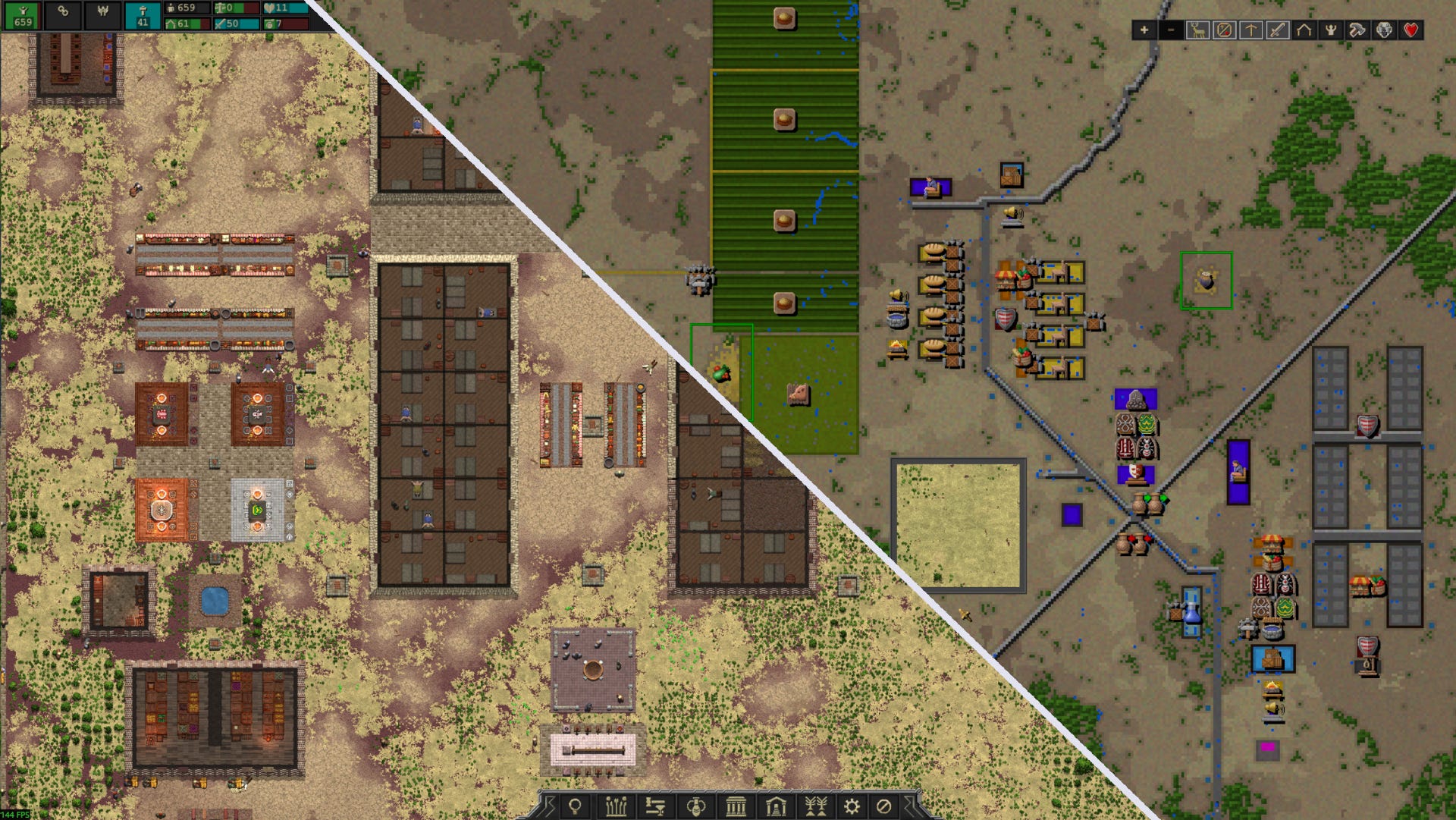
First, a practically self-evident observation about colony sims in particular: the act of conquering nature and transforming it into an instrument of progress is, as far as I’m concerned, an inherently compelling premise. There’s presumably something evolutionary and instinctual about it. One suspects that, when some Promethean troglodytes domesticated fire around a million years ago, it can’t have been long after the first taste of char-broiled mammoth that their thoughts turned to industry and conquest. Every good colony sim I’ve played takes pains to emulate this progression somehow, and to truncate its ordinarily vast timeline into a fraction of a human lifespan. A game of RimWorld, for example, can see a gaggle of tribal hunter-gatherers progress from weaving baskets to assembling nuclear reactors within a couple dozen hours of concerted play. It requires a suspension of disbelief, to be sure, but one can hardly deny the satisfaction intrinsic to clear-cutting a forest from whence the wolves once prowled. Don’t even trip about the environmental considerations — there are plenty more rim-worlds where this came from.
Actually, that leads us to another cleverly realized emotional-intellectual flourish of the colony sim: replicating the adventurous fantasy of colonization, but subtracting the baggage one associates with the cruel and violent displacement of those who haven’t the Maxim gun. Off the top of my head, I can’t think of any colony sims where your game starts in a location already populated by anything sapient.2 The only creatures one displaces in the average game of Dwarf Fortress are the giant honey badgers, and they can go fuck themselves. The fantasy of taming a wild frontier and carving our mark upon it appeals to our evolutionary desires, and it’s right and proper to indulge that fantasy without the psychological friction that can get in the way during, say, a colonization-focused campaign of Europa Universalis.
But those are largely superficial aspects of these games’ design, and there’s something deeper and more structural that lends them this appeal. Nebulous and representational genre commonalities aside, the principal aspect that connects games as otherwise mechanically distinct as Dwarf Fortress, RimWorld, and Songs of Syx is how they use their mechanical inventories as the machinery behind a systems-driven emergence of narrative. To play one of these games is to be the architect of a story mirroring one’s own anthropological inheritance, the precise contours of which are shaped by your imagination. RimWorld creator Tynan Sylvester even went as far as to deny that he’d made a game at all, calling it a “story generator” instead. A pretentious-bordering-on-cringeworthy abuse of semantics, to be sure, but there’s undoubtedly a kernel of truth behind the sentiment. To tease it out a little further, let’s skip to the exciting part and consider how an emergent narrative meets its end.
EMBRACING THE FAILURE STATE
“Losing is fun!” So proclaims the Dwarf Fortress wiki, foregrounding the statement even at the very top of the Fortress Mode quickstart guide. There’s a curious logic to the idea: since the game was programmed without any singular player goal, deterministic victory condition, or scripted denouement of any kind, the only way to finish a game of DF other than abandoning it is to lose. The only fortresses that don’t fail, argues the wiki, “tend to be very conservative and very boring — and what fun is that?” Dwarf Fortress equals fun and Dwarf Fortress equals losing, producing the legendary formulation that, by the transitive property, losing equals fun.
And it’s the truth! It’s unintuitive, but losing an eighty-hour fortress after making a single mistake is some of the most fun I’ve had with a video game. I dominated the harsh mistress of nature, dug secure lodgings within the earth, and created a bustling hub of industry in the middle of nowhere to which caravans of merchants and immigrants flocked. Even those goddamn giant honey badgers were neutralized, now confined in gilded, jewel-encrusted cages and kept as living ornamentation for the common areas. My legendarily skilled, steel-clad hammerdwarves repelled a legion of goblins, cutting down their leadership before casting the prisoners into a hundred-meter pit. I began to feel invincible, and this bred overconfidence. I dug too deep. The miners greedily penetrated an ancient column of adamantine, whereupon something happened that DF players famously hate to spoil.3 The military was eviscerated in a minute, alongside ninety-five percent of the civilian population. The dozen shaken survivors who managed to seal themselves behind a wall tried desperately to dig for fresh water and mushrooms, but all were taken by insanity and struck one another down long before there was even a glimmer of hope. The last one perished of his wounds, and a solitary textbox announced my failure.
Fucking genius.
I had a similar experience with Songs of Syx just this past week. About fifteen hours into a campaign in which I’d developed a fairly advanced society of humans, complete with centralized administration and an enforceable code of laws, an emissary from a foreign trading partner arrived at my throne. They’d come as a mediator from a notorious bandit lord, who coveted my wealth and demanded ludicrous tribute in exchange for peace. I sent the emissary away empty-handed, confident in my burgeoning industrial base that produced enough weapons and armor to fully equip fifty men. As expected, the bandits were unimpressed by my intransigence and formed up at the outskirts of my city. My militia outnumbered them three-to-one, and I was supremely confident as they formed into a tight phalanx and marched toward the foe. I clicked the “Charge” button, and felt an almost narcotic rush of excitement as they ran at the enemy’s shield wall. Then the bandits cut them down to a man without taking a scratch, and I realized to my immense consternation that, though I’d fully equipped my soldiers, I’d somehow neglected to assign them any melee training. “We must beg for mercy,” reported a textbox afterwards. None came. It was goddamn terrific.
If you’re sat there wondering how on earth I could be so casually indifferent to — or, indeed, actively excited about — losing games like these into which I’d sunk dozens of hours, I can assure you that the appeal lies in much more than the simple dopamine rewards associated with progress. If that’s all I wanted, I’d download one of those insufferable gacha games on my iPhone and fall, slackjawed, onto my mattress to piss away the hours opening lootboxes and watching advertisements. What makes these failure states so exhilarating is the same sensation one gets from the final pages of a great novel or during the last minutes of an excellent TV series. They’re the conclusions of stories into which you’ve invested yourself for a long time, and so an intoxicating sense of closure is to be expected. But more than that, the failure state resolves a story of which you were the primary author, so that investment is even more personal. Paradoxically, to fail in-game constitutes a victory of the imagination. It’s a sensation that no medium can produce as reliably or as profoundly as can game design, and I wish more folks would give it a chance.
Now, I hope you’ll forgive me for presuming to quote Dostoevsky in my seat-of-the-pants essay about video game design, but I read the following exchange while I was mulling over this topic and decided I had to share it with you. It’s not every day that a nineteenth-century novel suddenly gives voice to a foundational aspect of my own beliefs about creativity.
“[T]here’s a libelous story going about me, that last week I played robbers with the preparatory boys… I wasn’t playing for my own amusement, it was for the sake of the children,” explains the thirteen-year-old Kolya Krassotkin to the grown-ass Alyosha Karamazov, a respectable mensch before whom Kolya fears appearing juvenile.
“But what if you had been playing for your own amusement, what’s the harm?” responds the cherubic Karamazov.
“[F]or my own amusement! You don’t play horses, do you?”
“But you must look at it like this. Grown-up people go to the theatre and there the adventures of all sorts of heroes are represented—sometimes there are robbers and battles, too—and isn’t that just the same thing, in a different form, of course? And young people’s games of soldiers or robbers in their play-time are also art in its first stage. You know, they spring from the growing artistic instincts of the young… the only difference is that people go [to the theatre] to look at actors, while in these games the young people are the actors themselves.”4
“Emergent narrative” isn’t just a pseudo-profound catchphrase employed by pretentious jackasses of my ilk who want more respect for game design as an artistic medium. More than that, it describes the form of play in its natural evolution, familiar to anyone who ever used their imagination for fun — one’s “artistic instincts,” if you will. This is one of those manifestations of engagement that games are uniquely well positioned to exploit: becoming a participatory agent in a story as it unfolds, and guiding that story’s emergence through active expressions of said agency. It’s an instinctual itch for catharsis, and scratching it is good for the mind. We do this all the time without really thinking about it. It takes place whenever we’re engrossed in a story, and doubly so when that story is of our own making.
This is why I look to vast, intricate simulations like Dwarf Fortress and Songs of Syx as profound works of art. And, as I’ve said before, embracing players’ imaginations and facilitating the expression thereof is a much more reliable strategy for ensuring a game’s success than plastering it with the shiniest possible graphics or chasing this-or-that genre trend. This, I gather, is why the likes of Roblox can have 380 million monthly active users while the average triple-A open-world RPG these days launches to consumer apathy and a thousand layoffs.
And that, good people, is just about everything I wanted to say about colony sims that escaped my conscience back in February while I was busy gushing about how great the shader-work is in Songs of Syx. Of course, it can go almost without saying that my observations here aren’t wholly unique to this particular subgenre of strategy gaming. If you’re curious about how else video games have effectively leveraged the human imagination as a primary driver of gameplay, check out my review of Kenshi from last year. Also, please do share your thoughts in the comments below. While you do that, I’m going to play some more of this damn game while I count down the minutes until I can eat bread and pasta again. See ya next week.
The sole exception was S.T.A.L.K.E.R. But in the time since writing that newsletter, I became thoroughly transfixed by S.T.A.L.K.E.R.: GAMMA, which is basically Shadow of Chornobyl but with more strategic management and less traditional narrative structure. Go figure.
I mean, unless you count Sid Meier’s Colonization!, but it’d be a stretch to call it a representative of the genre.
The secret hidden at the bottom of the world reliably causes you to lose when revealed, hence its affectionate moniker “HFS” or “hidden fun stuff.”
From The Brothers Karamazov. I’ve got the Barnes & Noble Classics edition of Constance Garnett’s translation, in which this exchange takes place on p. 491.
Excellent piece as always! Your thoughts on emergent narrative give me some encouragement, as a fellow member of that ilk. I may use this to spin off my own post about the fact that scholars are obsessed with failure in gaming cultures
Lovely to see that Brothers Karamazov bit in the wild, I love the interlude with Alyosha and the children. How many Dostoyevskies have you read now? I remember you mentioned reading The Idiot a while back.