

The Victorian Techno-Fantasy RPG
Four great ideas to steal from Arcanum

MAGICK OBSCURA? I DON’T EVEN KNOW HER
After spending December playing almost nothing but classic Fallout, you’d think I’d be over isometric CRPGs from the turn of the millennium about the ravages of civilization’s violent collapse. You’d be half-right — the first two weeks of 2026 have drawn a few too many comparisons with the post-apocalypse for comfort, and I could really use a break from games about the misery of the modern human condition. Luckily, the early-modern human condition feels more distant than ever, and I’m not yet weary of systems-heavy RPGs at large. It only made sense that, after exhausting the late-nineties Fallout games, I’d move onto the famously Fallout-like game from a couple years later that shared most of the early franchise’s creative talent.
Arcanum: Of Steamworks and Magick Obscura is a 2001 CRPG created by Troika Games, a humble outfit formed by three of the principle minds that brought us Fallout in 1997. While working on Fallout 2, the three — to wit, Tim Cain, Leonard Boyarsky, and Jason Anderson — fell out with the suits at Interplay over the sequel’s production and left to form their own studio. For their first project, they resolved to stick with what they knew worked best, and developed a Fallout-like CRPG now remembered as a critical darling in spite of many, many rough edges.
Nowadays, Arcanum is probably most famous for its unique and never-replicated setting. It takes place on the titular continent, which was until recently a fairly unremarkable fantasy world. You know the sort — humans, elves, dwarves, and so on intermingling with one another in a land not yet abandoned by the miraculous wonders of magick, etc., etc. But the nifty twist on the formula is that, through a combination of dwarven ingenuity, human ambition, and gnomish avarice,1 an industrial revolution has swept over most of Arcanum. The nature of everything from craftsmanship to warfare is changing faster than the land’s people can adapt, and conflict grows apace with private equity.
The setting and its particulars are the most fascinating thing about this game, made all the more intriguing by the fact that no IP since has convincingly replicated it. But there’s more to it than that: Arcanum, being the passion-driven brainchild of three of gaming’s most deservedly legendary creators, is absolutely sodden with great ideas that I’ve been waiting nearly twenty-five years for other games to steal. I came up with four things Arcanum does better than any other game I’ve played, and those are our subject for this week. Once we’re through, I’ll give you some advice for how to get it running at its best all these years later in case you care to see it for yourself.
FOUR IDEAS TO STEAL FROM ARCANUM
I: In-Universe Instruction Manual
“To begin the game with all haste, we can choose one of many pre-fabricated persons. To make such a selection, click upon ‘Pick Character,’ as shown in Figure 4-3… For now, we shall choose a pre-fabricated Character — one Mr. Merwin Tumblebrook. If the Gentle Player simply can’t bear Merwin, make use of the arrows next to his Character Portrait to select someone else; be aware, however, that you are certain to injure the gentleman’s feelings.”
-- Arcanum Players Guide, p. 91
I reckon Arcanum features the greatest instruction manual of all time, and its excellence makes the demise of standalone manuals all the more poignant. See, I remember simpler times long past when I’d get a new game off a store shelf, tear the shrink-wrap from the box as soon as it was paid for, and excitedly read the manual throughout the car ride home. Even when they were phoned-in hunks of crap, this never failed to get me excited for the experience to come. Once, after buying a copy of Far Cry 2 and realizing that my parents’ cheap-ass office computer wasn’t powerful enough to run it, I read and re-read the manual over and over again to extract just a bit of excitement from the fantasy of playing the game. You might think that says less about game manuals than about how much of a punished hyper-sperg I was as a kid, and, while you’d obviously be right, my point is that something real and valuable was lost when the industry largely abandoned them.
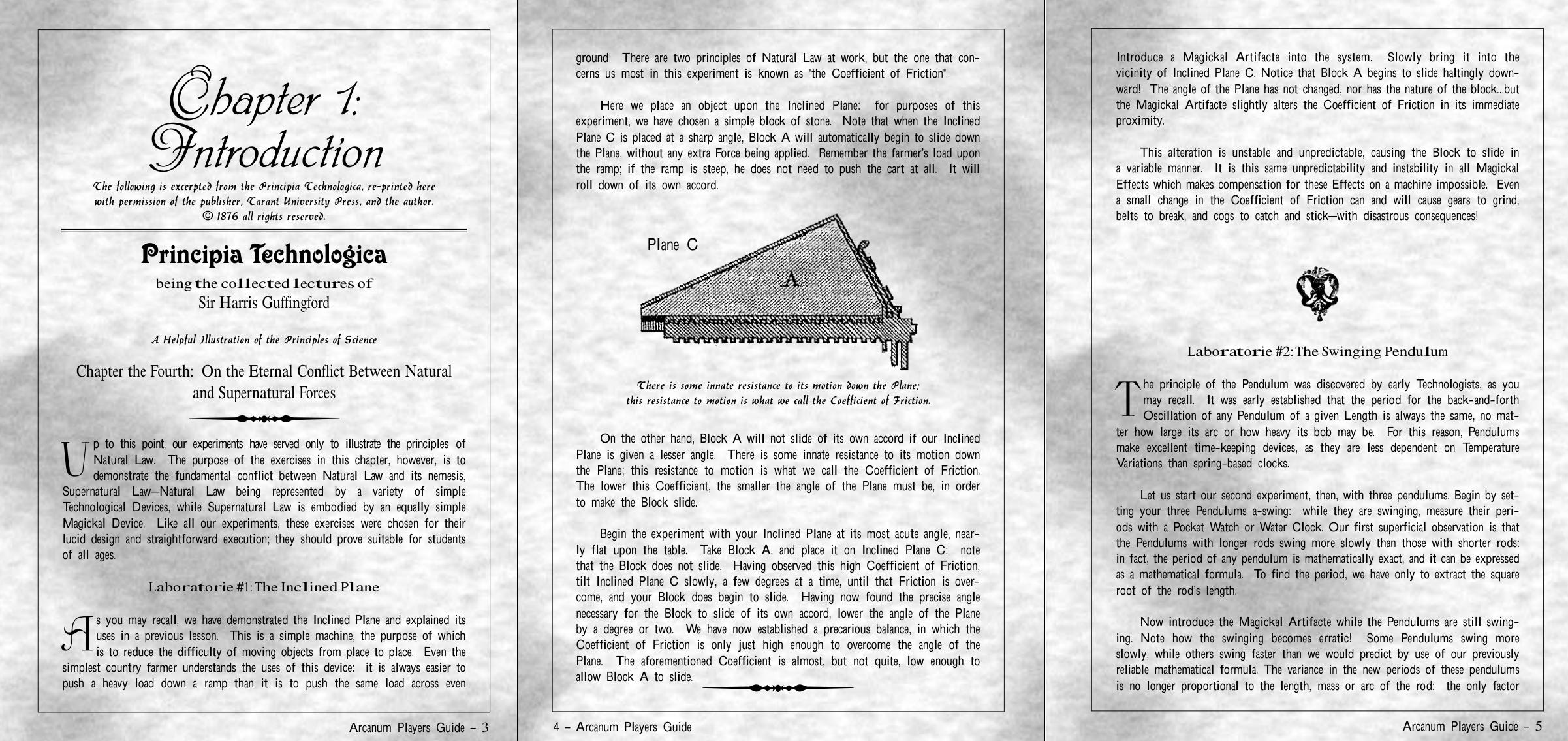
The genius of the Arcanum Players Guide is that, utterly confident in the game’s brilliantly realized setting, it presents itself almost entirely in thematic prose. Where most manuals would introduce their games’ settings in a blurb on the rear of the retail box, the Players Guide opens with the foreword to an in-universe history textbook, which sets up the game’s fiction and its central conflicts in the learned, scholastic tone of nineteenth century academia. Immediately thereafter, it advances the mystique of the game’s central thematic conflict — that between magic and technology — with a series of lab manuals like you’d get assigned in a science class. Even the details of player-facing gameplay are craftily imbued with a charming Victorian flair. Also, uniquely among game manuals, it ends with an in-universe recipe for banana bread. I have it on good authority that it’s very nice.
For good measure, I’ll be referring back to this document several times over the rest of this installment. Right, then — let’s talk more about that brilliantly realized setting of which I spoke.
II: The Early-Industrial High-Fantasy Setting
“One cannot speak about the recent history of Arcanum without addressing the growing dichotomy between Magick and what has come to be known as Technology. My research has shown to me a direct correlation between the widespread use of these two Forces, and increased levels of societal development… Humans, it seems, have now inherited the scientific legacy of the dwarves — and does it not appear that we are now poised for what might be called a Golden Age of cultural expansion and hegemony?”
-- Foreword to A Brief History of Arcanum, Arcanum Players Guide, p. 2
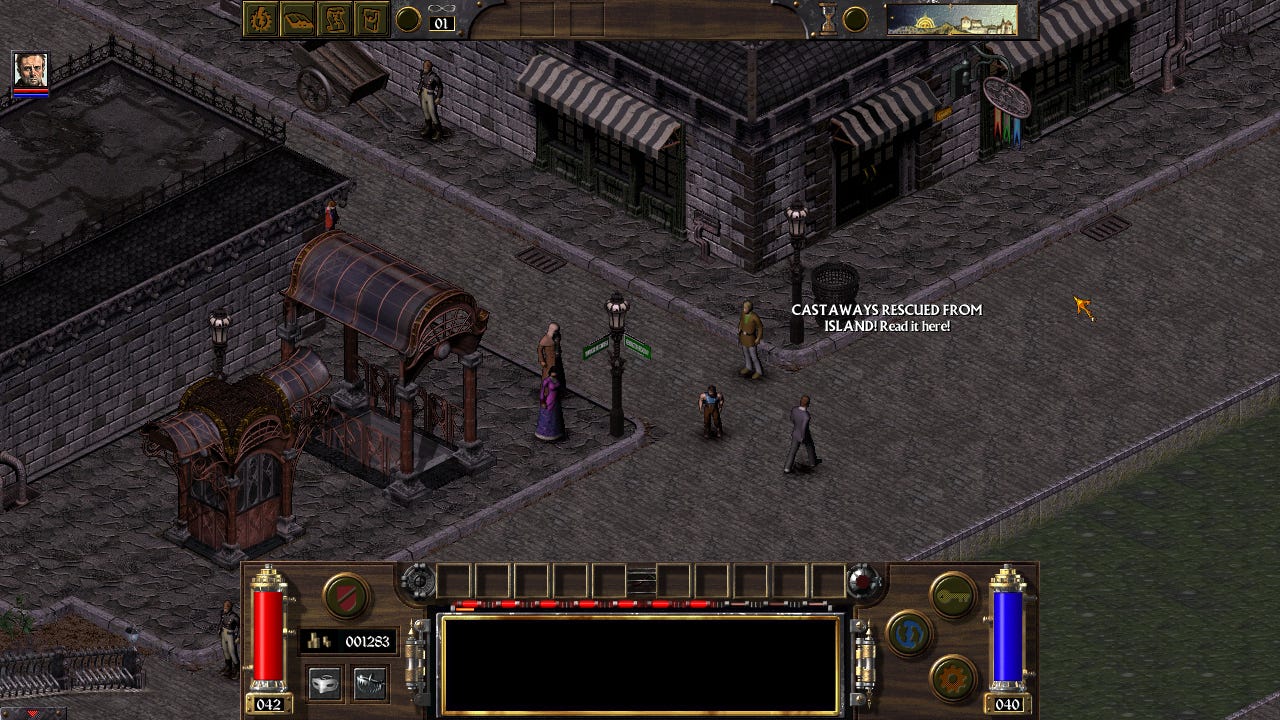
I think it’s probably fair to say that, of all its standout features, Arcanum is best remembered today for the unique and fascinating setting left tragically underexplored by the cancellation of its planned sequel. For the uninitiated, understand that I don’t use the phrase “Victorian Techno-Fantasy” lightly — the game world is essentially a Tolkien-ish continent populated by your usual suite of humans and variously magical fantasy races, but it happens to be in the throes of rapid and profound change following humanity’s operationalizing of the steam engine. The socioeconomic upheaval wrought by the introduction of steam locomotives, electricity, and the industrial production of firearms is eminently visible almost anywhere you care to look.
As in our world, nothing short of complete isolation from society can shield a people from the unstoppable march of technological progress. In the course of a full playthrough of Arcanum, you’ll visit at least two settlements that attempt to do exactly that, and the results of such totalizing isolation are about as grim as you’d expect. That’s not to say that the factions embracing change are faring altogether better, though — in addition to deadlier wars, polluted cities, and continuous political dysfunction, Arcanum’s civilized societies endure the tremendous and destabilizing antagonism of the masses oppressed by the emerging order. It’s enough to provoke the ire of some extraordinarily powerful beings with the means to tear it all down, but I’ll withhold major plot spoilers this week.
Of course, no discussion of Arcanum’s set-dressing would be complete without mentioning the top-notch original soundtrack composed by Ben Houge, easily one of the most evocative soundtracks in the medium. Scored almost entirely for string quartet, it nails the game’s nineteenth-century veneer while carrying a determined, fantastical aura that suits any playstyle. It manages the incredible feat of feeling thematically and emotionally resonant regardless of your decisions or character build. For the love of God, if you’re not going to play or replay Arcanum — and I bet you won’t — at least go listen to its Main Menu Theme.
III: The Physical Conflict between Magic and Technology
“According to some authorities, Technology is nothing more than the twisted shadow of Magic — but nay-sayers have fallen increasingly silent in recent years, as the Technological Disciplines have grown more and more powerful. Over the past few decades… Arcanum’s great cities have discovered that while a job accomplished by Technological Devices is seldom accomplished prettily, or with Magic’s flair for the dramatic, such jobs are accomplished very quickly — and they stay done indefinitely!”
-- Arcanum Players Guide, Section 3-7, p. 81
In your average fantasy RPG, the study of magic is supreme while technological progress stagnates somewhere around the invention of the crossbow. This is fair enough — if your fictional universe allows for the arbitrary manipulation of reality to mystically effectuate everything from instantaneous creation to unparalleled destruction, it makes sense that the typical egghead would prefer to study the arcane over the principles of engineering. The unfortunate side-effect is that this forecloses any world-building or decision-making inspired by the familiar achievements of the natural sciences. By means of clever lore-craft and thoughtful gameplay integration, Arcanum overcomes this and foregrounds the inevitable conflict between magic and technology in its setting and in its primary mechanics.
The spark that makes it all work is that, in Arcanum’s fiction, technology works by harmonizing the physical laws of the universe while magic works by flaunting them. Hence, the two are fundamentally incompatible with each other, and bringing them together courts disaster. In gameplay, this is reflected by an alignment meter that measures each character’s proclivity toward either magic or technology, and one’s position on the meter affects all sorts of mechanics. For example, expert technologists can create and use enormously powerful inventions like levered machine guns and power armor, but scarcely benefit from healing magic or even magical health potions. Meanwhile, expert mages can teleport across the continent in an instant or kill a man by looking at him, but mechanical armor doesn’t protect them and firearms explode in their faces.
The setting itself takes full advantage of the opportunities this all provides. My favorite example: if you buy a train ticket, the person at the ticketing booth will interrogate you about your magical proclivities and those of your companions. If your alignment is heavily skewed toward magic, you won’t be allowed to board, because your very presence could derail the train. Even if you’re just somewhat magically inclined, you’ll be made to ride in the second-class carriage at the very rear. Technological societies tend to mistrust the magically inclined, and magic-using societies often openly discriminate against technologists.
Just so we’re clear, though, the magic-technology dichotomy isn’t just a schmaltzy allegory for racism. It’s postured more like a stand-in for the conflict between tradition and progress, and the game and its story are better for it. That said, there is plenty of racism afoot, alongside an inventory of -isms big enough to paralyze an entire social sciences department. Arcanum does a pretty great job of tastefully and thoughtfully representing the race- and class-based antagonisms that its Victorian setting unavoidably brings to mind.2 It’s a little too involved to squeeze into this installment, though, so we’ll save it for another time. For now, I want to tell you about one of the foremost technological innovations of the game itself.
IV: Procedural Dialogue
“Healthy social interaction is a very important aspect of a Character’s performance in our Game! No player will be able to pursue his adventures solely by virtue of theft and murder. At some point, we must all interact with the denizens of many towns, cities, and fortifications, and a large variety of Interfaces and Skills are available to make each interaction a pleasant one… This deceptively simple interface conceals an enormously complex model of conversation.”
-- Arcanum Players Guide, Section 3-5, pp. 66–67
Arcanum was a tremendously ambitious project, replete with never-before-seen innovations of gameplay-focused storytelling. It’s generally understood that this was a major source of its infamous bugginess and instability. But what isn’t broadly acknowledged is the extent to which Troika’s ambitions paid off in spite of the final product’s rough edges, especially in light of its short development timeline and its skeleton crew of barely a dozen people. Now, with the benefit of hindsight — alongside some five-dozen retrospective videos by Tim Cain himself — we scions of the vibe-coding age can at last wholly appreciate the staggering levels of creativity and ingenuity on display in Troika’s work. To illustrate precisely what I mean, I’ll zero in on the game’s particularly well-documented system of generated dialogue.
Now, when you hear the term “generated dialogue” in a game-design context these days, you’re usually listening to the deranged ravings of a non-gamer in a publisher’s C-suite as, with eyes bulging, he explains how generative AI will soon enable us to ask our RPG interlocutors for advice on NFL parlays. But over twenty years before this kind of delirious indulgence became commonplace in the games industry, Troika managed something a hundred times more impressive with a fucking Excel sheet. Seriously, look at this:
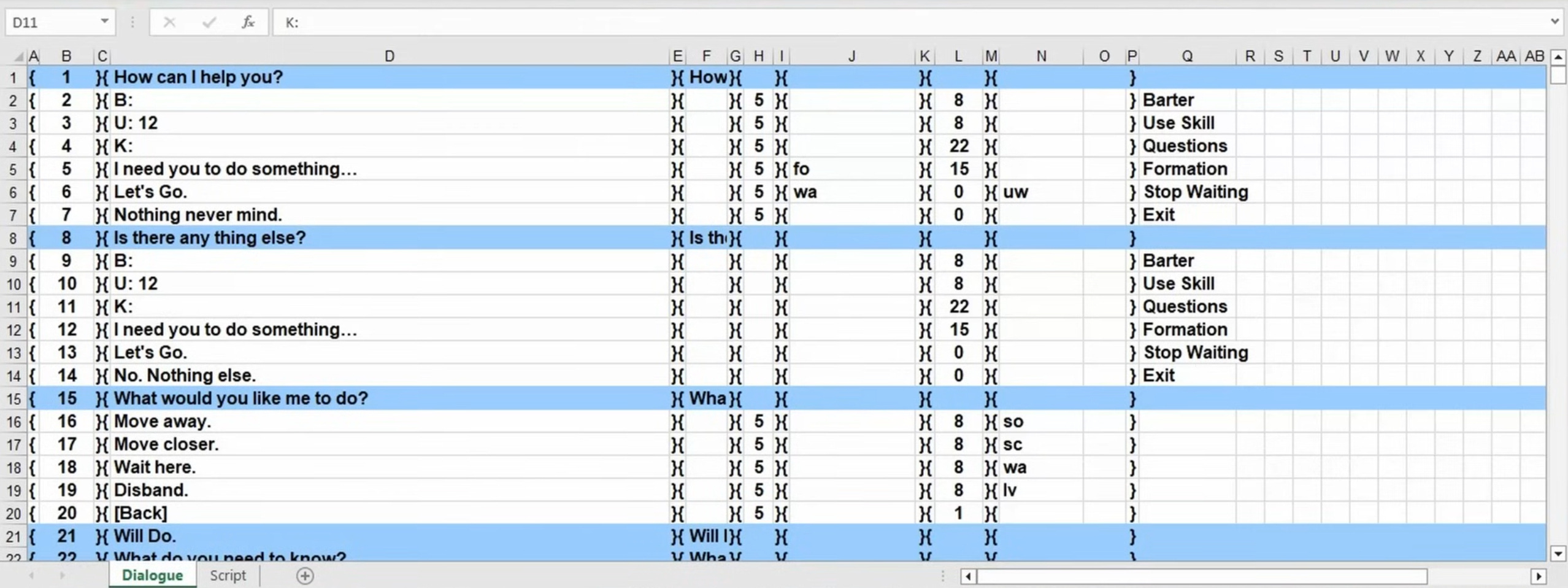
Given a vast inventory of parameters and modifiers, Arcanum’s writers could scaffold out the shape of a dialogue, and the engine would populate it with content appropriate to the player’s precise context. NPCs can take the player’s race and gender into account, as you’d probably expect, but also their reputation, tech/magic alignment, companions, and a lot more besides. And, in service of the Victorian class-antagonistic theming, each sapient NPC represents one of eleven different social castes and will vary their interactions with the player based on their mutual compatibility (or lack thereof). Because of all this, you can have enormously different playthroughs by changing nothing more than your character’s race. Once-friendly NPCs may become aggressively discriminatory, and previously hateful ones may be willing to help you for nothing out of sheer solidarity. At its best, it embarrasses many of even the newest RPG dialogue systems.
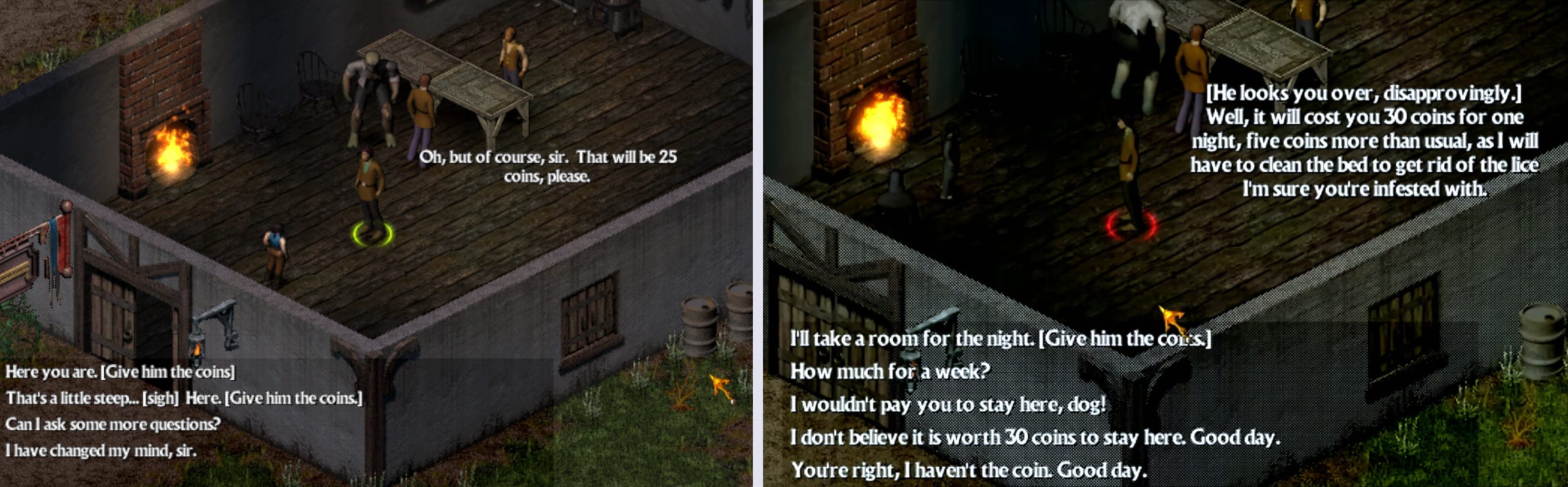
I’m barely scratching the surface — one could write an entire essay on the subject of Arcanum’s dialogue and still leave stones unturned. It felt like a profound evolution over Fallout, which itself had an excellent implementation of branching dialogue, and it still feels immersive and captivating even decades later. Above all, it’s a stark reminder that great and memorable systems are influenced by their designers’ ambitions and creativity far more so than their budgets or the technology available to them. If somebody ever makes a remotely compelling dialogue system implementing a generative language model, it’ll be as a result of thoughtfully augmenting the work of talented writers and emphatically not of foregoing the creative process altogether. Fingers crossed for Wayward Realms, I suppose.
There you have it: four brilliant ideas from a twenty-five-year-old game that, for some reason, game designers obstinately refuse to steal even to this day. Arcanum may be flawed and imperfect like every title in Troika’s stable, but it still holds up as one of the greats and remains one of the most versatile and replayable CRPGs of which I’m aware. I think you’ll love it if you were intrigued by any of what I wrote above, and any fan of classic Fallout will almost definitely adore it, too.
By the way, Arcanum is still remarkably playable on modern hardware even decades after its release. Actually, it plays better than it did in 2001. You can buy a copy for a few dollars on either Steam or GOG, and either will probably run out of the box. But all are strongly advised to install the Unofficial Patch developed over many years by the world’s biggest Arcanum nerd, which adds widescreen support, fixes legions of bugs, and optionally restores cut content. I had no trouble installing it atop my GOG copy on Linux, and, once again, I feel obliged to take a moment to appreciate how wild it is that a famously unstable CRPG from 2000 runs flawlessly on my modern hardware and non-standard OS.
That’ll do it for this week. I’d love to hear from you in the comments if you have any heartwarming memories of Arcanum to share, or if, against the odds, you can name any intellectual properties that have successfully replicated or built upon any of what we discussed here. I’ll see ya next Wednesday.
Seriously, though, fuck gnomes. If you’ve finished that one sidequest, you know what I mean.
The gnomes sometimes lean uncomfortably close to historical anti-semitic stereotypes, but at least Arcanum was made long before the internet folded those back into modern hate culture. For real, fuck gnomes.
One of my all-time favourite games.
Game manuals are long gone now, but I always used to read them too - it was the _manual_, that's how you learned how to play the game! When it became more than that, a kind of accompanying tome, it really elevated the game and how the background details connected together. It is sad how they don't exist anymore.
This sounds like a fascinating game, and definitely has components that could be revisited again. Thanks for sharing a game I had never heard of before.