

Morrowind is Better Off without Bethesda
2002’s greatest RPG is doing just fine, thank you.

REMAKE UP YOUR MIND
So, word on the street is that a Scrubs reboot will air on ABC at this end of this month. Apparently, it’ll be a direct continuation of the plot that was supposedly concluded the better part of twenty years ago. It’ll also feature most of the original cast, now suddenly aged into their fifties and sixties. According to an interview I skimmed through, there’s a gag based on the premise that Turk’s back is no longer strong enough to hold J.D.’s weight. There’s a great joke in there somewhere about how Donald Faison can’t carry Zach Braff anymore, but let’s not get too distracted. Point is, I can hardly imagine a more apt metaphor for the dreary state of legacy IP reboots.
Now, I’m fully aware that bemoaning this isn’t exactly fresh or incisive in 2026, but you’ll have to forgive me, because it’s starting to feel personal. The reason I bring up every millennial’s favorite sardonic hospital sitcom is twofold: first, because it’s a timely reminder that this nostalgia-baiting sequelization shit has gone too far; and second, because Scrubs isn’t the only cultural touchstone from 2002 that’s found its way back into the news lately. At the end of January, UK-based content agency Press Box PR published a lengthy and detailed interview with Bethesda veteran Bruce Nesmith that ruffled an aviary’s worth of feathers, and I’d quite like to get the forthcoming rant off my chest.
For the uninitiated: Nesmith was, until his mid-Starfield departure in 2021, among the ducal tier of Bethesda royalty under god-king Todd Howard and his courtiers. After contributing to the development of TES 2: Daggerfall and pioneering the (in)famous Radiant AI system for TES 4: Oblivion, he was tapped as Lead Designer for Skyrim and thus secured one of the most noteworthy credits in the modern history of game design. Accordingly, I’m interested in his opinion and take him seriously even when he says cracked-out lunatic shit like “go back and play Morrowind and tell me that’s the game you want to play again” or “the reality of playing Morrowind would not stand the test of time.” He said all that in response to a question about why Bethesda resists fan pressure to remaster Morrowind as it did Oblivion, whereupon a substantial and vocal segment of TES 3’s still-thriving fanbase was predictably incensed.
Now, I’m not here to argue with Nesmith’s abovementioned opinions. Not because I agree with them, of course, but because they’re so demonstrably at odds with reality that I can only give him the benefit of the doubt and assume he isn’t abreast of the fanbase’s strength. Morrowind is alive and well, and remains the open-world RPG of choice for countless PC gaming nerds despite its vintage. I’m actually here to take exception with the growing chorus of fans who take this as evidence that Bethesda should remaster or remake the game, and that’s our subject for this week.
Leaving aside the practical barriers standing in the way of such a project that make a first-party attempt impractical,1 the game is doing just fine. It enjoys enthusiastic fan support that, by virtually every important metric, better reflects the attitudes and desires of Morrowind’s fanbase than modern Bethesda possibly could. We’ll discuss that in more detail later on. First, though, it falls on me to acknowledge the pair of elephants in the room, since the explosive discourse of the past two weeks has all but stared right through them.
I: The “Remaster” Already Exists
Long-time readers know I’ve harped on this before — and will certainly harp on it further still when Tamriel Rebuilt’s Poison Song expansion releases sometime soon — but this point deserves to be made and remade in perpetuity: Morrowind’s passionate and increasingly vast modding community has been improving the game almost continuously for well over two decades now, and progress continues apace. Thanks to the modders and their growing patronage networks, the ambitious open-world RPG from 2002 gets better and better with every passing year. For ages now, those in the know have said without controversy that Morrowind modders are, by virtue of having much more practice, better at designing the game than the paid professionals at Bethesda ever were. This has some important implications for the prospect of an official remaster that aren’t shared by other legacy titles in Bethesda’s stable.
Let’s begin with the most obvious: OpenMW, the fan-made engine reimplementation that’s now the de-facto2 means of playing Morrowind on modern hardware, long ago foreclosed just about every rational argument for a commercial remaster of the original game. It is, in effect, a custom engine that loads the original game assets into memory and then reconstructs the original gameplay experience using modern paradigms — or, in other words, it’s a goddamn remaster of Morrowind. It’s free and open-source, runs on every major operating system, performs like a crack-smoking racehorse, and takes advantage of modern hardware to overcome the limitations that once hampered Bethesda’s original vision. And, of course, that’s before we even get into the built-in modding support backed by a rabidly devoted community. OpenMW plays great and is a rollicking good time even right out of the box.
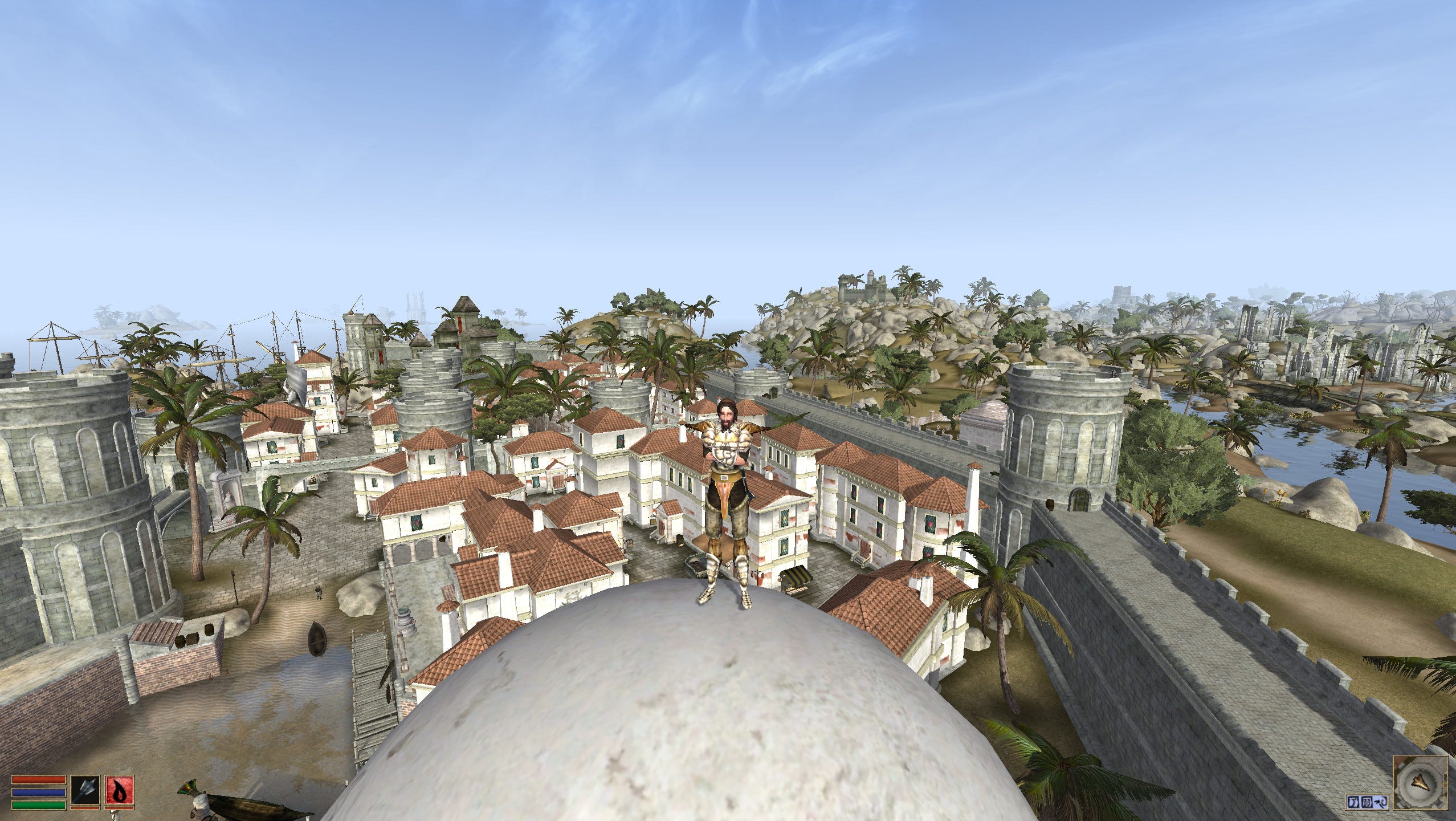
Once we do consider the game’s modding potential, it’s basically lights out for any pretense of an official re-release that could meet the diversity of whims and expectations already served by the fan recreations. The versatility on offer reaches nearly Skyrim-like levels of modularity — with just a little patience, one can reforge Morrowind into practically any experience one likes, even if one would prefer to rip out the Morrowind experience altogether and replace it with motherfucking Star Wars. More commonly, of course, you’ll mod out or improve whichever gameplay systems you don’t like and perhaps add some interesting new content when you’ve worn out the original batch. I’ve heard modded OpenMW described as a “bathtub remaster” of Morrowind, and that’s basically on point. You’re totally free to install hundreds of mods and turn it into a resource-hungry behemoth that takes advantage of today’s finest hardware, but you really don’t need much at all to bring your next Morrowind campaign into parity with more contemporary RPGs. I’ll leave a little appendix of recommendations at the bottom in case you’re interested, and to further prove my point.
So, given the above, a rhetorical question: what on earth could Bethesda — or some contracted third party — possibly bring to the formula that modders haven’t already made available? Aside from charging for it, I mean. The only arguable improvement I think they could possibly make would be to redo it with modern, professional-quality assets, presumably driven by Unreal 5 like last year’s Oblivion remaster. If I make a concerted effort to suppress my distaste for the modern industry’s obsessive pursuit of fancier graphics, then I guess I can imagine a certain sideshow-like appeal to the prospect. I can certainly understand how it might be gratifying to experience one of gaming history’s greatest RPGs anew with the innovations wrought by over two decades of technological advancement. Besides, to realize such a project without the labor of a professional studio and a major publisher’s financial support, we’d require a colossal and interdisciplinary team of passionate volunteers who dedicated themselves to remaking Morrowind on an existing triple-A engine over a period of many years.
Oh, wait…
II: The Remake is Already in Development
You know what the very best part of the Oblivion remaster’s hype cycle was? It was when Bethesda made supportive overtures to the Skyblivion team and promised that their project could coexist with the commercial release. A lot of us community-minded Elder Scrolls fans were very worried that Bethesda was plotting to needlessly step on the modders’ dicks in order to maximize revenue, but cooler heads somehow prevailed and that didn’t come to pass. That was an important development that gives me confidence for the future of TES fan support.
For those of you unaware, Skyblivion is an extraordinarily ambitious, noncommercial project to rebuild all of The Elder Scrolls IV: Oblivion on the Skyrim engine. It’s been in nearly continuous development since at least 2012, and is slated to finally release this year after being delayed from a planned 2025 release. It’s under the banner of the even-more-ambitious The Elder Scrolls Renewal meta-project, which makes it a peer to another remake effort appropriately called Skywind.
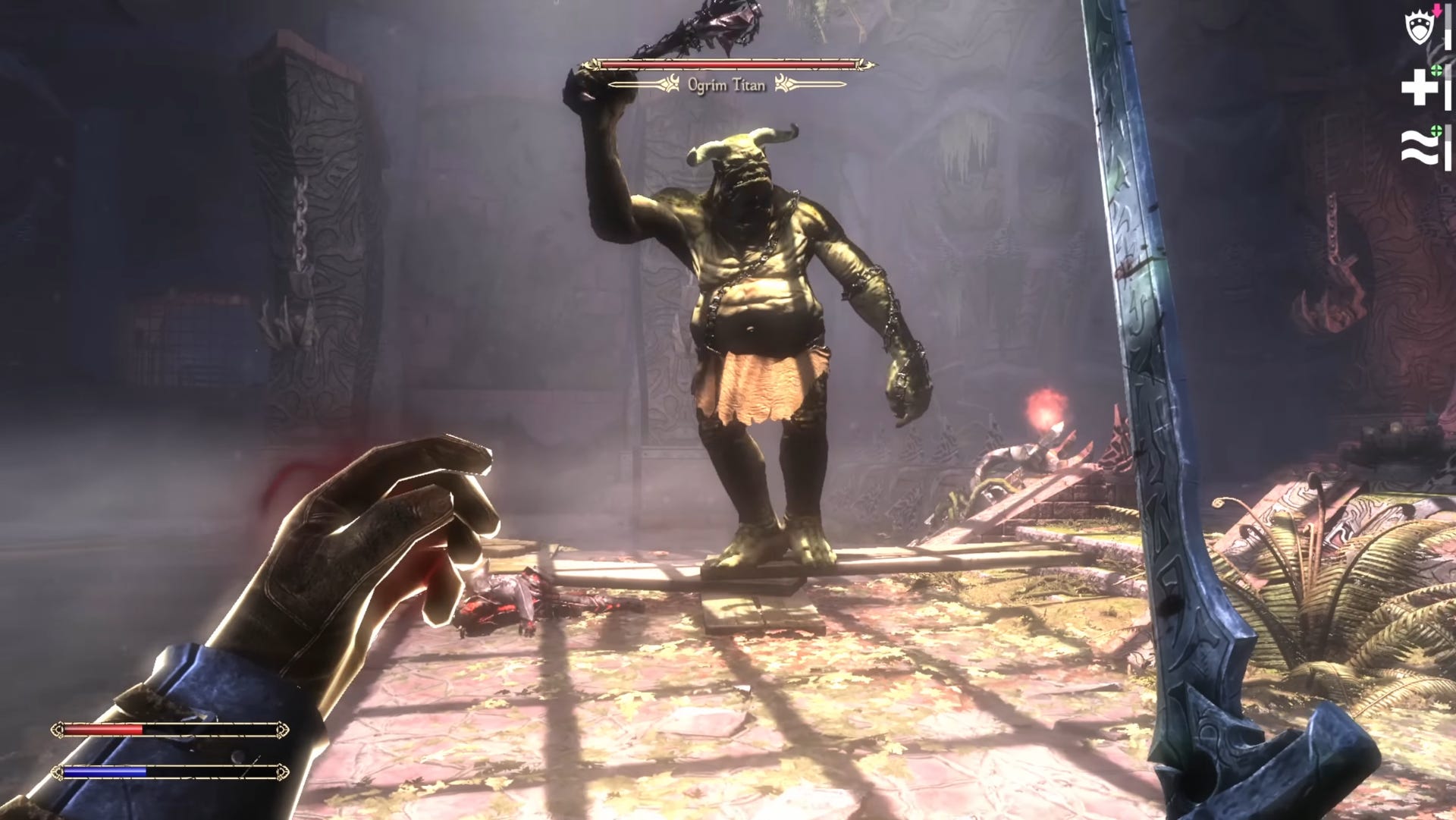
As you’ll have guessed from the title, Skywind is an effort to rebuild all of Morrowind on the Skyrim engine. It’s not presently at the same advanced stage of development as Skyblivion, and, because of that, I don’t have too much to say. But some things can be said with confidence: in light of the progress that’s already been made — as evidenced by, e.g., a terrific twenty-minute gameplay demo from last May — it’s clearly transcended the visual presentation of the Skyrim-era Creation Engine on which it runs. It doesn’t quite rise to the graphical fidelity of an Unreal 5 backend, but the strides they’ve made in lighting, visual effects, and UI design are remarkable. Actually, since it lacks the Oblivion remaster’s dough-headed character models and the melting clown masks they have instead of faces, it transcends even the triple-A approach in at least one important respect.
With all this in mind, the thought of Bethesda kicking off another yearslong development cycle to reproduce Morrowind on a modern engine just doesn’t make sense. Unless I’m to believe that a triple-A studio in 2026 would reintroduce dice-roll combat and a story presented by nested paragraphs in a static dialogue window, then we’d be looking at a from-scratch reimagining of the original game, including a comprehensive mechanical redesign. In trying to fathom it, I find myself back in agreement with Bruce Nesmith: “that’s an entire project… Why not go and make something new?”
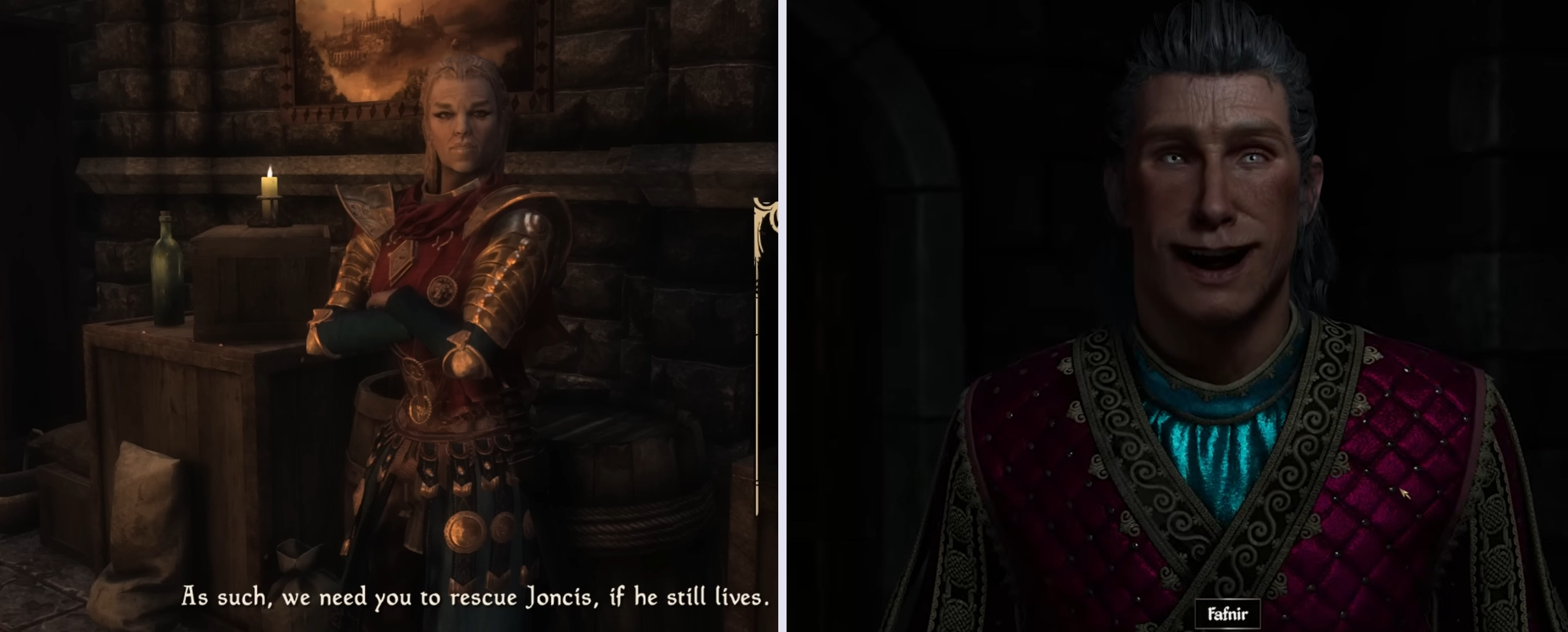
You know, like the supposedly forthcoming The Elder Scrolls 6, about which we know virtually nothing despite its being announced almost eight years ago.
I don’t suppose Skywind will become the standard way to play Morrowind even after it sees its 1.0 release, but I have every reason to believe that its high-effort presentation and zero-dollar pricetag will delight the fanbase to a degree that Bethesda just can’t match. I’ll wrap up this week by trying to explicate what exactly I mean by that.
TRIPLE-A CAN’T HANDLE THE CLASSICS
Here’s the thing, folks: the Bethesda Game Studios of today is, in almost every respect germane to creative ambition, unrecognizable from the plucky team that brought us Daggerfall and Morrowind a generation ago. Hell, it’s practically unrecognizable from the billion-dollar juggernaut that built Skyrim. Lest we forget, the Oblivion remake could only occur because the original source code was still lying around and another studio was brought in to do most of the work. I just can’t imagine how the bloated, rudderless sub-subsidiary of the Microsoft Corporation could possibly live up to so cherished a legacy as Morrowind’s, unless of course you consider the exodic plague3 of bugs to be a significant part of said legacy — after all, Fallout 76 and Starfield were both considered fit for commercial release in spite of their garish lack of polish.
What’s more, the managerial incentives fueling the triple-A games industry are resolutely misaligned with the spirit of late-90s/early-2000s Bethesda. The heavy focus on systems and the deliberate paucity of direct guidance from that period vested trust in players and contributed to a massively varied surface of valid approaches to gameplay, and that’s why the likes of Daggerfall and Morrowind are still so cherished to this day: they still hold up, for one, and there’s been no first-party effort to match or exceed them since. It’s no longer enough to appeal to a dedicated and enthusiastic audience, hence why nearly every first-party BGS game published since the early 2000s feels like it was made to be somebody’s first RPG. Morrowind doesn’t need to capture a broad audience of gamers with wildly variant tastes. It’s far better off in the hands of the folks who care most about it and its legacy.
I conclude for this week by echoing a tongue-in-cheek but nevertheless sympathetic opinion I remember reading on PC Gamer after the Oblivion remaster last year: rather than shoveling good money after bad on a hypothetical Morrowind remake and then galling the fanbase by asking fifty dollars for it, perhaps Bethesda would be better served by cutting a fat check to the OpenMW team to get it over the 1.0 finish line ahead of schedule. I obviously wouldn’t expect the purse-string holders of the modern triple-A industry to do such a thing if their lives depended on it, but what if they did? The gaming press would be head-over-heels, and the Morrowind nerds would have an actual, tangible reason to celebrate Bethesda’s creative direction for the first time in eons. What a comforting fantasy, right?
See ya next time <3
APPENDIX: On Modding Morrowind
In 2026, a patient modder can bring Morrowind to a borderline triple-A level of fidelity and polish. If you’re after something curated and comprehensive, check out modding-openmw.org/lists for various well-supported modlists and idiot-proof instructions for getting it all working. They have a bunch of collections that should satisfy just about any craving. I’ve played a full campaign with the “I Heart Vanilla” list before and like it a lot.
Personally, though, I really dig the unadulterated experience and prefer very few mods. Here’s the modlist I use for trying out new Tamriel Rebuilt content, including brief summaries of what each does:
Patch for Purists: fixes several thousand bugs and subtle inconsistencies without interfering with the core experience
ReAnimation v2: adds first-person weapon animations for more dynamic, Skyrim-like visual flavor
Impact Effects: adds material-appropriate sound and particle effects to missed melee attacks to make the dice-roll combat less immersion-breaking
Expansion Delay: removes events and NPC dialogue that pester you about the shitty official expansion content until high character levels
Tamriel Rebuilt: I wrote all about this one — check out the official website for instructions. See also Project Cyrodiil and Skyrim Home of the Nords for other huge, vanilla-friendly content additions.
Feel free to tell me about your favorite mods below! Cheers, and keep enjoying Morrowind.
For the record, Bethesda has given us no particular reason to believe that they’re even seriously considering an official Morrowind remaster or remake.
Morrowind also has a robust script extender called MWSE that can similarly modernize the official release without need for OpenMW. I’ve never used it, but some folks prefer it, and it has some unique features of its own — for all intents and purposes, just about everything I say about OpenMW here could equally apply to MWSE.
Morrowind’s modern Patch for Purists, which I recommend, claims to fix over nine-thousand discrete bugs left over from the official release.
This is pretty much my feeling re. the possibility of a Morrowind remake as well. I recently went down the Oblivion remaster rabbit hole, and it was an incredible experience, I felt like for the first time, the graphics and techology actually did justice to the designs and ideas, and even very simple improvements (additional voices, better animations and feedback, better character models) make a vast difference.
However, I don't really think you could do the same for Morrowind, not least because, imo, Morrowind actually has less wrong with it in the first place. The simpler graphics are much more stylised and impressionistic, which works really well for the type of setting that Morrowind offers. Morrowind's combat is actually somewhat better than baseline Oblivion's in the first place as well, because yes, some attacks miss, but when they hit, you feel them hit. The gameplay also doesn't take that long to become enjoyable, once you have improved your attributes and acquired some magic items.
So, I'd argue that even without mods, Morrowind still holds up reasonably well (particularly considering that its main draw is in the writing and ideas, which have nothing to do with the technology).
The unlikelihood of Bethesda ever attempting a Morrowind remake speaks, I think, to a kind of almost superstitious thing that big gaming companies have now, which amounts to an excessive respect for the done thing, and a fear of being different. RPGs MUST be fully voiced, because that's what other games are like. Graphics MUST move towards high-fidelity representations, whether that's necessary or not (that's why original Oblivion was so uncanny valley in the first place - the belief was that characters had to look more realistic and more fully animated, but the tech/budget was not nearly there, so you got distractingly hideous characters that sucked the dignity and immersion from the world).
My game backlog contains Black Mesa, a fan made remake of Half Life rebuilt on the latest engine and with some design choices significantly smoothed out. I believe it was built by the community over many years. It is not the same as Half Life exactly, more a companion to it, and most importantly it has Valve's blessing to be sold independently.
So as I was reading this I thought of that. Perhaps the difference though is purely down to business. A Microsoft owned company (who ironically has been praising open source as much as possible for the past decade) would not want to watch revenue be taken from them or shared. And that's another reason why remakes/remasters exist.