

How I Roleplay in Singleplayer RPGs
Plus, hungrily anticipating the forthcoming Tamriel Rebuilt expansion

POISON SONG OF SONGS
Well, the hardware crisis continues unabated and the video game industry exhibits the tact and stability of Weimar Germany, but at least fans of Western-style open-world RPGs are in for some major windfalls in the near term. Thanks to Xbox’s sudden turn from disengaged, bureaucratic management of its subsidiaries to taskmaster-like domination of those subsidiaries’ valuable IP, we now have first-party confirmation of a new, Obsidian-developed Fallout game, alongside modern remakes of Fallouts 3 and New Vegas. They’re also doing something with Fallout 76 and Fallout Shelter, which I’m sure will be deeply gratifying to whichever invisible cadre of gamers still boots those up every day.
Of course, the ongoing shortage of Taiwanese silicon and the corporate industry’s ceaseless avarice forces many of us to question whether or not we’ll actually get to play any of the fucking things. My own graphics hardware dates back to around the destruction of the Second Temple, and I’m not exactly holding my breath for a brand-new Fallout RPG that’ll run on it. And, with the job market like it is, I don’t anticipate an upgrade becoming fiscally tenable any time soon. And even if I suddenly won the lottery and could replace my rig with a top-of-the-line GPU supercluster, this is Bethesda we’re talking about, and it’d still be a few weeks before the modders came through to fix the release version’s performance. As usual, I’m ushered into the dank refuge of low- and no-budget projects made by independent creatives.
Fortunately for us deprived wretches, that scene also promises marvels to come. At time of writing, the release of Tamriel Rebuilt’s Poison Song expansion is, according to project leadership, “imminent.” Tamriel Rebuilt, in case you’re new around here, is a modding project as old as Morrowind itself whose central remit is to implement the entire landmass of the titular province as the original developers once intended. The team behind TR releases major expansions every year or so, each with dozens if not hundreds of hours of new gameplay, and it’s all done as a passion project whose result is entirely free to the end-user. I first brought up this latest expansion several months ago in a post about how little I trust modern Bethesda around Morrowind,1 and the hype has built reliably ever since. I can’t remember the last time I was quite so excited for a mod to update, and it seems I’m not alone — in the wake of last year’s excellent Grasping Fortune expansion, about which I effusively gushed last year, there’s a positively ravenous appetite among Morrowboomers2 for TR’s next major release.
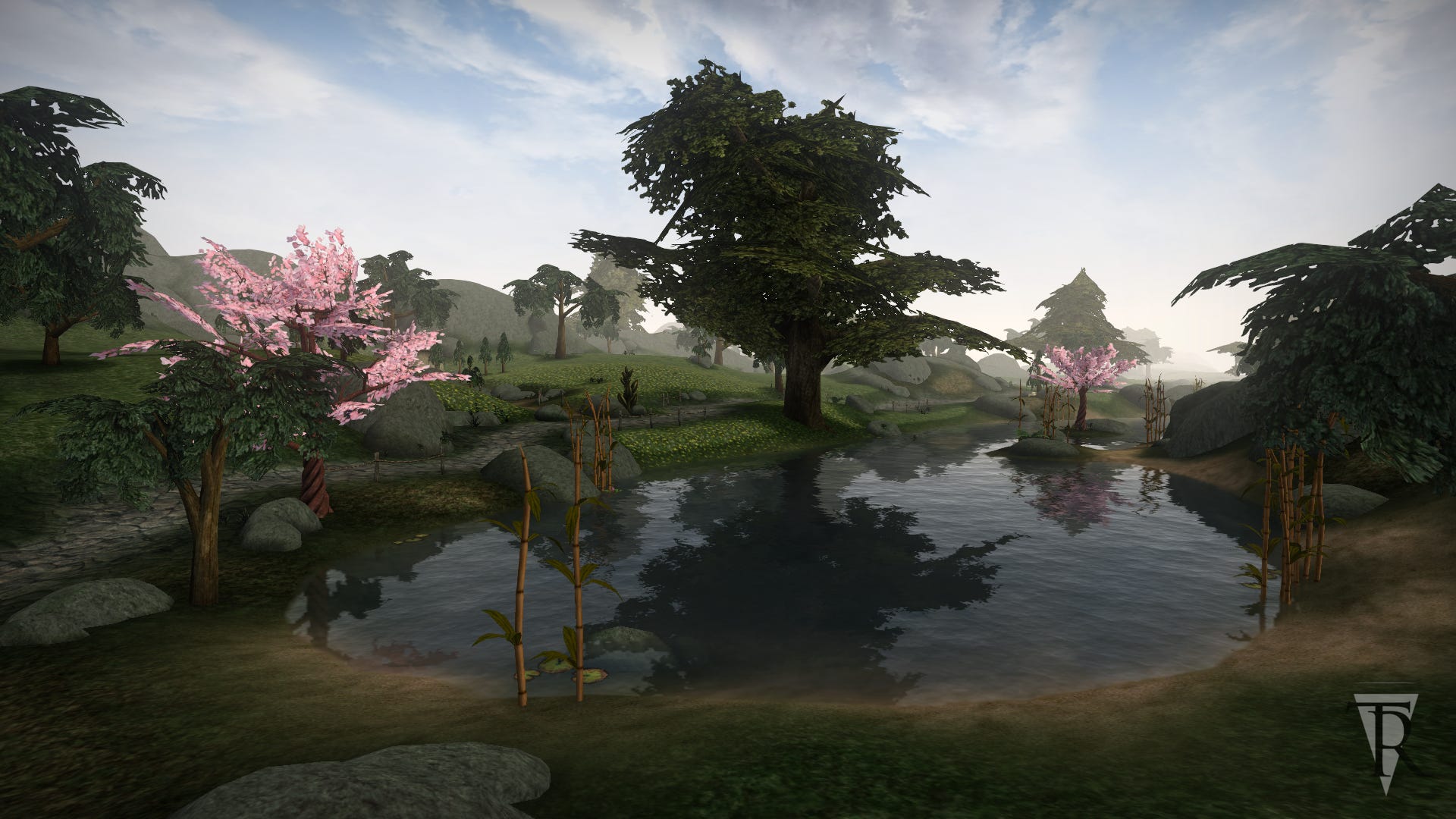
It’s been a long time coming, too. Poison Song was first teased back in October of last year, some five months after the release of Grasping Fortune. It promises a bevy of features, some of which have been eagerly anticipated for the better part of twenty years. Of particular note is the introduction of House Indoril and the Ordinators as joinable factions, a sentence I know will electrify Morrowind veterans and puzzle everyone else. No matter — our subject for this week is more general and accessible.
This week, in anticipation of Poison Song once again extending the life of everyone’s favorite millennial RPG, I thought it’d be nice to reflect on the approach I take toward roleplaying in singleplayer games. I have video games particularly in mind, of course, but I’ll note here that pretty much everything I describe below maps neatly onto my approach for singleplayer pen-and-paper roleplaying — I’ve been meaning to write about the latter for quite some time, so expect to hear about it before long.
I should also note that the process I’m about to describe applies specifically to RPGs in which you’re expected to create a custom character who isn’t already well defined by the game’s fiction. There are plenty of RPGs that have you embody an existing, already developed character — The Witcher, Planescape: Torment, practically every BioWare RPG, etc., etc. — that present great roleplaying opportunities of their own, but it’s tricky to cross-apply this methodology to them. Perhaps I’ll write about roleplaying a predefined character some other time.
Now, then:
PRE-GAME
It starts with the mechanical foundation of the playthrough, i.e., the playstyle. I almost always decide in advance how I intend to build a character, and the extent to which I commit to an early plan is proportional to how tightly the game couples character-building with gameplay progression. For example, when I start a new playthrough of New Vegas, I pick a single weapon skill to focus on in the early game, but don’t worry too much about it because I’ll invariably pick up so many superfluous skill points that almost every skill will approach its maximum value by the third act. By contrast, if I’m playing a game like Underrail that enthusiastically punishes suboptimal characters, I’ll decide on more or less the entire build in advance and rigidly stick to it.
But even for titles where early-game build choices don’t constrain later-game decisions in any irreversible manner,3 I always put at least some thought into this. The reason is that the set of things at which a character is skilled and the background that led to them being so skilled is one of the most fundamental aspects of a custom RPG protagonist’s identity. This, I believe, is a large part of why Western fantasy RPGs have tended to converge on the warrior/mage/rogue trichotomy: representing skills and background as a discrete profession is a convenient, shorthand means of projecting identity onto a character, and even the most unimaginative philistine can fantasize about those three in particular.
With that handled, I consider how my character came to arrive in the game world and what motivates them once they’ve arrived. And, again, different RPGs can make this anywhere between trivial and impossible depending on their own story contexts. It’s no coincidence, for example, that practically every Elder Scrolls game begins with your character languishing in state custody: you need accept as given only that your character was arrested, and it’s up to you to decide why that happened and whether or not it was just. Some RPGs make this very difficult, and one just has to cope. In Fallout 3, for example, any fantasy will have to reckon with the fact that every character spends almost their entire youth in Vault 101 under Liam Neeson’s emotionally distant guardianship. Others — the likes of Kenshi and Mount & Blade come to mind — are instead superlatively open-ended and so permit almost any conceivable background (so long as it’s post-apocalyptic or medieval in nature, respectively).
Finally, I decide on my character’s disposition toward the game’s main quest. My approach to this is wildly variable, depending on the game in question. In Morrowind, particularly with Tamriel Rebuilt installed, I almost universally ignore the main quest and leave Vvardenfell to its gruesome fate as I depart Seyda Neen middle fingers raised. In games whose narratives are highly main-quest-driven, e.g., New Vegas, I instead decide on how attached my character is to the main quest’s impetus and play accordingly: in some playthroughs, my Courier is laser-focused on revenge and beelines to the Strip in order to execute Benny in broad daylight, with as many witnesses as possible; in others, Courier 6 doesn’t hold too big a grudge and spends the game’s first fifteen hours gallivanting around the southern reaches of the map in search of fat loot. Finally, in games with no main quest whatsoever (again, Kenshi and Mount & Blade are my index examples), I extend the character fantasy to come up with near- and medium-term goals4 that motivate my character in the main quest’s stead.
IN-GAME
Once the setup is complete and the playthrough begun, it’s all about applying the decisions I’ve made about my character to my engagement with the game world. Some of this is a fairly straightforward matter of realizing the build in gameplay, e.g., through gathering equipment and considering faction membership. If I’m playing Morrowind as a battlemage, for example, I’ll find some dope-looking heavy armor and join the mage’s guild. Decisions like these are typically no-brainers, because they’re mechanically incentivized by the character build — in Morrowind, for example, I’ll immediately try to acquire whichever weapon matches my highest weapon skill, because doing otherwise will result in my impotently swinging at the empty space just in front of a mudcrab for minutes at a time.
But there are many aspects of gameplay intrinsic to RPG design that lack any kind of mechanical enforcement of this nature, and that’s where things start to get more creatively fulfilling and more intellectually challenging. Few RPGs ever made5 have represented abstract concepts like characters’ personalities as whole-ass gameplay systems, so the act of embodying your character as a person instead of just a cipher for some archetypal profession is done all but entirely within your own imagination. This can have some important utility that I’ll try to illustrate with an example.
Consider the first ten minutes of Morrowind, in which you’re released from custody and sent through the local Customs & Excise office before you’re set loose into the game world. One thing you can do pretty much right away — and which plenty of Morrowind veterans recommend — is to ransack the building, stealing everything that isn’t nailed down. Among the loot to be had for so doing is an expensive limeware platter that you can hock for a big early-game infusion of cash, and a key to a warehouse that contains vast amounts of valuable narcotics and materiel. Burglarizing this apparatus of the state is, by any objective measure, the “optimal” way to start a game of Morrowind. So why doesn’t everyone do it?
WHY BOTHER?
Well, because only a very particular archetype of protagonist would even consider something so suicidally risky6 in the first minutes after being released from custody.
Now, if you actually happen to be playing that archetype, i.e., the world’s most recklessly bold kleptomaniac, then robbing your erstwhile captors evolves from cheesy powergaming into a genuine expression of your protagonist’s agency. Of course, if you’re playing such a thief and then spend your ill-gotten gains on alchemy training and potion ingredients so that you can artificially boost your non-rogueish skills, you’ll be right back in cheesy powergaming territory. Embodying your character in a believable, narratively satisfying manner is a continuous process that takes commitment, creativity, and a little bit of discipline. But for my money, doing so pays dividends that are more than worth what little cognitive burden it may add to the experience.
What might those be? Above all, it’s a way of translating the principles of effective storytelling into the gameplay experience. The best RPGs — in my opinion, at least — are those that give their players the necessary latitude to create memorable sequences in gameplay and to string those sequences together into a unique and personal story. This is probably the single most important reason that I’m still playing the likes of Fallout: New Vegas and Morrowind even sixteen and twenty-four years after their original releases: they construct compelling and versatile opportunities for roleplaying atop a foundation of rich setting design, and trust their players to make the most of it all without railroading them into any particular approach. I suspect this is also a major reason behind the continued strength and enthusiasm of these older games’ respective modding communities, whose memberships naturally select for creativity and devotion to roleplaying.
Beyond that, it simply makes for a more stimulating and memorable gameplay experience. I find that as I get older, I increasingly favor gaming experiences that make me think and feel something, and commensurately disfavor games that tend to soothe and numb. There can be no doubt that playing an RPG with a heavily optimized and extremely powerful character lends itself to a soothing and numbing experience, and it can be fun in its own right, but it’s just not what I’m after nowadays. It’s so much more stimulating and memorable to struggle against adversity in pursuit of a goal, even when my own self-imposed restrictions are the source of that struggle and my own whim the source of that goal.
I’m very curious to hear about how you prefer to approach the act of roleplaying in your RPGs, and particularly so if your approach is considerably different from mine. Part of the beauty of the medium is how different people can enjoy similarly fulfilling experiences from wildly different approaches to a given game, and I imagine there’s much to be learned from your perspectives on the matter. Meanwhile, my fingers remain crossed for a Poison Song release date any moment now, and you can bet I’ll have a lot to say about it when we have it before us.
Thanks for reading to the end! How do you approach roleplaying in singleplayer RPGs? Do you prefer games that mechanically incentivize it, or do you want your RPGs as open-ended as possible? What’s most important to your own process? Let me know in the comments, and I’ll see ya next week.
As an aside, it’s interesting that Bethesda greenlit new versions of the elder 3D Fallout games but didn’t say a word about any redo of Morrowind. I take this as a sign that they’re keeping their noses out of it in perpetuity, which is bullish for all the reasons I discussed in that post.
My wife asked me whether “morrowboomer” was a term of art, and I absolutely adore the idea that RPG-playing is an art in and of itself.
I have the latter-day Bethesda RPGs in mind when I say this, but it could also apply to any CRPG with a character re-spec mechanic like Baldur’s Gate 3 or Wasteland 3.
Examples of near-term goals might include “acquire class-suitable equipment” or “make enough money to catch a ride out of town.” Examples of medium-term goals with longer time horizons might include “set up operations on the other side of the game world” or “advance a primary skill to a competitive level.”
The only exception I can think of at the moment is Crusader Kings 3 (which I consider an RPG for all intents and purposes), which punishes out-of-character decisions by means of its Stress system. Mechanical enforcement of character personalities is an interesting subject in its own right, so let me know downstairs if you can think of any other games that do something like this.
Mechanically speaking, it’s really not that risky at all, since NPCs in the C&E office will (uniquely throughout the rest of the game) let you off with a stern warning if you’re caught stealing. But that’s a design decision meant to ease onboarding for new players, and I think it’s counter to effective roleplaying to treat it as a diegetic characteristic of the world itself.
One of the reasons I never streamed Morrowind back when I did streams was because it's one of those games where one in three people remotely interested are also convinced they are the sole arbiters of the 'correct' way to play, ie they will never shut up about where the Sword of White Woe is, how you can divert your flight into Caldera or take a long hike to get to a merchant that doesn't haggle you down, and will just get endlessly frustrated at witnessing 'suboptimal' play as though they're watching you ignore the solution in a puzzle game. Shut the fuck up. I know where the Sword of White Woe is. If I cared I'd have gotten it already.
When it comes to gameplay mechanics informing roleplaying, I think one of my favorite tricks was in the [free to play] 2023 RPG Moonring, which has open-ended character development with a lot of meaningfully different stat focuses, but also skills directly enabled by specific gods, and committing to one in particular is how you finally 'embrace' a 'build,' letting you cast their skills cheaply, and giving you a boon that ties into their skills and stat preferences... but only so long as you remain 'faithful' to their cause. And each god also considers a particular action 'sinful,' and doing it TOO much results in them purging you from their fellowship, after which the skills of theirs you've unlocked cost TWICE as much as normal to channel, and you have to find some way to appease them to return to the status quo.
I think this system does a bunch of stuff just right for encouraging role-playing without being completely oppressive. The sins, for example, are mostly stuff you would just kind of do without thinking about in an RPG - one really hates it if you attack anything that isn't already aggressive, meaning not only can you not murder passive animals for resources, but you can't even get the drop on something dangerous for a stealth kill or extra damage. Another hates ALCHEMY, meaning your entire potion stockpile is on a strict 'break glass in case of emergency' basis. But the slight leeway in sinning means you can still consider those things an option if every other one is exhausted, and THAT, in turn, means that one of the worst aspects of RPGs in general, the gradual buildup of choice paralysis, gets addressed, because no matter which god you devote yourself to, you're pushing yourself, mechanically and diegetically, into certain actions, while simultaneously avoiding others. I think a LOT of RPGs, especially open-ended ones, could use some system like that.
Currently playing underrail. I discovered it with great pleasure and no warnings... i play a lazy Jack of all trade who likes to stay independant, and yes the game punishes me ! I can do everything really bad. But I like that i still can overcome adversity with a bit of cunnîng and a few grenades. So I made my character évolve around that, while struggling to keep a certain moral line in a world that really wants to expose his inner organs. I love that the game let my character adapt rather than force me to min/max and forget about rp.