

Exploring Edmund McMillen’s Early Work
In which I play eighteen 2000s-era Flash games by one of the Mewgenics guys

Polite Notice: This installment ended up quite a bit longer than usual, and it’ll probably be truncated by email clients. If you usually read these as an email, check out the published web version to read the whole thing.
FLASH OF GENIUS
My goodness, the past two weeks have been astonishingly good for the tactical roguelike life-sim vertical. I expected Mewgenics to do numbers sheerly by virtue of its developers’ pedigree, but I can’t say I was expecting it to sell over a million copies and gross over twenty-five million dollars after just a week on the market. It’s a particularly staggering margin in light of its two-person development team, and it’s heartening to know that an indie game so thoroughly evocative of the Flash era can compete with $70 triple-A releases. It’s a triumph for co-developers Edmund McMillen and Tyler Glaiel, to be sure, and presumably an important development in the history of indie gaming more broadly. That’ll take awhile longer to properly game out, so I’d like to have a look into the past this week.
I haven’t got stuck into Mewgenics just yet, but simply watching its success carries with it a certain emotional resonance. You see, I’m very much a child of the Newgrounds era: back in the early-mid 2000s, rather than developing normally, I scrolled through the Portal and devoured Flash games on my parents’ cheap-ass office computer almost every day. Thanks to the site’s creator-positive ethos, the wealth of talent it attracted, and its infamous lack of censorship, it was an ideal refuge for the type of lonely and depraved suburban teenager I used to be. This was all some years before society broadly acknowledged that adolescents shouldn’t spend hours online each day to cope with their domestic misfortune, and so I was active on the forums and even published a few crappy Flash games of my own.1 More to the point, I was a big fan of Edmund McMillen’s work long before he made his name in the broader gaming industry with Super Meat Boy and The Binding of Isaac. Going all the way back to around 2004, I played almost every single one of his Flash games as they came out.
Now, if you haven’t heard of The Binding of Isaac, suffice it to say that it’s a masterfully crafted and eminently addictive roguelike that still gets played to this day, even finding devotees beyond the core gaming audience. Some identify it — and plausibly so, in my opinion — as ground-zero for the roguelike renaissance of the 2010s that’s still continuing apace. It’s sold millions of units and spawned a remake with three expansions, which have collectively represented a legend-making endeavor for creator Edmund McMillen and surely laid much of the groundwork for the contemporary success of Mewgenics. I really oughta write about Isaac in detail one day, since it must be one of my picks for top five most influential games of the new millennium. Of course, I hear people talking about it all the time for precisely that reason, and there’s not too much untrodden ground left to cover.
But what I almost never hear people talking about is McMillen’s pre-Isaac work, which comprises a ludography of some twenty2 Flash games going all the way back to the early 2000s. Nearly all are noncommercial works that he and various collaborators made for the love of creation rather than money, wholly embodying the spirit of that increasingly distant past. In the intervening period, the independent game-development scene has, for various reasons, pivoted convincingly toward commercial production and distribution. Not by any means a bad thing in and of itself, as Mewgenics’ cool twenty-five million can attest. But it does mean that the Flash era is now a historical relic rather than an ongoing reality. And, like any such object or institution, it has to be actively preserved if its contributions are to be recognized by posterity. Luckily, the necessary archival efforts have so far been largely successful, and Flash games are still playable on modern browsers through compatibility layers that preserve them in modern Javascript.
So, driven by a combination of historical interest and wistful nostalgia, I played through almost all of Edmund McMillen’s old Flash game catalog this past week (exceptions enumerated below). Most of them are available in The Basement Collection, which you can get on Steam for a few dollars. But for my research, I played them all for free on Newgrounds as if twenty-plus years hadn’t passed — Flash was discontinued years ago, but they still work just fine with the abovementioned compatibility measures. What follows are some brief reflections on every piece of McMillen ephemera I replayed, with more space carved out for the handful that I think still hold up and are deserving of your time in 2026. For kicks, I’ve listed each in order of how much I enjoyed the experience on revisitation.
Not included are any of the following:
Games released after 2009
Commercial releases
Host, an online multiplayer game from 2007 that I couldn’t get working
Works lacking any substantial game-mechanical identity (e.g., AVGM; The Lonely Hermit; any of the dozen-odd Dead Baby Dressup games)
This’ll take awhile, so let’s get started.
THE “HONORABLE” MENTIONS
We begin with the games that, while interesting enough to discuss for a paragraph or two, only get a recommendation for those interested in Flash game history. I’ll include Newgrounds links nonetheless, in case morbid curiosity overwhelms your good sense and you just have to see what Edmund was on about.
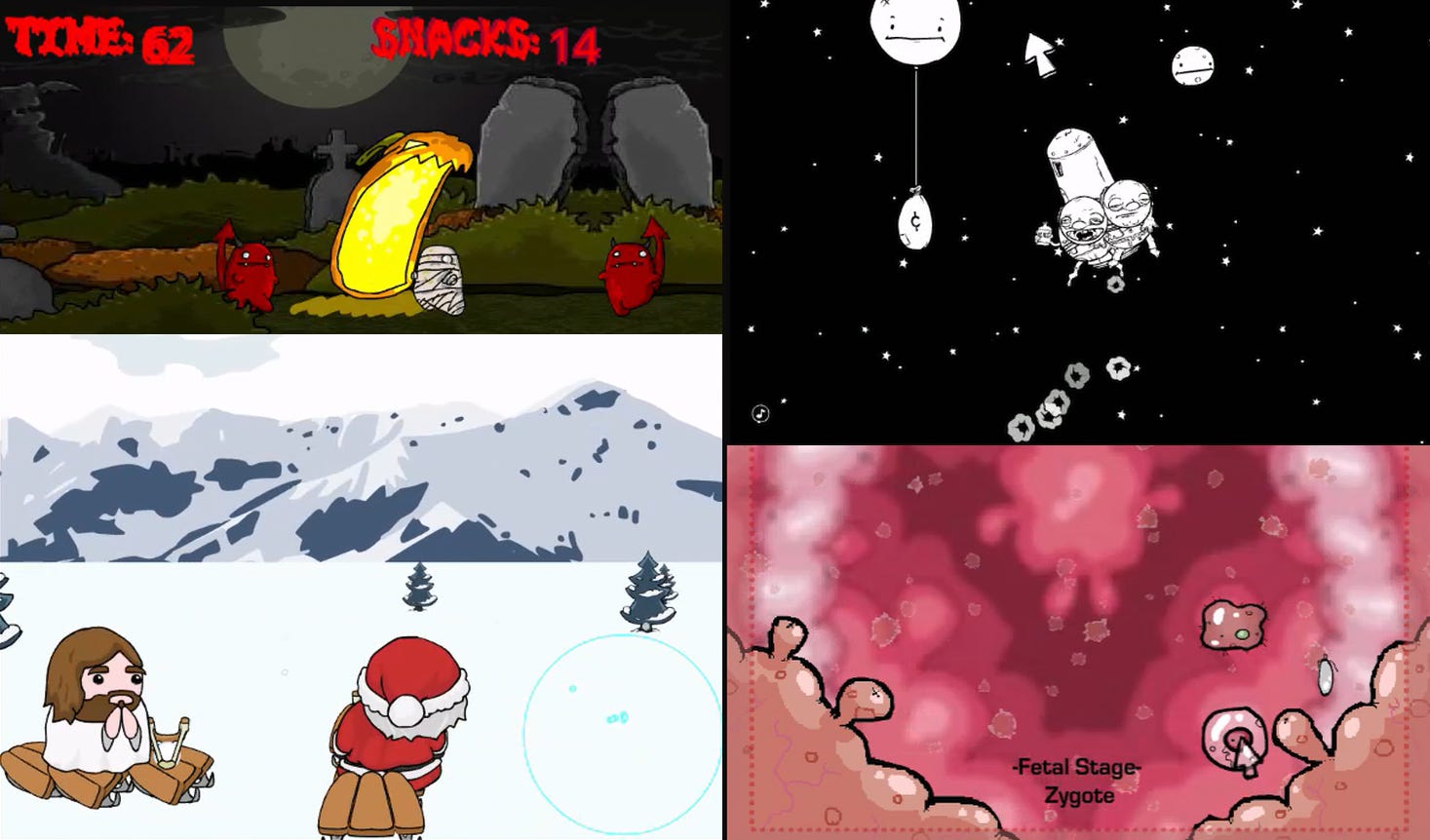
16. SnackOlantern (2003) | Newgrounds Link
Wikipedia tells me that McMillen once described SnackOlantern as his “worst game.” I couldn’t find a source to confirm that, but… I mean, yeah, pretty much. There’s almost nothing to SnackOlantern — you play as a carved pumpkin somehow imbued with homicidal malice, and you bounce around a sidewalk to devour trick-or-treaters who make no effort to evade you. The controls are stiff and the hitboxes are unintuitively narrow, so it’s really frustrating to play even though it’s not the least bit challenging. It is, at the very least, mercifully short. I guess the artwork and animation are pretty appealing for 2003. Let this one lie, and we’ll move on to some more interesting representatives of McMillen’s oeuvre.
15. Holiday Snow Wars (2006) | Newgrounds Link
That is, we’ll eventually move on to some more interesting ones. Holiday Snow Wars was an ambitious attempt at a psuedo-3D vehicular combat game that, regrettably, is virtually unplayable. You play as one of two Christmastime legends — either Santa Claus or Jesus — and compete against the other in a race. You slide around on sleds and can throw snowballs to knock your opponent off course, but it feels less like sledding on a snow-hill and more like crawling through a lake of cold molasses. It’s probably the only Santa vs. Jesus game ever made, so at least it has that going for it.
14. Twin Hobo Rocket (2008) | Newgrounds Link
There might be some kind of mechanical or narrative depth to Twin Hobo Rocket that simply evaded my grasp, but if so, it’s hidden behind opaque goals and a profoundly annoying voiceover performance. You play as two unhoused wretches strapped to a jury-rigged propulsion device, and your objective is to do something or other that I never figured out. This is actually the game I played for the least amount of time, because I found it especially grating on the senses. It does at least have some amusing artwork and a halfway decent-feeling core mechanic, on the backs of which it exceeds the first two entries on this list.
13. Viviparous Dumpling (2005) | Newgrounds Link
In the early 2000s, McMillen and frequent collaborator Caulder Bradford created a fictional setting called The Badlands, populated by a host of grotesque fauna, racially insensitive caricatures, and a variety of simple gameplay loops. We begin with one of the precious few games that takes place in a uterus: in Viviparous Dumpling,3 you play as a fetal Dumpling, part of a species of rotund, fleshy blobs that seem incapable of any action whatsoever. You drag your Dumpling fetus around a womb, collecting nutritious sperm cells and avoiding foreign protozoa. It’s remarkably difficult despite the simplicity of its premise, and I couldn’t quite make it to the end. I’d call this one worthwhile for Edmund McMillen completionists who are interested in his early worldbuilding, because there’s a fair amount of it on display here even though the gameplay is nothing to write home about.
12. The C Word (2008)
Well, I guess it’s time to talk about this game for the first and last time. Properly titled Cunt, it was published on Newgrounds under the alternate title The C Word. It was, in McMillen’s words, intended as “a career suicide piece.” Worried that he was selling out and despairing of the possibility that he’d lose the ability to make whatever art he wanted, he spent a little over a week throwing together a mediocre-but-playable shooter where you play as a micropenis fighting an enormous and aggressive set of female reproductive organs. The surface-level misogyny implicit in that premise resulted in predictable controversy, and this one is a little tricky to find and play nowadays. To be perfectly frank, though, it’s just not that interesting to talk about. Mechanically, it’s a bog-standard shoot-em-up where you dodge projectiles and fire at a large target. It’s functional, but incredibly dry. The presentation and theming, though unmistakably borne of the internet-brained edginess that characterized the period, don’t come across as hateful so much as immature. Folks mostly seem happy to forget about this one, so I haven’t bothered providing a link. You’ll be able to dig it up if you really want to, though.
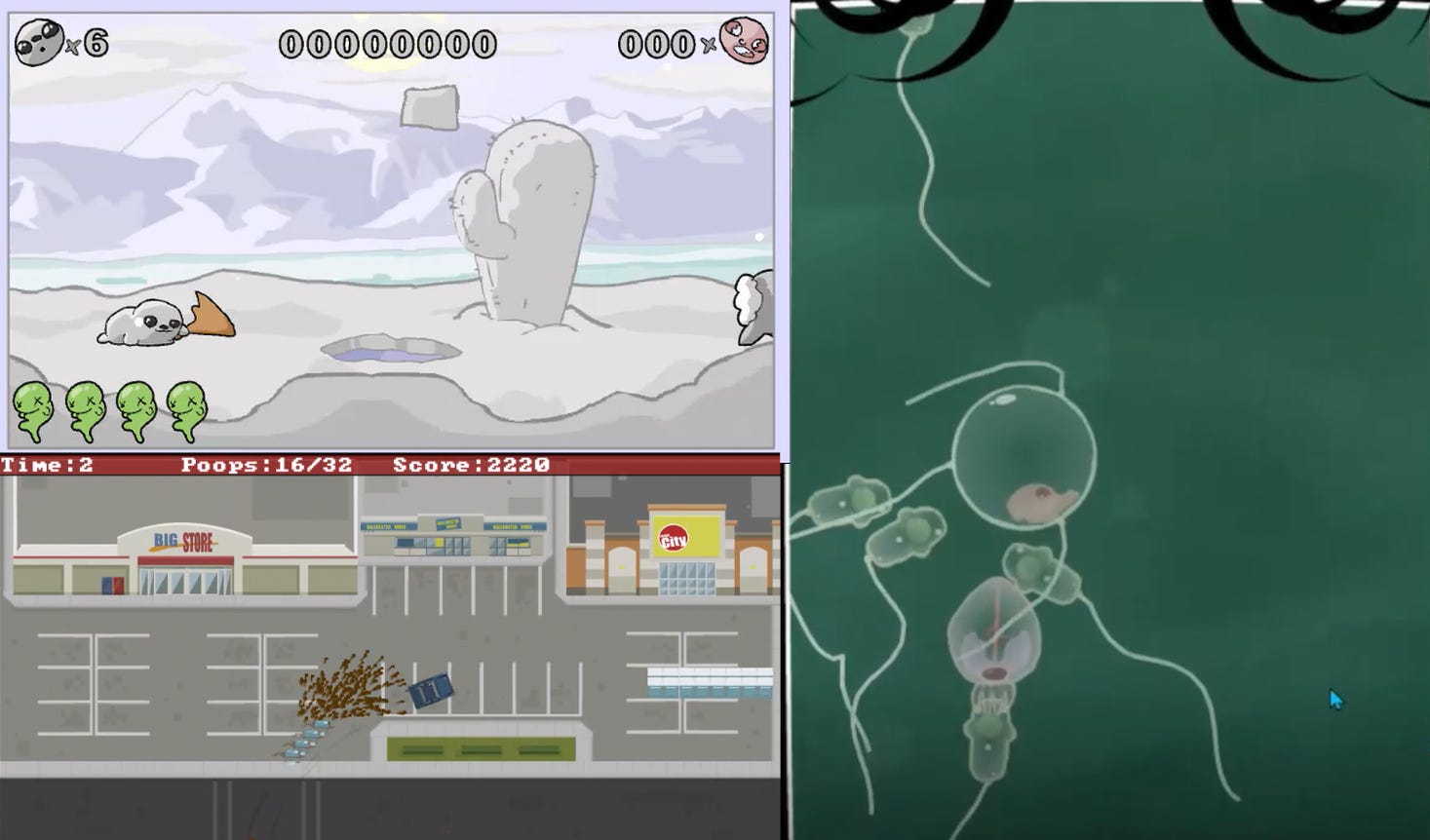
11. Coil (2008) | Newgrounds Link
“Coil is a game with no instruction or clear direction,” reports the game as it begins. “Please keep an open mind when playing.” Yeah, this one’s pretty goddamned weird.
Coil is less a game and more a series of interactive vignettes. In each, you’re given some organic form to embody and an unclear objective that becomes apparent as you experiment with the controls, all bookended by a few sentences of mysterious narrative that postures you as some feminine-coded consciousness at the whim of a male authority. It might be that Coil is a daring interactive narrative steeped in profound metaphor, or it could just be a bizarre experiment in which you follow the life of some alien biology from its insemination to its… birth? It’s very weird, but it’s the good kind of weird that an open mind will find intriguing rather than off-putting. It’s not particularly fun to play, but the surreal presentation is at least curiosity-provoking, and there aren’t any other games like it.
10. Clubby the Seal (2004) and Clubby: Killing Season (2008) | Newgrounds Link
Clubby the Seal is — get this — a club-wielding baby seal. He seeks revenge on the cruel Eskibobs, a race of humanoid bastards who kill Clubby’s kind for sport and who, by the standards of contemporary sensitivity, are portrayed uncomfortably close to the indigenous peoples of the subarctic. The 2004 original is a fairly unsophisticated platformer notable mostly for the amusing contrast between its cutesy presentation and its shocking violence. It’s also quite a bit better than the 2008 spin-off in which an already dominant Clubby goes on an arbitrary killing spree with a chainsaw. The questions of where he got the chainsaw or how he manages to operate it go unexplored. You’ll experience just about everything that both games have to offer after just a few minutes of playtime, but both are moderately entertaining if you can develop a feel for the generally awkward controls.
9. Blood Car! 2000 (2008) | Newgrounds Link
Newgrounds oldheads will recall that the site had more than its fair share of controversies on account of its pathologically lax standards for taste and decorum. This resulted in a veritable pantheon of games made with the primary intent of shocking and disgusting a norm-constrained audience, often themed around perpetrating massacres. Blood Car! 2000 is one of them, but, lacking any timely connection to real-world events or any particularly gruesome portrayals, I’d say it doesn’t even crack the top fifty most offensive Newgrounds games. Actually, there’s really not much going on at all. You drive a car that handles like a bar of wet soap atop a greased bowling lane, and your objective is to run down a set number of nondescript, square-shaped human analogues. There’s a pretty amusing decal system under the hood that streaks the map with blood and burnt rubber, as well as several dozen gallons of human shit if you happen to strike a portable toilet. A deluxe version was released later the same year that made the level progression less boring, but this one probably won’t hold your attention for long. Nevertheless, bonus points for innovations like the decal engine and the Poop Slalom.
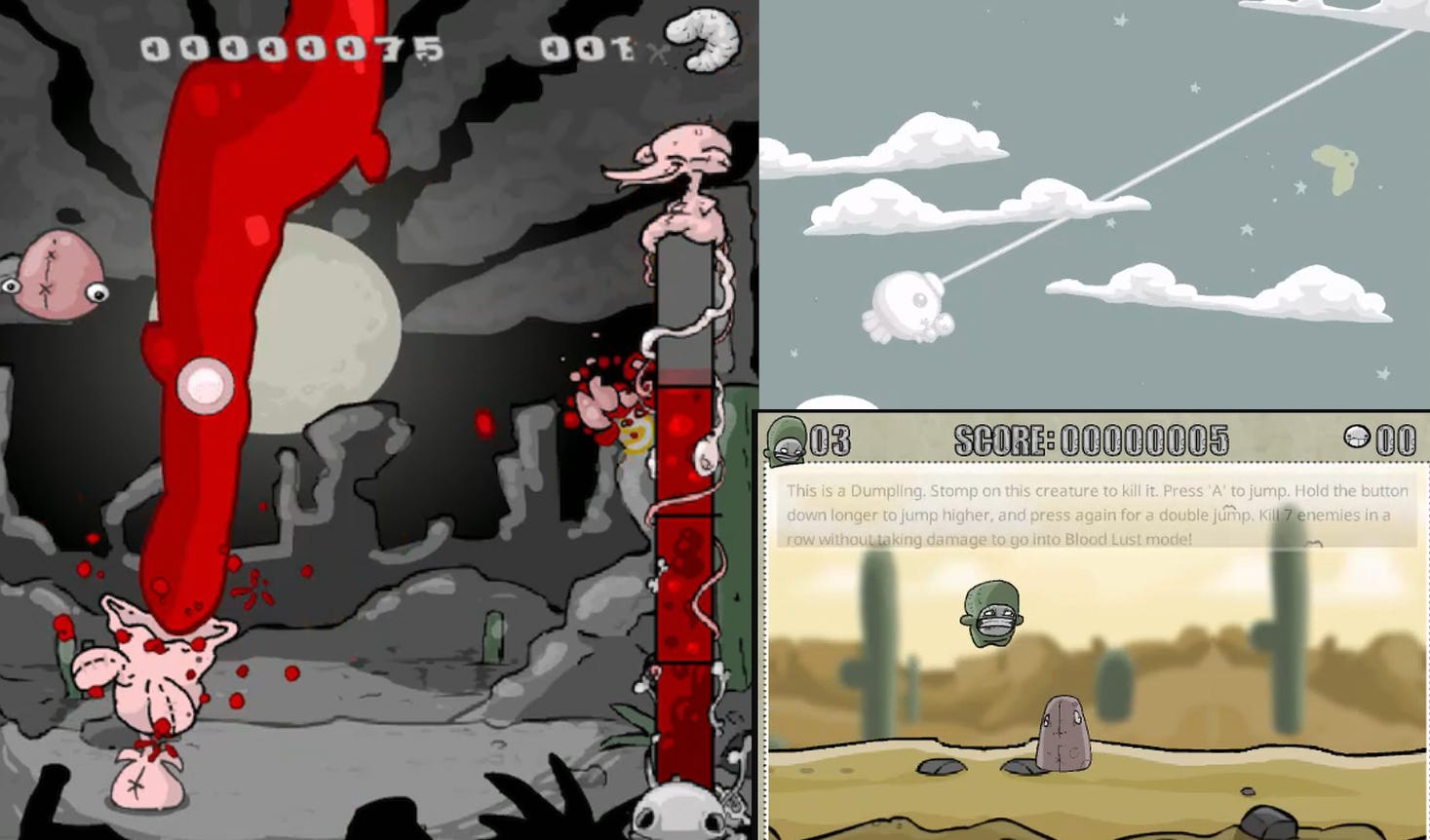
8. Carious Weltling (2003) and Carious Weltling 2 (2004) | Newgrounds Link
The Weltling is another species from McMillen’s Badlands lore, this one a featherless bird with no eyes that defends itself from predators by disgorging projectiles of coagulated blood. That probably sounds more disgusting than it actually comes across — the artwork from these earlier projects is almost universally goofy and tongue-in-cheek, so it’s impossible to interpret in any remotely serious capacity. The Carious Weltling duology is basically a pair of arcade shoot-em-ups with fleshy desert creatures instead of space-ships, and I happen to prefer the first because it controls more fluently. From a primary gameplay perspective, though, they’re basically identical. What most recommends the first as a historical gaming experience is that it’s McMillen’s first project with a serious attempt at core gameplay — worth checking out for those with the right sense of humor.
7. Aether (2008) | Newgrounds Link
The first collaboration with Mewgenics co-developer Tyler Glaiel, Aether brings us back into “is this actually a game?” territory, and it’s hard to tersely summarize. You play as a young boy riding a rotund creature whose prehensile tongue can grasp and swing from clouds, and by these means you escape the earth’s gravitational pull and travel to a handful of interplanetary setpiece encounters at your leisure. The core movement mechanic is surprisingly gratifying and enjoyable once you figure it out, but it exists solely in service of conveying you to loosely connected narrative beats themed around childhood angst. It’s not cringe-worthy or anything, but I wouldn’t call it a competitor to contemporary ludonarrative standards. Check this one out anyway if you read that bit about the prehensile tongue and felt like you had to see it for yourself.
6. Cereus Peashy (2007) | Newgrounds Link
Rounding out our selection of interesting-but-not-great legacy McMillen works is the last of the Badlands games, this time featuring the genocidally violent cactus-folk. It takes the form of a 2D sidescroller with much of the early-90s mascot platformers about it, but imbued with an unmistakable aura of Newgrounds-era jank. This is definitely one of the more complete gameplay experiences in McMillen’s early catalog, featuring a collection of discrete levels brought together in an overworld, alongside some contributions by Newgrounds royalty Tom Fulp. This one was in a sort of development hell for several years prior to its release, and McMillen recently said he was “kinda over it” by the time it came out. Like many Flash platformers, the controls aren’t very fluid and it’s easy to accidentally lose a life on account of mistaken input. Still, this one has a lot of personality and was definitely one of the more nostalgia-provoking revisits for me.
THE ONES YOU SHOULD PLAY IN 2026
The five games below are, to my mind, the best non-commercial work with which Edmund McMillen has been involved. I’d recommend trying them all if you can spare the time.
5. Tri-achnid (2006) | Newgrounds Link
There are two particularly notable attributes that set Tri-achnid apart. First is that it was McMillen’s first collaboration with Austrian game-dev Florian Himsl, with whom he’d later create The Binding of Isaac. The second is that it’s got one of the most unique central mechanics I’ve ever seen: playing as the titular three-legged spider-thing, you navigate the game world’s jagged topology by individually click-dragging each limb into position. It calls for steady and deliberate action, and the result is a slow-paced movement puzzler where every step feels like a minor accomplishment unto itself.
Of course, being a gangly bug with toothpick-thin limbs leaves you exceptionally fragile, and you can lose a life just by moving too fast or too greedily. I’ve never beaten Tri-achnid, or even come particularly close — it’s one of those games where losing all your lives sends you right back to the beginning. A light, abstractly told story would ideally motivate a full playthrough, but it ends up as an endurance challenge that doesn’t quite live up to the time it’d take to master. Nevertheless, I recommend trying it for a few minutes just to experience its core loop and novel movement mechanic. It’s very much emblematic of the Flash era’s experimental spirit, and that alone is worth celebrating.
4. Grey-Matter (2008) | Newgrounds Link
Called an “anti-shooter” in its original description, Grey-Matter is a high-concept experiment by Team Meat made with the apparent intention of keeping their creative juices flowing in while Super Meat Boy was in development. You play as an already-fired bullet, which you maneuver in 2D space with the arrow keys to crash into brain-shaped enemies. Again, though, there’s a unique mechanical conceit. Each time you strike an enemy, you leave behind a vertex of a triangle. After killing three in a row, the triangle is completed, and any enemies within its area are slain automatically and spectacularly. This is used to great effect — some enemy types have dangerous and hard-to-avoid proximity attacks, so you can use it to trap stubborn ones without risking yourself up close.
Enemies become gradually more dangerous as you make progress, and you’re kept in a nearly constant state of peril. It’s pretty exhilarating once it gets going, and the controls are responsive and buttery-smooth. It feels very much like a game made by the Meat Boy lads, and it’s a worthy distraction even in the absence of a sophisticated progression system. The most interesting part by far is the triangle-based attack mechanic. If it had found its way into an arcade cabinet from the 80s, I’m sure it’d be remembered as a timeless classic.
3. Time Fcuk (2009) | Newgrounds Link
2010’s Super Meat Boy represented a dramatic inflection point in the trajectory of Edmund McMillen’s career, and Time Fcuk was the last Flash game he published before its release. It’s mechanically simple, boiling down to a two-layered platform puzzler. You jump between platforms, push boxes to make space, and swap between parallel dimensions that facilitate complex logic challenges using the otherwise dead-simple setup. It’s hard to explain in concrete terms, but you’ll quickly intuit it if you take sixty seconds to play the first two or three levels.
I’m not exactly sure why, but I find Time Fcuk to be strikingly reminiscent of Terry Cavangh’s VVVVVV from the following year. It might be the art style, or I guess it could be the subtly oppressive tone. More likely responsible is the complexity it achieves with such a profoundly simple mechanical inventory. Like VVVVVV, this game probably could’ve run on a Commodore 64 decades before its actual release date — there’s almost nothing going on at the surface, but that simplicity belies how the whole of Time Fcuk is much greater than the sum of its parts. This became a recurring theme in McMillen’s later, commercial ludography.
2. Meat Boy and Meat Boy (map pack) (2008) | Newgrounds Link
Before Super Meat Boy turned Edmund McMillen and Team Meat into respected industry professionals, there was the prototype Flash version that proved the viability of its premise. If you’re not familiar with said premise, allow me the distinct pleasure of enlightening you: playing as an animate hunk of wet muscle tissue, you run and jump through tile-based levels in pursuit of the evil Dr. Fetus to rescue your beloved Bandage Girl. Perfectly responsive controls have you bouncing between walls, leaping over buzzsaws, and weaving through missiles, all the while leaving a slick trail of heme-colored moisture upon every surface you cross.
I’m delighted to say that, even eighteen years later, the original Meat Boy holds up great. It’s a little tricky to play with a keyboard in lieu of a controller, but it’s totally possible once you get into a rhythm. Meat Boy (map pack) was released later that year, featuring dozens of player-created maps of varying difficulties, many of which matched or even exceeded the originals. It also happens to factor into my own early lore — at the age of thirteen, I designed and submitted a Meat Boy map that made it into this release. It’s hard to describe the complicated emotions that I, now thirty, felt while replaying said map all these years later. It wasn’t that great, but I’m flattered even now that game designers of this caliber played my work and thought it was worth including.
Oh, and if you’re curious about which map it was, keep wondering. It’s credited with my old username, and I’d be fucking mortified if anyone ever dug up my Newgrounds account from when I was an edgy teenager.
1. Spewer (2009) | Newgrounds Link
At last we come to my personal favorite McMillen game from the pre-commercial era. Spewer is another puzzle-platformer in which you play as the eponymous experimental lifeform and must navigate a gauntlet of movement challenges at the behest of your mad-scientist creator. Your principle means of doing so is also your namesake: you’re capable of vomiting many times your body weight, which can propel you to great heights or produce a safe, fluid medium through which to swim over hazards. Various pharmaceutical enhancements can change the physical properties of your spew, and there are dozens of levels that take advantage of the opportunities to which this central mechanic lends itself.
For a Flash game, the fluid-mechanical simulation undergirding Spewer is a tremendous feat of software engineering. And, despite its deliberately unsavory premise, this game is really damn charming. Spewer, to whom I’ll assign masculine gender out of convenience rather than physical evidence, always has a smile on his face and seemingly lives for the thrill of his purpose. If you struggle to imagine the idea that a puzzle game designed around creative vomiting could be charming and delightful, go play Spewer. It might not be as consistent as Meat Boy or as replayable as Isaac, but it’s an excellent puzzle-platformer that still warms my jaded, world-weary heart.
That covers just about every Edmund McMillen game from the before-times. The Flash era deserves more credit than it gets for its role in shaping today’s gaming ecosystem, I could only barely touch on it given this week’s narrow focus. These days, when financial prerogatives have colonized so much of the gaming industry and its surrounding media, it’s almost hard to imagine that independent, non-commercial video games used to be as popular and well-platformed as they were in the heyday of Newgrounds, Kongregate, Armor Games, and the rest.
At least it wasn’t for nothing — a lucky handful of those creators, of whom Edmund McMillen and Tyler Glaiel are two shining examples — ultimately leveraged their talent into successful careers in the industry that succeeded the Flash era. And, thanks to the hard work of passionate fans, most of these projects are not lost to time. There’s something powerfully motivating in the thought that, when a corporation of Adobe’s stature decided against continuing to support the platform responsible for all this great artwork, a legion of talented folk were able to pick up the slack and keep it all alive by freely available, third-party means. I’m sure I’ll return to the subject of the Flash era one day.
Alright, I appreciate your reading to the end of this unusually girthy installment. I’ll be visiting family over the latter half of this week, so next week’s edition will be on the shorter side. Hope you learned something, and I strongly recommend you check out at least a few of the entries from later in the list above — they’re all free to play on Newgrounds, and even the most resource-deprived computer of modern times can run them with no trouble. No installations necessary, as long as you’ve got an Internet browser to hand. If you give these a try or have played any of them before, let me know which were your favorites! I’d also love to hear about any cherished memories you may have of non-McMillen Flash games from back in the day.
Don’t worry — I would sooner die than expose you to the garbage I made at age twelve.
The exact number depends on your definition of “game.” If you count infanticide-themed drag-and-drop dressup games, it’s more like 30.
The Internet tells me “Viviparous” means “bearing live young.” I do love a good vocab word.
Good article! Kinda disappointed that The Backup Files didn't even get a mention, but I guess that's because it's not really a game. I still think it's interesting what 21 y/o (that can't be right. He was probably 15 when he made this) McMillen wrote about his character, Freddy.
Also, shout out to Stile man Dressup because why did McMillen decide to link to porn lmao
Team Meat was the "pee/poo" 12yo edgy persona of the 2000's indie boom--unfortunately it's been proven the most ressonant bunch with the gamers™ audience, so here we are.
And jesus, is SnackOlantern worse than Gish? I won't find out.