

Can Gaming Do Social Realism?
Investigating the connections between game design and realist artwork

“Games signal a third phase for realism. The first two phases were realism in narrative (literature) and realism in images (painting, photography, film). Now there is also realism in action.”
— Alexander R. Galloway, 2004
TOO REAL
You ever get a good look at American Gothic? The original, I mean, not the parodies where Twinkie the Kid stares forlornly at Alfred E. Neuman or whatever. If you haven’t, go load up a hi-res scan of it real quick and really scrutinize that dusty old bastard who used to do the artist’s dental work. Have a gander at the woman standing in for his daughter while you’re at it. Really drink in those eyes, and then follow their gaze over to the drooping jowls that practically melt onto the muddy overalls and crusty suit jacket in which the old yeoman might as well be buried. A haunting critique of the agrarian idyll as it clung to relevance in a rapidly modernizing world. Or is it?

Contemporaneous records suggest that Grant Wood intended American Gothic as an ode to the phlegmatic tenacity of rural America in spite of the social trends that challenged it, but he had a hell of a time convincing a skeptical public of that. Art critics, even those who looked favorably upon it, interpreted it as a satire. Then, when a reproduction appeared in the Cedar Rapids Gazette, Iowans were apoplectic at the sight of what they took as a caricature of their lifestyle. Iowa farmwives undertook an aggressive letter-writing campaign in protest — it’s said that one wished the painter’s head bashed in, and that another threatened to personally bite off his ear.
We’re talking about realism this week, and I bring all of this up to illustrate how powerful it can be when deliberately applied by skilled hands. American Gothic is a portrait of two people in front of a house, but it inspires more emotion and reflection than perhaps any other American painting. This is worth celebrating — in our hyperreal era of institutionalized sports-betting rackets, matcha-flavored protein lattes, and AI-generated videos of Gordon Ramsey lactating cornflakes, artwork that inspires by making direct, unvarnished connections with our lived realities is precious, even when it upsets us. Literature, painting, and cinema each have well-established traditions of depicting that unobstructed reality, and each has produced works with profound and lasting legacies. This week, I want to discuss the extent to which video games can do the same.
Enter Social Realism in Gaming, a 2004 paper by the author and professor Alexander R. Galloway that I came across late last year. Its stated goal was to elucidate how the theories of realism from other media traditions could be applied to games, and thus to expand the aesthetic notion of realism to accommodate the unique affective qualities intrinsic to gameplay. In order to do that, Galloway writes, gaming has to expand beyond the idea of realism as “mere realistic representation” that we often take it to mean. It’s not enough to have extremely detailed graphics and/or high attention to detail if the characters and events one portrays don’t mirror any recognizable facet of the audience’s experience — for Galloway, a truly realist game is one that “reflect[s] critically on the minutia of everyday life, replete as it is with struggle, personal drama, and injustice.”
Now, in 2004, Galloway had to stretch to find extant examples of this in the commercial gaming landscape. Do any of you remember Rockstar Games’ State of Emergency? Can’t say I do. Thing is, gaming has evolved dramatically in the decades since the publication of this paper. The vastly larger audience, the accessibility of design software, the relative ease of distribution, and many other factors besides contribute to ever greater strides in the aesthetic horizons of game design. There’s also been a considerable amount of research in response, including no shortage of work critically reevaluating Galloway’s seminal work. We’ll talk about some of it this week as we discuss the still-emerging but very much established character of realist game design. Later on, I’ll ask you for any examples you might have in mind. Let’s begin with a singleplayer WWII campaign that nobody seems to remember these days.
Red Orchestra 2: Heroes of Stalingrad
Tripwire Interactive’s suite of first-person war shooters were big throughout the 2010s, and their squad-based gunplay was just about the biggest thing going in multiplayer shooters until Fortnite and Escape from Tarkov came around to burn all our crops and raze all our dwellings. Though the studio is most remembered for its tactical multiplayer offerings, it’s often forgotten that 2011’s Red Orchestra 2: Heroes of Stalingrad had a mission-based singleplayer campaign. That’s probably because it was removed from the game altogether in later updates and is now available only to nerds like me who bought the thing ages ago.1 It’s worth talking about nonetheless, because it might be the first WWII shooter to earnestly portray the subjectivity of its participants in the heat of the action, without leaning on cutscenes or other cinematic flourishes.
RO2’s most fascinating innovation in this regard is its disturbingly grounded portrayal of the acute psychological stress endured by the soldiers you control. Men will scream in terror as bullets crack past their ears, or loudly exclaim that they don’t want to die. Many of the voice performances sound conspicuously youthful. It gets especially distressing when a Bolshevik nails you in the gut and your doughy, eighteen-year-old avatar begins whimpering for his mother. It’s quite discomforting, and it works pretty well.
Galloway’s paper devotes an entire section to the question of whether military games are in any meaningful sense realist, which ultimately concludes against the proposition on the basis that war shooters of the era (e.g., SOCOM U.S. Navy SEALs, Delta Force, and America’s Army) were designed around the supposed thrill of participating in armed conflict rather than around any encouragement of critical reflection in their audiences. Fair enough — gamers in the early 2000s were easily sold on the fantasy of heroic military achievement, but generally preferred not to openly question the nobility of sending their countrymen to die overseas for at-best nebulous reasons. However, Galloway does make an exception for military games whose events directly correspond with the lived experiences of their players. One example he cites is a game released by no less than the Central Internet Bureau of Hezbollah2, speculating that its target audience might reasonably identify with its portrayals in a deeply personal manner. This ultimately informs Galloway’s conclusion that realist games require some direct congruence between the political reality portrayed in the game and that lived by the gamer, which he calls the “congruence requirement.”
I think there’s something to Galloway’s congruence requirement, but RO2 may just demonstrate that there’s more to realist game design than that.
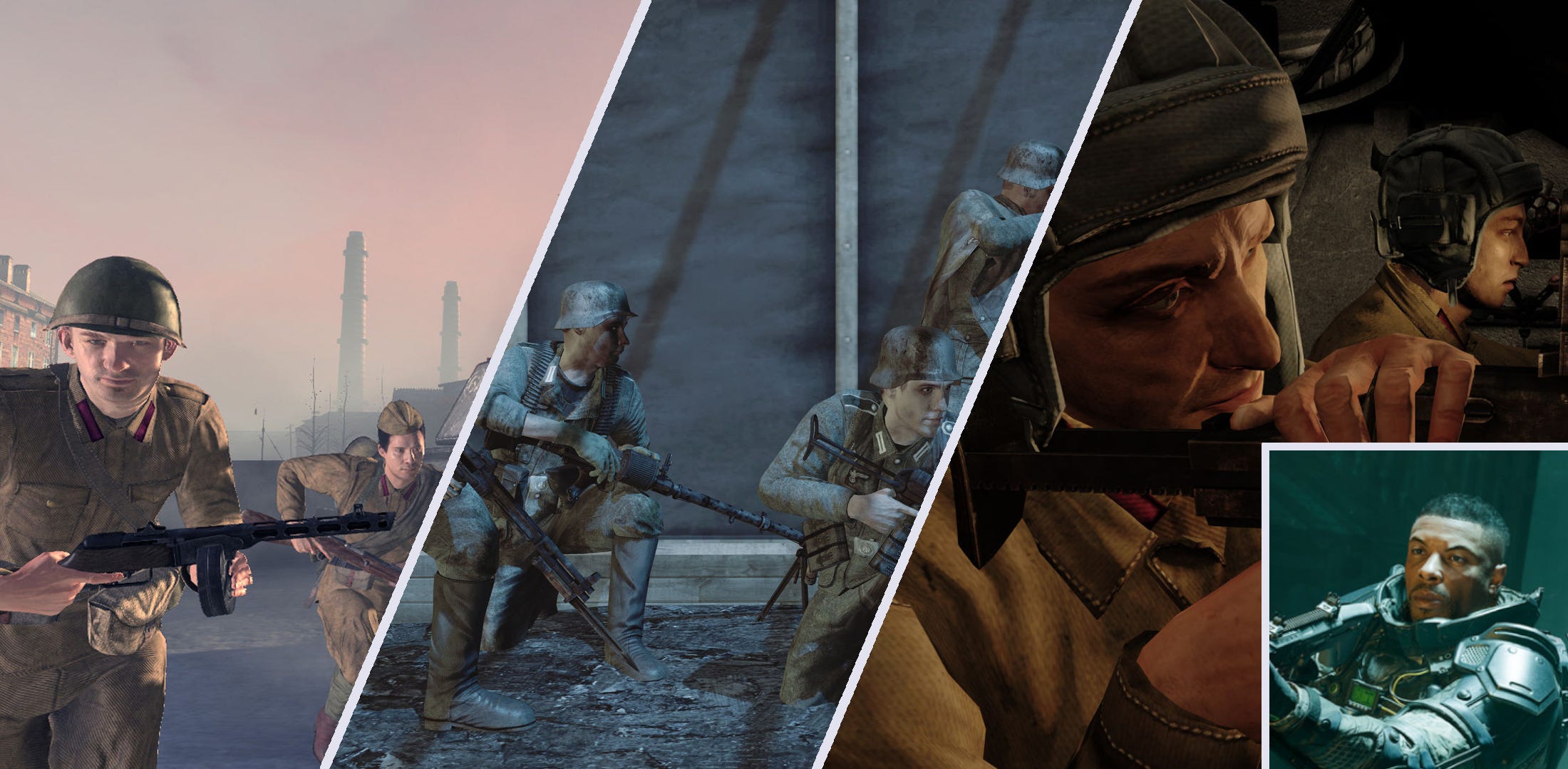
“[T]actics emphasizing player-character subjectivity… convey the philosophical and ideological tenants of neorealism and broader social realism,” argues Maxim Tvorun-Dunn in Social Realism in Red Orchestra 2, a 2022 paper that seeks to critically reevaluate Galloway’s work. Those “philosophical and ideological tenants,” steeped as they were in the growing social consciousness that grew from the gruesome aftermath of the Industrial Revolution and the first World War, are a natural fit for the orgy of ideological violence that characterized World War II. Tvorun-Dunn suggests that social realism in games is, as in neorealist cinema, dependent on “convergence between a game’s functional and visual rhetoric” and need not possess the direct congruence between portrayed reality and player reality for which Galloway argued.
That’s certainly convenient for RO2, since you don’t run into many people these days whose lived realities are affectively congruent with the defense of Stalingrad. By my estimation, it’s probably more accurate to call it a game with a realist edge rather than a social-realist game outright, since it broadly lacks the critical teeth that Galloway and others have identified as instrumental to the social-realist aesthetic. This is a common pattern among games about war, even those that make an effort to humanize their participants or otherwise draw attention to the terrible realities of armed conflict — it’s difficult to feel somber and reflective while you’re having a rollicking good time shooting Nazis in their bellies. Nevertheless, it at least evinces the possibility of social-realist game design that doesn’t lean on the directly familiar. With that in mind, let me give you what I consider an even stronger example.
This War of Mine (2014)
After Minecraft changed the mainstream gaming landscape by selling more copies than the Bible, the early-mid 2010s were absolutely swamped with survival-crafting games. Most of them followed a familiar template, dropping players into resource-rich wilderness environs to gather supplies and fight off a derivative cast of fantasy enemies. It was getting pretty old by the middle of the decade, so 11 bit studios’ This War of Mine was a refreshing change of pace: instead of theming the survival experience around man’s struggle against nature, it adopted a soberingly realist take on man’s struggle against man, dropping players into a bombed-out urban hellscape in the middle of an active conflict zone. There are no trees to chop down for firewood and no wild pigs to hunt for food — most usable supplies are either scavenged from the rapidly dwindling pre-conflict stockpiles, or already possessed by other noncombatants who’d really prefer that you not doom them to a slow, miserable death by seizing them.
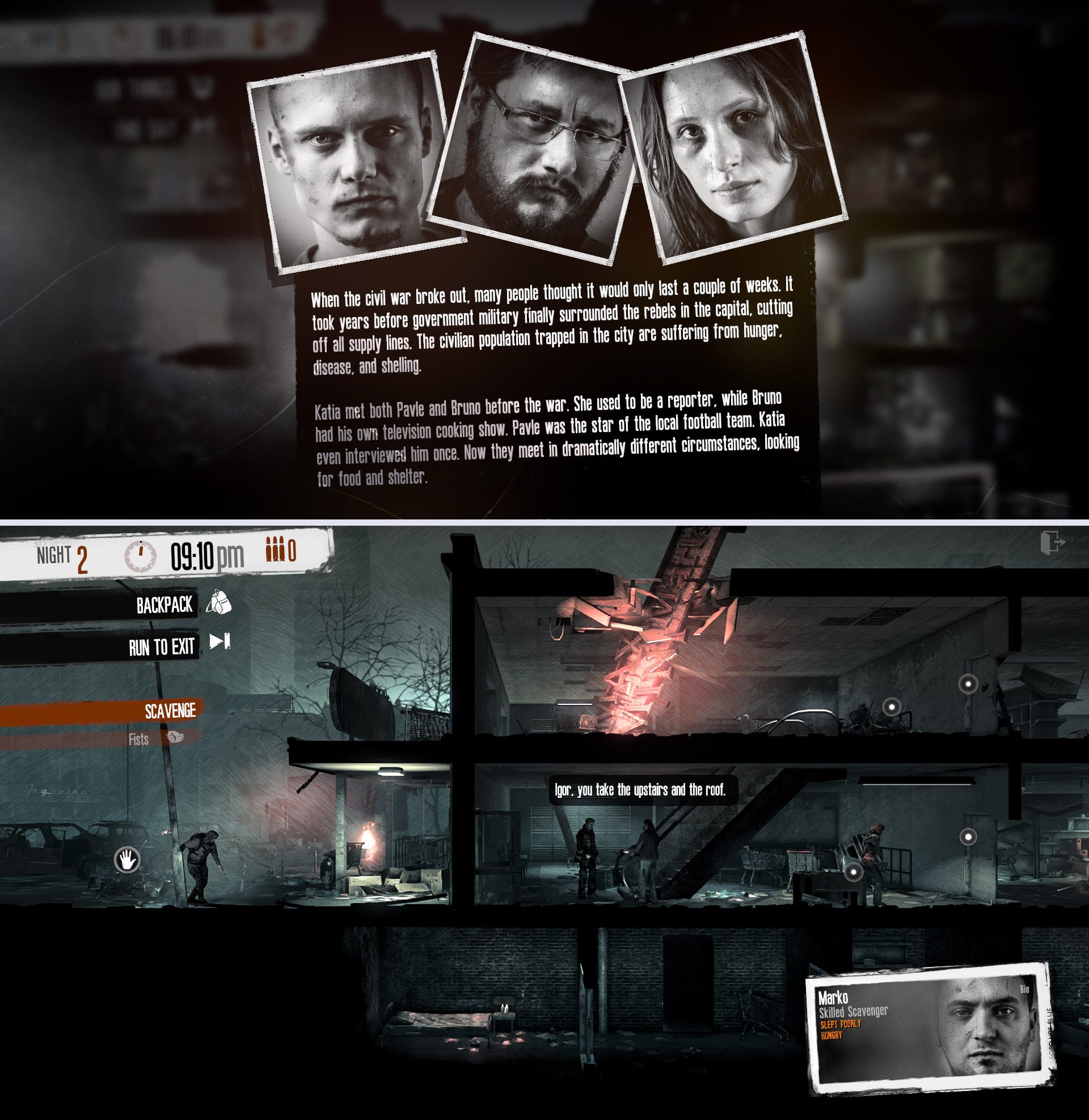
If it felt like a stretch to say that the designers of a 2011 WWII shooter had realist intentions, then you’ll be relieved by the explicitness with which TWoM’s Warsaw-based developers have enumerated their primary influences. The game’s linguistic and visual aesthetics are deliberately reminiscent of the siege of Sarajevo during the Bosnian war, and it’s of course unignorable that the game’s release in November 2014 took place against a backdrop of the conflicts in Syria and Gaza. The throughline uniting these influences is, naturally, the urban conflicts that displaced and slew countless civilians. A common refrain in interviews was that the developers wanted players to believe the kind of violent chaos they portrayed could take place anywhere, including wherever you live, and the game does a frighteningly good job at sustaining that premise.
Where Red Orchestra 2 is a game evoking the oft-forgotten humanity of frontline warfighters, TWoM is a game entirely focused upon the even less-remembered humanity of the non-combatants who shoulder the lion’s share of suffering and misery in societies ravaged by war. Gameplay consists of managing a dilapidated house that’s become home to a small group of survivors left deprived and terrified by the collateral damage of a war that rages off-screen. Your objective is simply to hold out until a ceasefire is declared. To do so, you send your survivors on scavenging expeditions where you’ll collect supplies, bargain with other survivors, and occasionally murder them in desperation as long as it’ll buy you one more day. One sequence that stands out in my memory to is when, with no clear alternative at my disposal, I stole from an elderly survivor who watched me the entire time but was powerless to stop me. Some ten million sales and a closetful of awards are proof enough that these grisly design choices resonated with the public.
I’m prepared to say that This War of Mine succeeds as a work of social realism by continuously reinforcing the depravity of its subject matter through primary gameplay. As long as one approaches it with serious intent, it’s bound to succeed at the developers’ goal of forcing the player to reckon with the pervasive familiarity and remorselessness of modern conflict. And, given the sheer volume of wartime imagery to which many of us are now exposed in the social media age, one might even credibly argue that TWoM at least partially satisfies Galloway’s congruence requirement.
But enough about the overt and unignorable terror of war. Let’s go back to where we began and talk about realist portrayals of the much more subtle violence that so often escapes our cultural purview.
My Summer Car (2025)
The game begins, and you peer through a narrow, almond-shaped aperture that allows a sliver of light into the inky blackness surrounding you. As the honorary march of the Finnish Defense Forces plays at great volume, the aperture gradually expands and pushes the darkness further away. It widens to its zenith, and you start to make out the interior side of a car door against which a woman’s pump-clad feet are firmly pressed. A baby’s cries fade in over the music, and the camera zooms out to reveal you, freshly born, still covered in amniotic goo. The camera zooms out further to reveal what looks like a Datsun 100A as it speeds along a highway. “SUOMI FINLAND 1976,” reports a title card. The time and place of your birth.
We fade in on a bedroom, humbly appointed for one. Nineteen years have passed, and you find yourself alone in your family’s home in the municipality of Alivieska. A handwritten note on the refrigerator reveals that your parents have gone off to Tenerife, leaving you alone to fend for yourself. “Fix your dad’s old car… it has been filling up the garage for years now,” it reads in part. “Your dad says if you can repair the car and make it pass the inspection, you can keep it.” And, indeed, the garage contains the scattered remnants of the Datsun in which you were born, half-buried in the sprawl of its several dozen parts. Your goal: stay alive long enough to piece together a whole fucking passenger sedan from scratch.
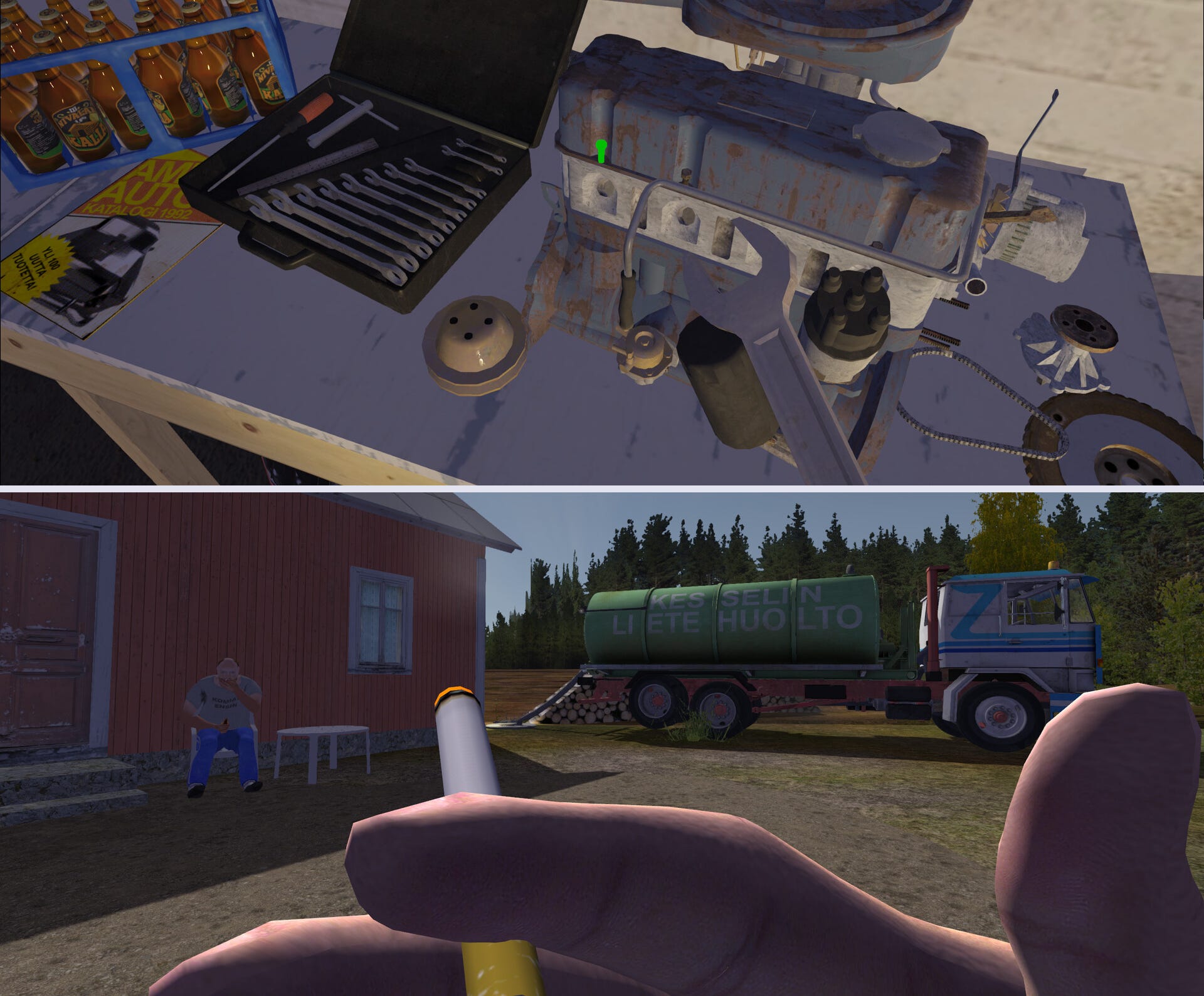
As a game, My Summer Car is alternately relaxing, lethargic, and exhilarating. As a work of realist design, it’s like the modal average of American Gothic and every single one of its parodies. Fundamentally, it’s a game about assembling a project car, given game-mechanical depth by the addition of survival mechanics. It’s made accessible by a superficially tongue-in-cheek presentation that begins to dissolve upon close examination. MSC also centralizes survival mechanics to drive the game’s pacing — the contextual adjustment that makes it so fascinating to talk about is that your player character, a teenage underachiever, survives not by trapping game or tilling soil but by performing blue-collar labor in order to afford sausages and beer. Building the titular car, then, ends up as a tertiary part of the game loop as you spend most of your time chopping firewood, picking fruit, or pumping liquid sewage from your neighbors’ septic tanks so that you don’t run out of money.
So, here’s where it gets real: My Summer Car is set in a fictional municipality in Finland during the aftermath of the country’s very real financial crisis in the early nineties. A combination of economic mismanagement and unsustainable equity bubbles incited massive devaluation and a precipitous collapse in consumer spending power, alongside wide and persistent unemployment. The game, set in 1995, reflects a society still reeling from the catastrophe — almost everyone you encounter in My Summer Car is either unemployed, dependent on alcohol, profoundly nihilistic, or some combination of the three.
This is another game that does a remarkably good job of emphasizing the player character’s subjectivity, like we discussed above in Red Orchestra 2. It features a standard suite of survival-game needs to fulfill — hunger, thirst, fatigue, the usual stuff — but also emphasizes the management of stress. You can keep it down by, in prototypically Finnish fashion, relaxing in the steam of a sauna, but it’s considerably more efficient to simply develop a nicotine habit. Your stress level passively grows while you’re awake even while you’re not engaged in stressful activity, and one can’t help but wonder about the motivations behind this design choice. A reflection of the player character’s angst at a life without much to look forward to? I’d have called that a stretch until I noticed that the sequel, fittingly titled My Winter Car and released into early access just days ago, now includes a “PROBLEM” meter that you satisfy by regularly consuming alcoholic beverages. Also, one can’t help but notice that the protagonist’s hands are now covered with prison tattoos.
What brings us over the edge from goofy work-sim into the realm of social realism is that MSC isn’t just about the central conceit of its title, i.e., fixing a car. It’s about inhabiting the reality of a person for whom the promises of society were left unfulfilled, and about finding some kind of satisfaction and peace in what’s left over. Crucially, it takes full advantage of its medium in service of facilitating that experience: you don’t just observe a sequence of pastiches that evoke the atmosphere the game is going for, but you actively plan and execute their every moment, even if that execution boils down to doing nothing for several minutes while you wait for the bus. The banality of the primary gameplay makes the occassional triumph all the more satisfying, not unlike the small victories that sustain so many of us through the seemingly unbreakable cycle of ennui that characterizes the gradual degeneration of our collective spirit.
Happy New Year, by the way!
“[R]ealism in gaming is a process of revisiting the material substrate of the medium and establishing correspondences with specific activities existent in the social reality of the gamer,” Galloway argues in his conclusion. This is part of what makes game design so special as a medium: it’s the only form in which an audience member personally acts upon the artist’s representations to evolve them. To Galloway, the correspondence between that action and the reality of the player is the foundation of the form’s realist aesthetic. Whether or not this is materially true, it’s been a fascinating subject to consider, and it’s apparent that the most creatively intrepid sectors of the gaming industry have met the challenge since this paper was published in 2004. The artistic potential of game design is practically limitless by nature of the medium’s versatility and intermodality, and ambitious game designers actualize more of that potential every year. 2025, for all its foibles, was an absolute banger of a year for innovation in game design. Here’s hoping that 2026 keeps the flame alight.
Alright, now I want to hear from you. What games do you remember as most absorbingly reflective of your own lived experiences? Or, do you have any games in your library that felt eerily evocative of social realities around you? Tell me about ‘em downstairs! Next week, we’re doing a retrospective review of everybody’s favorite Victorian-flavored techno-fantasy CRPG — hope I see ya there.
I think this is probably because the AI was so awful that the game was only barely playable. It might also have to do with controversy surrounding the Wehrmacht campaign in which you have to play as an allegiant of Hitler for several missions, which isn’t handled perfectly but is, I think, more thoughtful than it gets credit for. We might talk about that some other time.
It’s called Special Force, and I found very little surviving information about it. I did find a link to what purports to be its abandonware sequel (https://archive.org/details/special-force-2), but I’m not exactly in a hurry to try it.
I can't really list any games that relate exactly to the topic too much (though the UK does resemble Fallout 3's Megaton with Tenpenny Tower being London) but on the topic of lived experiences being reflected in games, I want to take a left-of-field option here and say that No Man's Sky is probably the best video game interpretation of learning a language I've ever seen.
The aliens you encounter don't vomit out absolute jibberish, their languages have suffixes, sentence structure and their own grammar but as you learn more words these are replaced with ones in your own chosen game language until finally, you are just reading normal sentences but in a different coloured font. I found this to be a pretty accurate depiction of my experience learning the Cyrillic alphabet and Russian; I don't see a different alphabet anymore, only the sounds each letter represents, it almost doesn't register anymore to me, as if it's just writing in a different colour.
The most social realism I ever got in a game, both in terms of being social, and being real, was playing Facade, saying something I thought was fine, having everyone else in the room stare at me for a few seconds as they parsed it, and then being told I needed to leave.