

Caesar’s Dialectic
How New Vegas's nerdiest villain carries on the legacy of great RPG writing

DICTATED, BUT NOT READ
Last week, our focus was dominated by an apocalyptic environmental catastrophe, endemic crises of mass psychosis, and the incipient normalization of cannibalism. But forget about the news for a moment — we also reviewed Fallout: DUST, which must be Fallout: New Vegas’s most brutally cunning mod project. And we did it on Linux, no less! As recently as February, I worried that an inability to play modded New Vegas campaigns would be an incurable side-effect of my zero-Windows diet, and I’ve never been more delighted to have been proven completely wrong. I’m stuck right back into New Vegas, and it’s both relieving and inspiring to see how well it holds up after all these years. Last week’s review argued that its core design is still wholly capable of delivering a memorable survival experience. This week, after reexposing myself to the original campaign, I’d like to talk about the strength of its writing.
New Vegas is broadly remembered as a sort of return-to-form for the franchise after Bethesda’s Fallout 3. To put it charitably, FO3 sought a much wider audience than its classic, Interplay-developed predecessors from the nineties, and so backpedaled on the more contemplative, political, and philosophical elements of their narrative presentation (among many other compromises beyond the scope of this tirade). New Vegas, for its part, leapt right back into the searing crucible of ideological warfare into which Fallouts 1 and 2 dipped their toes. After a first-act tour through the Mojave Wasteland introduces the player to the factions competing for dominance, the game becomes a political thriller in whose resolution the player character has a decisive role. Almost the whole political compass is represented: a bloated, corruptible liberal democracy with a progressive core; a quasi-fascistic, hypertraditionalist dictatorship; a right-libertarian autocracy very much in its Singapore era; and, of course, a friendly robot who will gleefully bring about chaotic, masterless anarchy at your behest. All that’s missing is a faction of left-wing dialectical materialists. But cut them a break — it got harder to advance a critique of labor economics after all the factories were bathed in nuclear fire.
And yet, New Vegas is by no means devoid of a dialectical approach to post-nuclear politics. On the contrary, the Hegelian dialectic is explicitly name-checked during the main quest. The only wrinkle is that it comes from a fairly nontraditional source, i.e., Caesar, Son of Mars, dictator of the Legion and sworn enemy of New-Californian republicanism. His “Hegelian” approach to pacifying the wasteland and ensuring man’s survival in the Great War’s aftermath is fairly well known these days. Experiencing it anew after several years, I’m reminded not only of why Caesar is probably my favorite villain in the entire franchise but of why (most of) Fallout’s villains are as memorable as they are. This week’s installment is basically my post-hoc analysis of that experience.
But first, what exactly is the Hegelian dialectic? Well, every serious thinker these days knows that truly understanding Hegel is a game for the kind of gauche poindexter who makes other philosophy nerds look like John Wayne, so I would explain it to you in the same way that Caesar explains it to the player character in New Vegas. That is, incorrectly. Accordingly, we’re going to sidestep an earnest discussion of what Hegel “really” meant, since I’m more likely to embarrass myself than to come up with any cogent exposition. Besides, Hegel himself is ancillary to Caesar’s character and his motivations at most. What’s really fascinating about the man is how his obviously and deliberately repugnant ideology is given strength and narrative weight by the context in which it emerged.
So, the plan is this: we’ll start by digging beneath the surface of Caesar’s character as it’s presented in New Vegas’s main quest, then we’ll have a more comprehensive look at his vision for the wasteland, and we’ll build up to how it exemplifies the narrative process that makes these games so enduringly cherished. Let’s begin with a look at the twenty-something dweeb who became, arguably, Fallout’s most interesting villain.
RED-PILLED ED: AN UNAUTHORIZED BIOGRAPHY
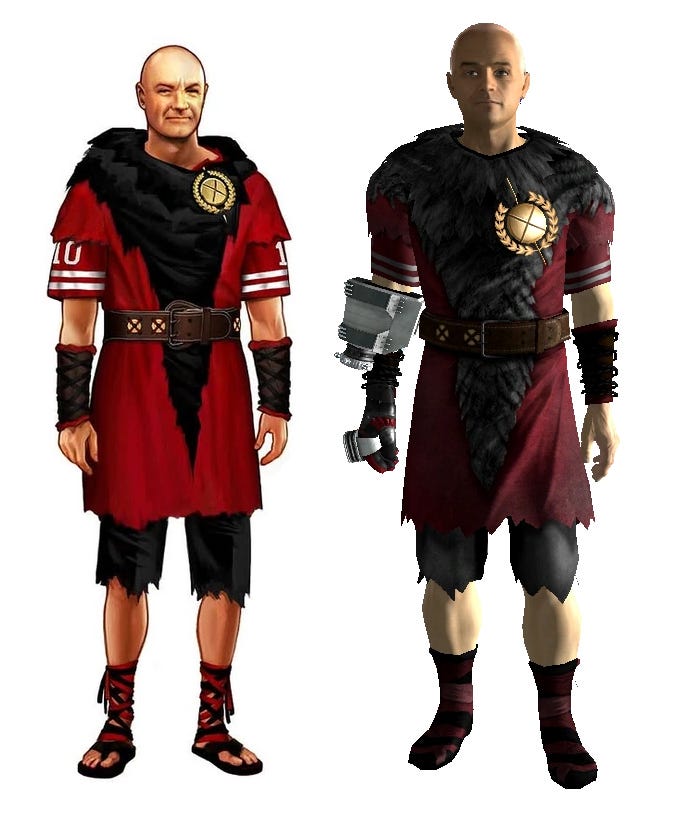
Oh, right, little-known fact: Caesar’s real name is fucking Edward. Edward Sallow, to be exact, presumably so named for what the scorching Nevadan climate did to his complexion. But I digress.
Fifty-some-odd years before the events of New Vegas, the man who would become Caesar was born someplace near the ruins of Los Angeles. His father was slain when he was two, and he grew up under the protection of the vaguely anarcho-syndicalist-coded Followers of the Apocalypse. By the age of twenty, he’d become a capable linguist and keen anthropologist. The Followers, seeking to advance their twin causes of equality and voluntary association, sent him on expedition to the Grand Canyon to study the dialects of the isolated tribes who lived thereabouts.
“What a fucking waste of time,” reflects a regretful Caesar if you happen to ask him about his journey from Follower to imperator.
For, far from a mutually uplifiting cultural exchange, young Edward found instead a band of tribal warmongers who captured him and his associates with the presumptive intent of holding them for ransom. Being taken captive by roving marauders is never great news, but this particular incident was made worse by the tribe’s exceptionally weak diplomatic situation. At simultaneous war with seven other tribes, the gestating Son of Mars realized that his captors would be defeated and that he would go down with them unless dramatic and decisive action were taken. He took it upon himself to instruct his tormentors in the use and care of firearms, the manufacture of ammunition and explosives, and tactical organization, among other post-liberal arts. He was made war chief by an impressed tribal leadership, whereupon he marched on and subsequently exterminated every man, woman, and child allegiant to the weakest foe. The remaining six tribes surrendered without a fuss after bearing witness to the devastation and were folded into the burgeoning imperium, and Caesar’s Legion began to grow.
A tale as old as time. But it does beg the question of how a linguistic anthropologist working for an anti-expansionist humanitarian organization came to embrace the divide-and-conquer ethos of imperial Rome. Don’t get me wrong — it’s not exactly surprising that a gigantic nerd should develop a performative obsession with the Roman Empire. But it’s curious that he did so centuries after doing so carried even the most remote possibility of advancing one’s social cachet. What’s going on here?
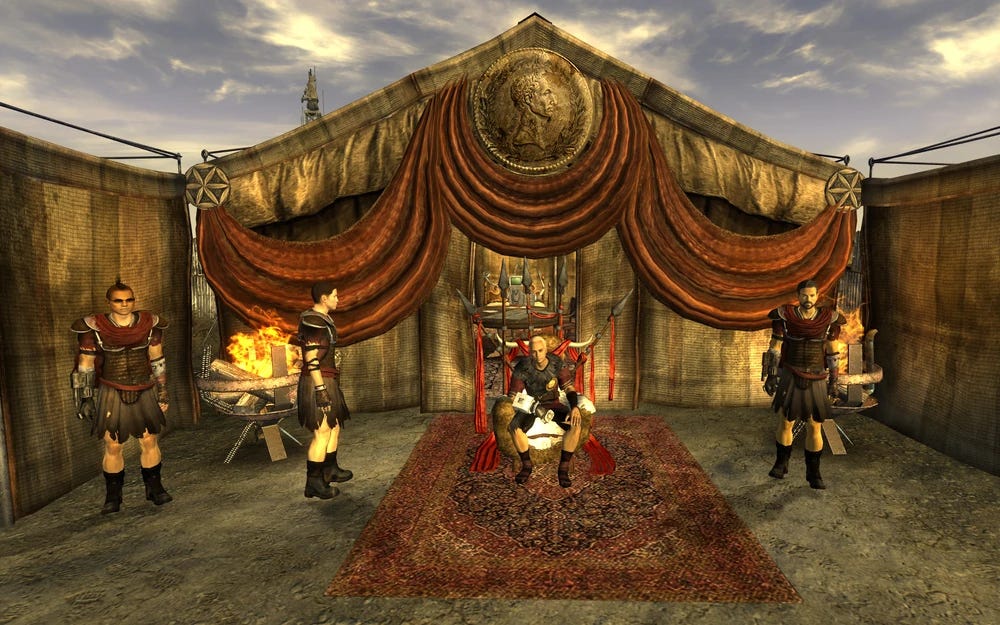
As it turns out, Edward and his companions chanced upon a cache of pre-war books during their journey to the Grand Canyon, among them Gibbon’s The History of the Decline and Fall of the Roman Empire and Julius Caesar’s Commentarii de Bello Gallico. These clearly had a big impression on the twenty-year-old nerd from what was once southern California, and it extends well beyond the plumed helmets, Latinate phraseology, and aquiline nose.
CAESAR’S DIALECTIC
“In Rome I found a template for a society equal to the challenges of the post-apocalyptic world — a society that could and would survive,” explains an ascendant Edward when we ask him about his Legion’s curious aesthetic. “A society that could prevent mankind from fracturing and destroying itself in this new world, by establishing a new Pax Romana.”
Aww, shit. Here we go again.
One of the things I most love about New Vegas is that, in a departure from its immediate predecessor, the designers figured their players had some stake in narrative cohesion and might want to explore the story’s characters beyond their most superficial motivations. “What does ‘Pax Romana’ mean?” asks my character, who, after all, is educated in little beyond murder and mail delivery.
“It means a nationalist, imperialist, totalitarian, homogenous culture that obliterates the identity of every group it conquers,” replies the Son of Mars. “Long-term stability at all costs. The individual has no value beyond his utility to the state, whether as an instrument of war, or production.” As a political project, it’s about as uncompromisingly opposed to the classically liberal ideals of the New California Republic as it’s possible to be.
“So you’ll destroy the NCR because you hate its inefficiencies?” asks my character, unable to grasp the sheer heft of Caesarian thought.
“No, I’ll destroy it because it’s inevitable that it be destroyed,” replies the august dictator. “It’s Hegelian Dialectics, not personal animosity… Just as with the ancient Republic, it is natural that a military force should conquer and transform the NCR into a military dictatorship. Thesis and antithesis… the resolution of the conflict yields something new — a synthesis — eliminating the flaws in each, leaving behind common elements and ideas.”
Now, this is where a certain kind of analyst would point out that, in his invocation of the “thesis-antithesis-synthesis” triad, Caesar is parroting a Kantianism expounded by Johann Fichte rather than an authentically Hegelian dialectical procedure. I’ll refrain from digging into that for two reasons: first, because I hardly understand Hegel any better than Caesar; and second, because I’m not trying to get beat up for my lunch money. So instead of poking holes in the man’s process, let’s consider the product at which he arrives.
“...the new synthesis will change the Legion as well: from a basically nomadic army to a standing military force that protects its citizens, and the power of its dictator.”
That Caesar misappropriates the language of German idealism in order to advance a cause in direct opposition of its liberatory ends is, of course, part of the joke. What distinguishes it from outright satire (as we get in, e.g., Psycho Patrol R) is that there’s a kernel of efficacy behind his designs. The writers of New Vegas gave themselves a difficult task: portray a grotesquely evil faction of hateful monsters who delight in their cruelty, and then situate it in a context that makes the player earnestly consider the potential merits of its approach. Striking that balance is where New Vegas triumphs, but it’s all part of a narrative legacy that began way back in 1997.
ANSWERING FALLOUT’S BIG QUESTION
Every Fallout game — or, at least, every Fallout game that earnestly attempts a coherent narrative — is ultimately about the conflict between practically incompatible strategies for preventing humankind from destroying itself. Those of you with several of the games under your belt know what I’m talking about: in Fallout 1, ought we biochemically erase that which divides us or embrace those divisions as greater than the sum of their parts? In Fallout 2, ought we recapture the utopian spirit of pre-war liberalism or shall we simply annihilate all those who are not like us? In Fallout 3, ought we retread the central conflict of Fallout 2 without an ounce of its wit, or shall we do so without even the pretense of respect for the player’s intellect? Finally, in Fallout: New Vegas, we have ourselves a soothing, old-fashioned conflict between political ideologies.
It’s often asserted — erroneously, in my opinion — that the development team had some kind of personal or emotional bias toward the NCR and its liberal-democratic ethos. I don’t think the evidence presented in the game quite bears that out. Instead, I get the impression that the writers were, if anything, critical of that ethos and sought to give the player opportunities to redress some of the contradictions that infected both the NCR’s republicanism and the actually existing liberal democracy in which they lived. Authorities in the Republic are all too eager to extort their agrarian constituencies, torture prisoners of war, and even perpetrate a straight-up massacre whose similarities to Wounded Knee cannot possibly be a coincidence. It takes the player’s direct, conscious intervention to prevent the NCR from casually engaging in atrocity.
Meanwhile, the Legion does actually present a coherent alternative, and the curious player of New Vegas will find plenty of evidence that Caesar’s approach is largely effective at accomplishing his stated goal of stability at all costs. Of particular note is that the caravaneers who form the backbone of the wasteland economy are practically universal in their acknowledgement of what we may as well call Caesar’s Pax Mojave. It’s not bumbling ineptitude or ideological incoherency that’s meant to sway the player away from the Legion approach. Instead, it’s the reckless personality cult, the institutionalized misogyny, the chattel slavery, and one final, inescapable weakness that dooms the whole project.
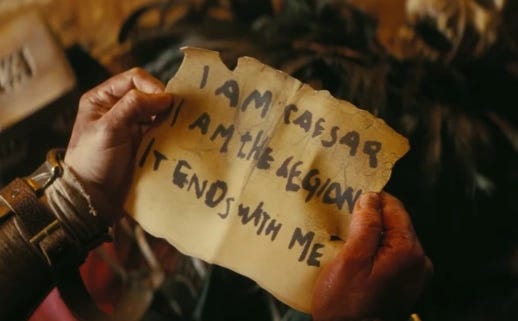
For you see, it’s also the case that every Fallout villain’s ideology is skewered by some grand contradiction that renders it unworkable and unsympathetic. In Fallout 1, the Master’s plan to turn everyone into a mutant is let down by the mutants’ sterility, assuring that his vision would cause mankind’s extinction. In Fallout 2, the Enclave’s plot to restore American democracy by murdering everyone else is let down by the NCR’s living example of liberal democracy sans genocide. In Fallout 3, Colonel Autumn’s plot to do... something, I think... is let down by how utterly it failed to make an impression on my memory. And in New Vegas, Caesar’s undeniable success at pacifying the territory under his control is let down not only by the wretchedness of his methods but by its sheer transience. He’s an old, sick man whose self-obsessed and uncompromising nature has foreclosed the possibility of the Legion’s continuity after his forthcoming death. None are fit to take his place, so chaos will reign after he’s gone. All that can remain of the Legion afterwards is the wretchedness.
New Vegas is, without question, a game about politics. But is it trying to make a political statement in and of itself? Something braver than “autocratic slave-states are bad,” I mean. And, if so, is it a successful model for how to broach the increasingly fraught subject of political organization through the medium of game design? If not, what can we learn from its shortcomings? These are all loaded questions that deserve a more complete answer than I’m prepared to give at this very moment. Do let me know in the comments if you have any thoughts you’d like to share on the matter. For now, I’d like to end on some wisdom from New Vegas project director Joshua Sawyer, who, after all, came up with the idea(archive.is/kZfc1) to make Caesar a performative Hegel-worshipper in the first place.
“[W]hile you are not necessarily supposed to DISlike Caesar, it was not our intention to make Caesar someone who is easy to like, nor his autocratic rule something that you react to by saying, “Oh, well it’s totally justified.” … Ultimately, Caesar is an educated tyrant living in an echo-chamber of his own creation. Despite having a long-term vision for the future, he is quite short-sighted. If you were expecting Caesar to be grey and found him to be black, I’d argue that he’s still grey, but he’s intentionally a very dark grey. Tamerlane and Charles Taylor also had reasons for doing the things they did, but it doesn’t make the things they did any less terrible.”1
See ya next week <3
I'm also replaying FNV for the bajillionth time and this time I've realised that Arcade Gannon is the perfect foil to Caesar in a way that is overtly textual, I was just too dumb to see it. Arcade is also educated, if not more so than Caesar, but understands the limits of his intellect to order the world. He helps where he can, but will not impose a grand theory of history or a supra-ideology onto unwilling people, hence his support for independent Vegas. He's basically learned from his Enclave parents, and recent post-nuclear history, in a way that Sallow never did. Arcade hates Caesar as a person more than anyone else in the game because he understands what ridiculous, megalomaniacal hubris it is to anoit yourself king of the world because you think you understand what a dialectic and no one else does. This is also why the true worst thing you do to Arcade is sell him into slavery to be Caesar's intellectual amusement and probable concubine (I think Caesar is also gay).
I've bought FO1 and F02, played half of F0NV and FO4, and completed FO3... reading this series of articles I really need to go back and play FO1, 2 and NV properly!
It's hard to imagine future FO games having the commentary that I've seen associated with the original games and FONV. I played half of Outer Worlds and other than an enjoyable opening chapter, I thought it's twee anti-corporatism was so overdone to be almost devoid of any real commentary and all the factions were essentially forgettable.