

Bohemian Peasant Simulator 2018
Seven years later, I guess it’s about time I gave Kingdom Come: Deliverance a fair shake

CZECH THIS OUT
Alright, I’m all done moving. Thanks again for bearing with me! Excited though I am for what comes next, I must admit to a little trepidation. For you see, I no longer have an excuse to keep putting off a fresh playthrough of the RPG that frustrated me more than perhaps any other game for which I’ve paid.
If you’re new around here, that’d be Warhorse Studios’ 2018 proto-classic Kingdom Come: Deliverance. It was one of precious few $60 games that I bought for full price when it was new, and it left a very bitter taste in my mouth that many correspondents have since assured me was not (entirely) the game’s fault. I’ve promised for months to give it another shot, and can’t credibly put it off any longer. I began my fresh playthrough a few days ago and, since it’ll definitely take me several dozen hours to finish, I thought it’d be useful to document my complicated feelings about it while this new attempt is still new. Perhaps we can unearth some insights in the fog of my old memories. Toward that end, I made a list of what I could remember liking about my first go in 2018, alongside a parallel list of everything that pissed me off and ultimately made me kick the fucking thing in the head before Act 2 was even in full-swing.
I can offer you the following summary right up top: KCD was and still is a plainly ambitious and creatively intrepid game made by a relatively small team punching well above its weight, which predisposes me to be charitable. Its presentation, characters, and setting are well realized and eminently charming, even when they’re smothered with grime. As an open-world roleplaying game following a defined protagonist’s story, it gets most things right. Even after just a few hours back in the literal saddle, I can already tell that I no longer despise this game as I did after my first go. In fact, I suspect I’ll probably end up liking it quite a lot by the time credits roll. But the things that frustrate me, baffle me, and piss me about are still here, and I’m excited for this opportunity to finally process them at length.
We’ll hold the criticism for a moment, though, because I’m feeling broadly positive about this new playthrough (at least for now) and want this newsletter to bring that across first and foremost. Here’s the plan: I’ll tell you about what I consider KCD’s standout triumphs, then a bit about the things that overcame those triumphs in my first playthrough back in the day, and we’ll close out by comparing my seven-year-old memories to my first few hours in this latest attempt. So without further hedging and qualification, let me tell you about what this game absolutely nails.
WHAT I LOVED
First and foremost, it’s my opinion that Kingdom Come: Deliverance does a better job at presenting historical fiction than any other video game of which I’m aware. One gets this impression almost straight away after starting a new game — the pre-rendered cinematic that opens the narrative introduces a grounded and richly detailed conception of a fifteenth-century Bohemian fiefdom and its denizens, and I’m more than willing to forgive its slightly-too-idyllic environs and the relative paucity of shit-smeared clothing1 since it all enhances the gut-punch that serves as our call to adventure. I’m no expert on the late medieval period by any means, mostly because my games of Crusader Kings seldom last beyond the thirteenth century. But I can say with some confidence that Warhorse Studios — based, as they are, in Prague — really pulled out all the stops in what’s unmistakably a production of significant personal importance to its creators.
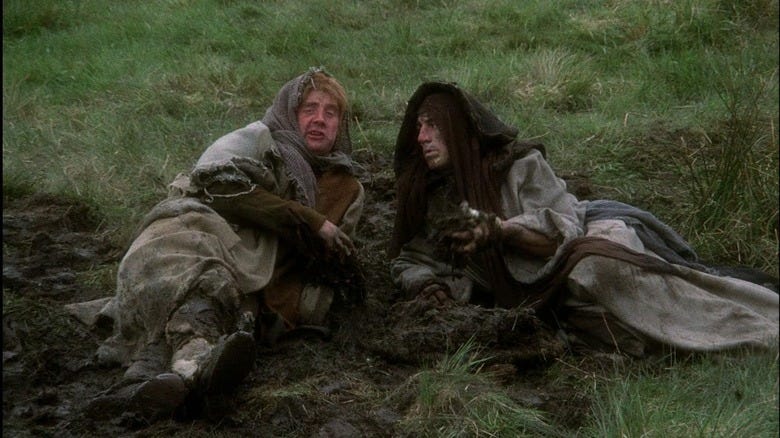
Then, of course, there’s the in-game Codex that regularly disgorges encyclopedic summaries of the real history from which KCD greedily draws. In the time since I last played, I’d forgotten that nearly every character who isn’t an immiserated peasant is based on an actual figure attested by genuine history. Though most such portrayals in the game itself are largely fictionalized by necessity, the simple fact of their inspirations’ reality makes the setting and its characters almost instantly engrossing. The Codex also explicates the real-world history of in-game locations, political events, and several dozen concepts of early-fifteenth-century society as it was in medieval Bohemia. More games ought to have something like this.
In light of all this, protagonist and player character Henry of Skalitz works pretty well in his capacity as audience POV. He’s of humble origins but has outsized aspirations for a man of his lowly station, as one would expect of a medieval RPG protagonist. This gives him license to explore and discover feudal Bohemia in parallel with the player, and the story does a great job of manufacturing interesting social and political developments in which Henry can involve himself. Generally speaking, the writers did a terrific job at coming up with thrilling sequences without crossing into utter implausibility (a bibulous night with a priest and the following morning’s aftermath stand out in my memory). The player is also, with a few notable exceptions, relatively free to decide how Henry approaches his various tribulations. I’ve already realized in my first few hours back that I’d previously underrated the extent of the player’s freedom in this regard.
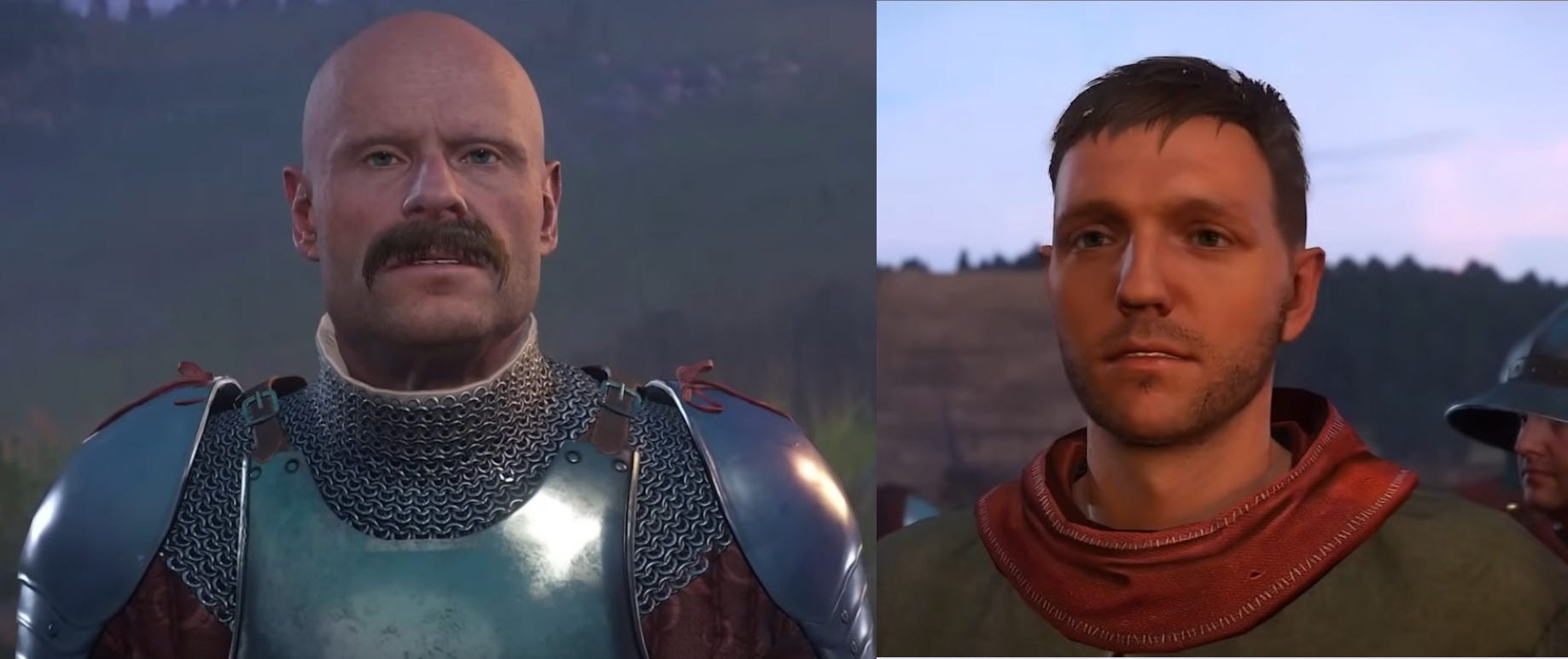
I also want to shout out the hard work that went into the game’s central antagonists (as I understand them having not yet finished the game), i.e., the Cuman mercenaries under the employ of Sigismund of Luxembourg. Their sudden attack on Skalitz in the game’s first hour is nothing short of harrowing, giving a frightfully realistic impression of medieval warfare unconstrained by law or norms. As they chase a shell-shocked Henry from the ruins of his home, they shout commands and hurl abuse in Hungarian which, although I understand they historically spoke a Kipchak dialect, is a terrifyingly effective flourish. The character of Markvart von Aulitz, fictionalized somewhat from a historical equivalent in Markvart z Úlic, is a suitably intimidating foe whose first proper introduction outside Talmberg damn near had me shivering.
So, if I consider KCD an unmatched work of ludonarrative historical fiction with high-tier writing, memorable characters, and a deeply engrossing setting, then why did I throw it to the curb back in 2018? Brace yourself for some recriminations for now — I’ll circle back around to my generally positive impression afterwards.
WHAT I HATED
We might as well begin with the final straw that made me rage-quit and uninstall KCD back in 2018, because it neatly encapsulates every major problem I had with the experience. This probably counts as a mild plot spoiler, so feel free to skip over the next paragraph if you’ve also been obstinately putting off a full playthrough for the past seven years.
After a dozen or so hours of exploration and historically inflected roleplay, Bohemian in more ways than one, Henry participates in an assault on a fortified holding, which is ultimately successful in capitulating the defense. This took me several tries on account of my relatively low stats and general disaffection with the combat, to which I’ll return shortly. The sequence ends when Henry identifies the bandit — a thick, towering lad called Runt — who stole a narratively important sword from him after crushing his skull and nearly killing him about an hour into the story. Henry, who until this point had shown little predilection toward grand displays of suicidal machismo, decides to fight Runt mano-a-mano on the latter’s terms in a narrow, enclosed arena without any help whatsoever from his many allies.
I’ll not mince words: that the game railroads you into open combat with such a formidable opponent regardless of your build or your decisions up to that point is straight-up bizarre, especially given how comparatively open-ended the game postures itself. It comes across as short-sighted and player-antagonistic in the same way as Deus Ex: Human Revolution’s execrable boss fights. I spent nearly an hour and a half trying everything to beat this goddamned boss… I tried carefully parrying his attacks, baiting them out and whittling him down with quick stabs, and even cheesing him with arrows. Nothing worked. I googled and re-googled the fight in search of strategy, but found only similarly despondent players who also hadn’t thought to build their willowy teenage protagonist into a violent killing machine. I eventually decided that the fight was impossible for my build and, not wanting to start a whole new game from scratch just for a better chance at this one miserable boss encounter, gave the hell up. I’m still a little bitter about it.
I mentioned that this admittedly emotional anecdote neatly encapsulated everything I disliked about KCD, so let me try to enumerate what precisely I meant (in no particular order):
Henry’s mercurial personality makes him difficult to roleplay
There’s an overcommitment to realism that hampers the “G” part of “RPG”
The combat system is
total dogshitconspicuously imperfect
Let’s consider these one by one.
I’ll begin with the protagonist himself. Straight talk only: Henry’s one weird fucker. Sometimes, he’s utterly constrained by his sense of chivalric duty, by his Christian morals, or by some combination of the two — this is why the story forces him back to Skalitz even as everyone around him calls him a dumbass for so desiring. Other times, he’s a cynical opportunist who desecrates graves, crashes out at noble lords, and speaks heresy from a pulpit. This is why his decision to 1v1 Runt in a private lobby regardless of the player’s decisions is so mind-boggling. At least for me, the inconsistency and unpredictability of Henry’s character creates a distance between us that makes him very difficult to properly inhabit.
If you’ve read my analysis of how “realism” is variably understood in game design, then you know I have a low opinion of realism for realism’s sake. KCD has some really cool ideas in its approach to verisimilitude2, but said approach is inconsistently applied and occasionally outright disastrous. Worst of all is the limited save system that’s baked into the game even on the non-hardcore difficulty — you can only manually save the game from “owned beds,” itself a confusing and inconsistently applied term, or by using a rare and expensive item. I understand and appreciate what Warhorse was trying to do: they want players to take the adventure very seriously and to live with the consequences of their decisions, which is fair enough. And were this system relegated strictly to the hardcore mode, I wouldn’t care at all. But it isn’t, and this creates a pair of intractable problems that spoiled the experience for me on my first go:
In addition to your major decisions, you also have to live with untelegraphed or straight-up buggy antagonisms on the game’s part
The rarity of the special save tokens discourages new players from using them at all (“I might need these later!”), which is why I’d have had to start an entirely new game to achieve a viable build for the Runt fight3
There are a number of other quibbles I have with the approach to realism but, as I say, I don’t want this writeup to come across too hateful, so let’s just move onto the combat.
The combat system is… well, it’s actually pretty intriguing in concept. There’s a For Honor-esque mechanic where you change attack angles by moving your cursor, complete with chain-attacks, feints, and timed parries. Your vision is obscured by certain helmets, you get no aiming reticle when firing a bow, you can’t heal mid-battle, and your maximum stamina is reduced as you take damage. Warhorse’s vision is obvious and, to at least some extent, laudable: KCD wants to realistically present medieval combat as plodding but lethal, and it wants the player (who, after all, is roleplaying a lanky peasant boy) to feel threatened by most encounters. Great! I’ve got no problem with that mission statement.
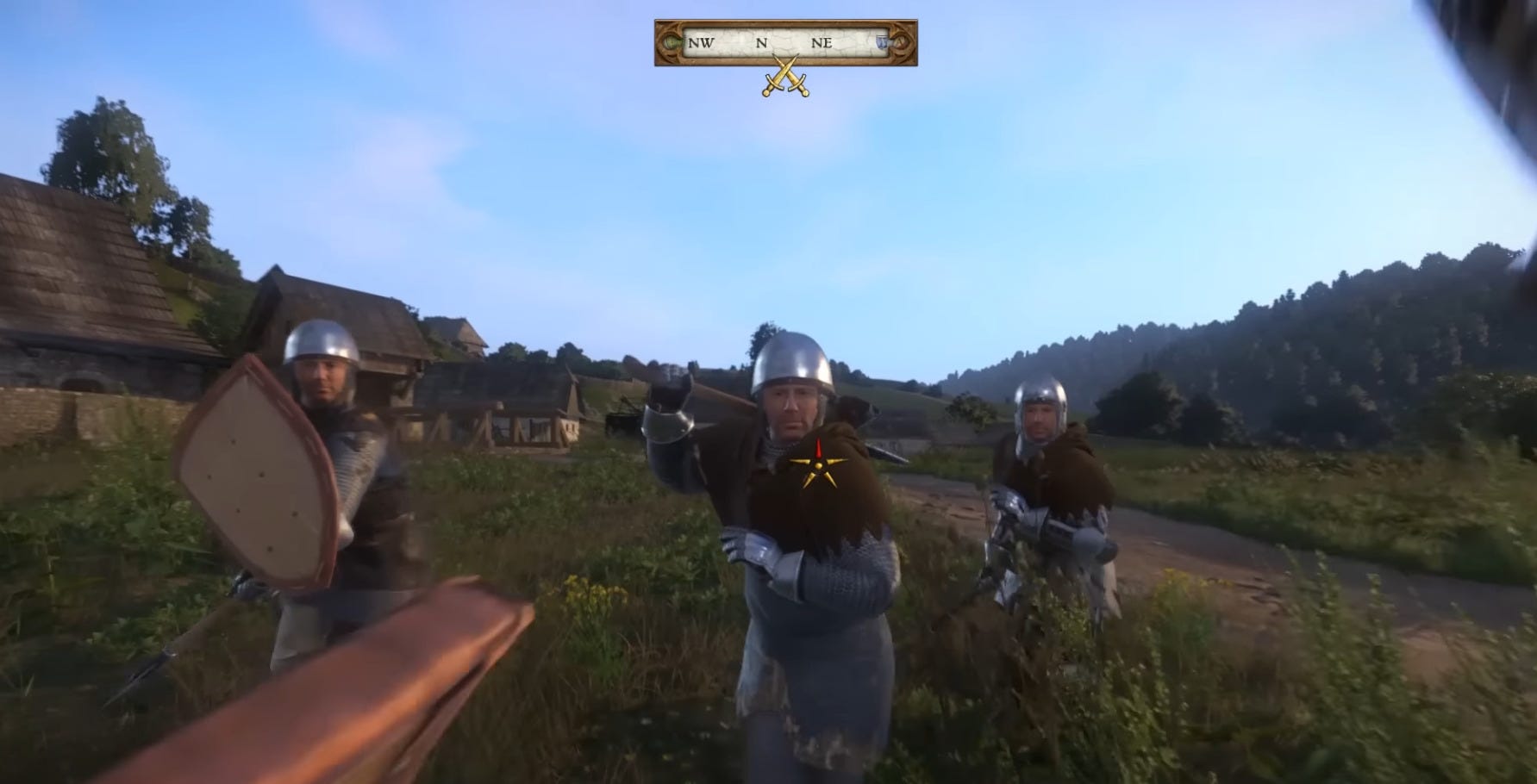
In execution, however, I just don’t think it comes together. I’m resisting the urge to condemn it outright or to pass final judgement, since I’ve yet to make it very far into the game and expect that the combat will feel different (and perhaps even satisfying?) once I’ve got a half-decent character sheet. But some of this shit is just bananas. Henry’s animations lag behind the player’s inputs such that the controls feel unresponsive. It’s weird that I have to pick out a distinct bit of texturing on my bow to use as a reference in lieu of a crosshair. It’s infuriating to swing at an enemy whose guard appears to be down only for him to grab Henry by the ears and knee him in the face. It all makes me wonder whether Warhorse could’ve more successfully realized their vision by just ripping off Skyrim or by giving up on real-time combat altogether. Probably not, but these aren’t the sorts of questions you want your players asking themselves while they’re supposed to be enjoying a heart-pounding melee.
Alright, thanks for putting up with all of that. It was unironically cathartic to write. Let’s move past the vitriol and talk about why I’m enjoying my new playthrough so much more.
SO WHAT’S CHANGED?
For one thing, I modded out the limited save system, and I don’t give a fuck. There’s been a mod on Nexus that disables it for nearly as long as the game’s been out, and it doesn’t even prevent you from earning Steam achievements. I tried playing without it at first because I thought I owed it to Warhorse to experience their art precisely as they intended, and then I had to do all of Talmberg over again because I broke both of Henry’s legs after stumbling over a hidden precipice on the way out. So kiss my ass, limited saving. I’ll hoard Saviour Schnapps like a prohibition-era liquor baron, and I’ll do so without guilt or fear. If any of you reading actually beat KCD on your first go with limited saves, God bless you. Feel free to brag about it in the comments, but understand that I’ll have no part in your devotional practice.
In more positive terms, I’m having a much better time because I’m making an effort to meet the game on its level. I started by taking my sweet time in Skalitz, picking herbs for a vitality bonus with which I subsequently beat Kunesh’s fat ass senseless for his disrespect. Then I flung shit at the German guy’s house after bearing false witness to his wife, got some lockpicks from a pal as a reward, and used them to break into Kunesh’s house and steal everything of value. These are the sorts of player-directed hijinks I’m looking for in a quality CRPG, and I feel slightly embarrassed for not having recognized their extent back when I first played this game.
Also, thanks to advice from the Substack gaming sphere’s proud KCD defenders, I have a stronger conception of how character progression is meant to work. Another thing I didn’t previously appreciate about this game is that its difficulty curve, while steep, strikes an uncommonly effective balance between fairness and challenge if the player commits to engaging with its progression systems. There are far more opportunities for improving your stats than I realized at first blush, even in the early game. You’ve got to seek them out and invest a fairly significant amount of time and effort, but doing so pays off in ways beyond just watching the numbers go up.
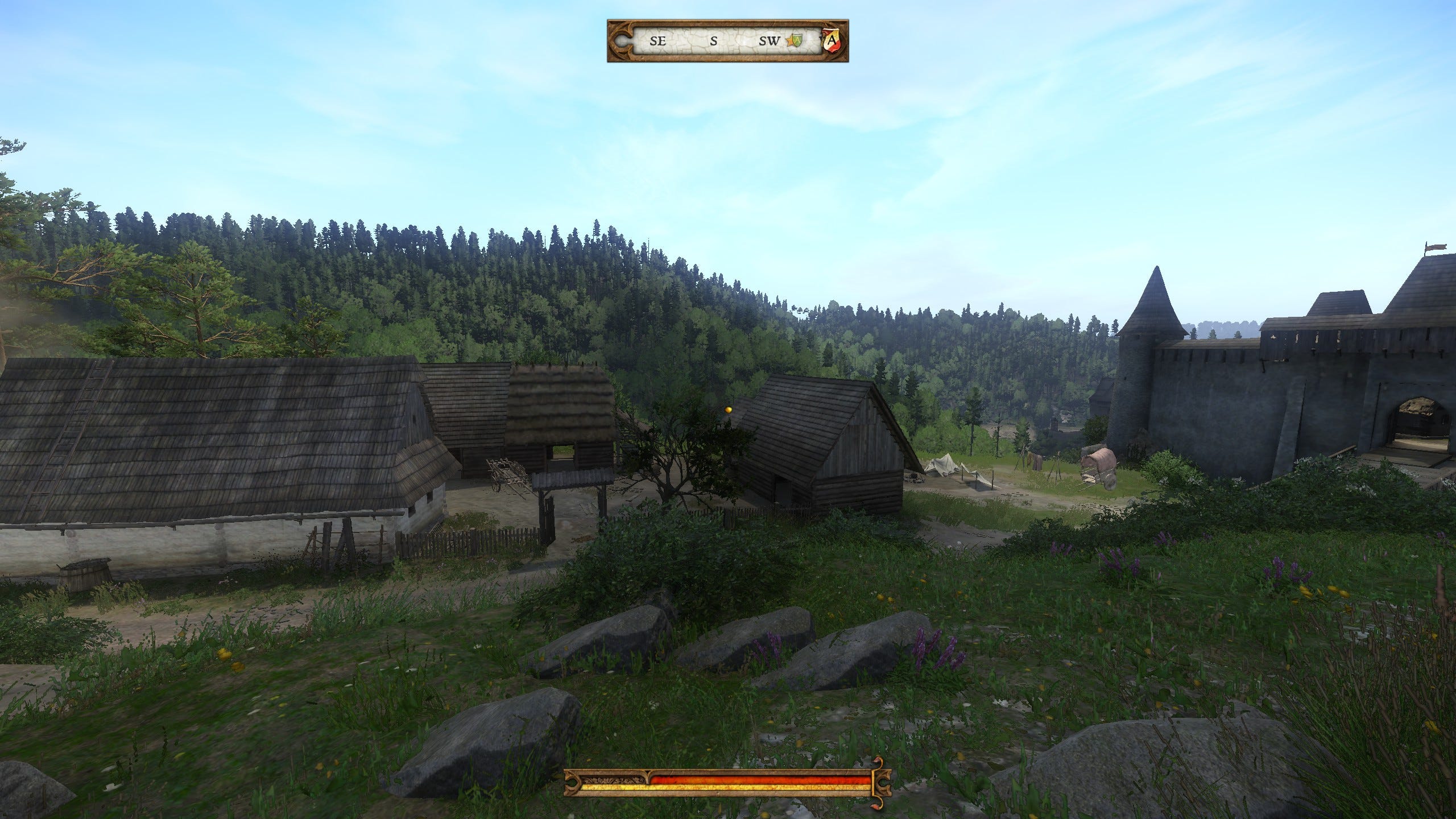
And that brings me to KCD’s brilliantly realized world. There’s a palpable reality to this vision of late-medieval Bohemia. Most characters I’ve met come across like real people with believable, sympathetic motivations. The environmental design is deeply engrossing, and I don’t think I’ve played another open-world RPG whose world is so plainly beautiful to look at. Even Henry himself is easy to root for, at least when he’s not doing the stupidest shit I ever saw in my life. I find myself repeatedly impressed by how often his reactions to the society around him mirror my own, and you know I love a good bit of ludonarrative synchronicity.
So, is Kingdom Come: Deliverance the elusive Skyrim-killer about which I speculated a few months ago? Not exactly, but that’s mostly because KCD has its own idea of how its story should be told and wants the player’s choices to act as connective tissue between a discrete set of events rather than as a story in their own right. That isn’t a criticism, by the way — The Witcher games all did the same thing, and (a couple of) those are among my favorite RPGs ever. Besides, there are several areas in which KCD exceeds and even laps the standards set by Bethesda’s best work. The characters and the world in which they live are each considerably more engrossing and dramatic than anything in Skyrim, and that’s despite the grounded and realistic style to which they’re all subject.
Anyway, this playthrough will take me a long while even without any of the DLC installed, so I’d better get back to it. Thanks to you folks who encouraged, prodded, and gently peer-pressured me into giving KCD another chance. It’s too early to tell whether or not I’ll end up adoring it after all, but I already know that this will be a valuable exercise regardless of how it goes. Stay tuned for more! I’ll probably write a review of the base game once I’m through.
Thanks for reading to the end! Where does KCD rank among the CRPGs you’ve played? Got any good anecdotes from your own adventures in late-medieval Bohemia? Tell me about it below!
Of course, anyone who’s played the first half-hour of KCD knows that all the shit is instead concentrated into exactly one setpiece encounter pertaining to a German man’s freshly whitewashed home.
A few standouts for me include: conversational partners reacting to blood and filth on Henry’s clothing; the importance of maintaining and honing your weapons; and stealth checks benefitting from dark-colored clothing and an absence of noisy armor
I’ve since discovered that there was at least one way I could’ve recovered the playthrough by reloading an old save and grinding my combat skills, but even that would’ve cost several hours
I cannot bring myself to play this game. I don’t think I’ll like the combat systems enough.
Guess who beat the whole game [twice] with the unmodded save system? That's right, this guy. You know what they say, if you ain't brewin, you ain't doin... it right.