

The Minimum Viable Wargame
Two minimalistic wargames and what they reveal about the genre’s unorthodox appeal

THE MALE URGE TO ENCIRCLE GERMANS
Regular readers know that wargames of various flavors have historically occupied a lot of the free time I could’ve spent on studying or other kinds of tangible self-improvement. There’s an irreplicable satisfaction to be had from getting one’s head around the deeply complex and baroquely interwoven systems that tend to characterize these games, and the experience of playing them can reach remarkable heights of exhilaration after one develops the requisite mastery of the mechanics. My favorite wargames and wargame-adjacent strategy titles, including such like as Shadow Empire and Europa Universalis, feature densely stat-driven combat supported by intricate simulations of economy and politics.
For the longest time, I assumed that the appeal at the heart of these military strategy games had less to do with winning engagements and everything to do with wrangling their simulations to produce desirable states in line with one’s crude fantasies of dominion. In short, my theory stipulates that, although primary gameplay revolves mostly around managing the operational tactics of your units, it’s given meaning and depth by the context surrounding it. That is, the sources of engagement in these games are the actions you take and the decisions you make that set up the circumstances under which you actually do the tactical management. Total War wouldn’t be half as engaging without the empire management to undergird and contextualize its battles, and Hearts of Iron would be thin indeed if all you did was micromanage your units along a front… right?
Perhaps, but now I’ve been given pause for thought about what martial strategy games truly need in order to create lasting player engagement. This past week, I played a pair of games that constrain themselves to comparatively meager systemic inventories: Sophie Games’ Lines of Battle, and TeaAndPython’s War of Dots. Each goes for a synthesis of engrossing and addictive core gameplay centered wholly around large-scale operational tactics, all while employing the bare minima of the genre’s base elements. Both are capable of producing transient flow states not unlike those to which EU4 et al. have accustomed me, and, most remarkably of all, the strength of those states seems inversely proportional to the mechanical complexity of the games themselves. This week, we’re going to have a look at these two ultra-streamlined wargames and see if we can’t isolate the source of their appeal.
LINES OF BATTLE (2024)
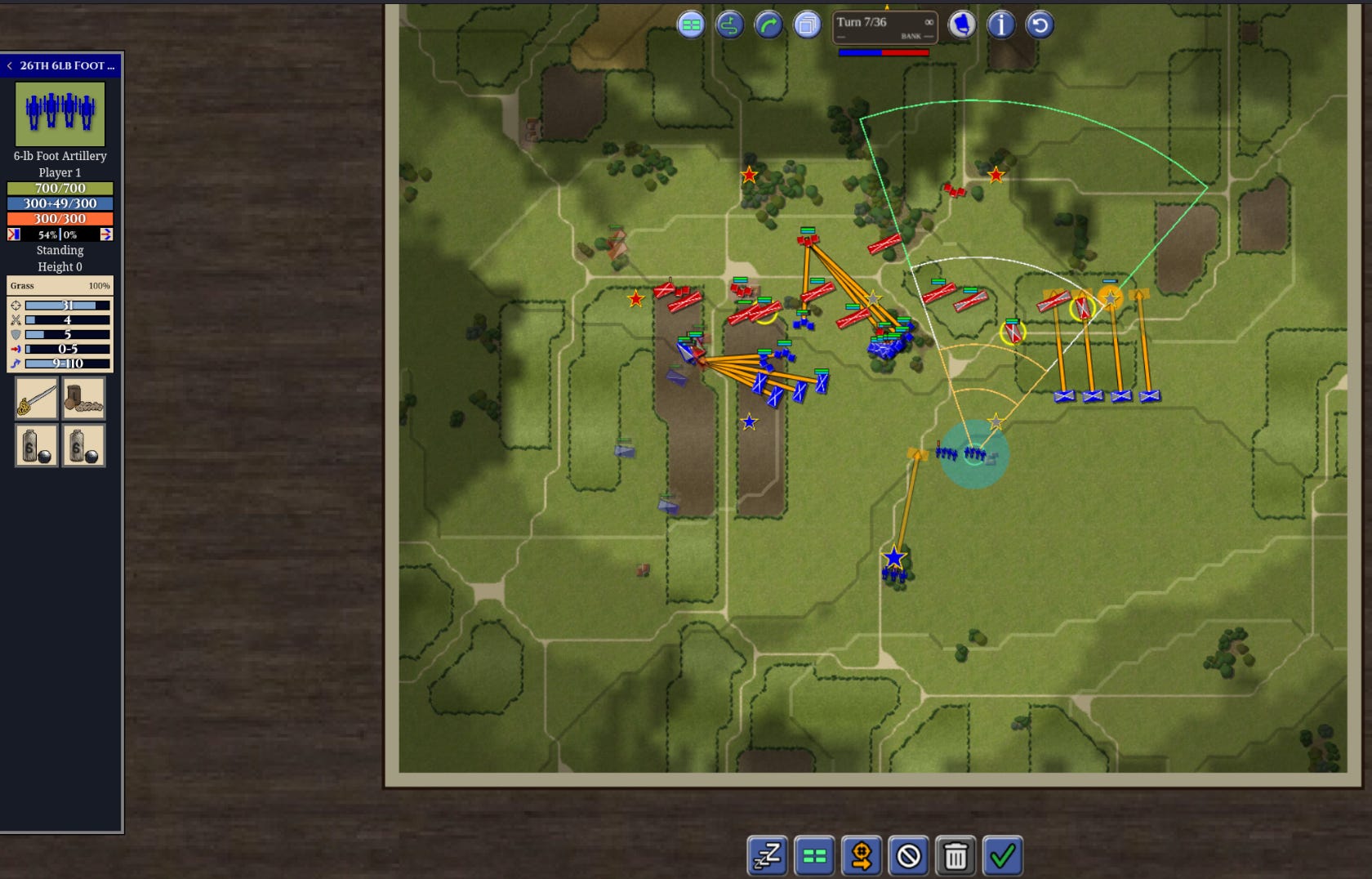
Lines of Battle by Sophie Games is a thoroughly researched and deeply tactical battle simulator with historical grounding in the Napoleonic era and a mechanical foundation with much of the Total War franchise about it. Its uniqueness lies in its stripped-back approach to presenting its tactical gameplay, which features a strictly symbolic representation of the men at your command. Representing a hundred-man unit of line infantry as a small rectangle may lack the visceral turmoil you’d get from a clash between individually modeled soldiers in a Total War game, but this means the designer’s focus can shift toward the combat simulation itself. There’s a remarkable depth to the titular battles in Lines of Battle, and an accordingly significant verisimilitude to its engagements. It’s also very easy to pick up and play, not least because its current incarnation is completely free and playable in-browser.
What really separates Lines of Battle from its game-mechanical peers in the Total War franchise, aside from the minimal presentation, is the total abdication of secondary gameplay beyond the battles themselves. There’s no campaign map, no economy, no unit recruitment, and no international diplomacy that doesn’t involve shooting notional Prussians in their notional guts. You set up individual battles and the relative strength of each side, then get thrown right in to manage your units’ movement and battlefield tactics until a victor is decided. That’s really all there is to it, and the elimination of ancillary systems means that all of the developer’s focus can be dedicated to making a great combat simulation.
The implementation thereof is built around simultaneous turns, and it works quite well. You individually assign orders to your units — various UI shortcuts make this quite efficient once you figure them out — and then press a button to confirm. Then the simulation runs for a few seconds, during which each side’s units simultaneously execute their orders. Then the simulation is again paused, and you have an opportunity to react to the evolving battlefield before running the next turn. The usual effect of this arrangement is as follows: the first few turns are very quiet and tense as your units approach the center of the field, not yet able to detect the enemy; then a couple turns will pass during which skirmishers clash with their counterparts; then you’ll hear the booming of artillery pieces as they come within range of the enemy; and finally, the infantry lines will make it to the frontline, begin firing, and turn the entire field into a chaotic, gunsmoke-blanketed hell.
On broad analysis, what Lines of Battle lacks in visceral imagery is mostly made up for by the strategic depth of the simulation. I keep comparing its battle mechanics to Total War, but the truth is that its simulation is actually deeper than what you’d find in several of those titles. That’s probably why it ultimately failed to hold my attention for very long. I eventually ran into the same psychological barrier that’s always kept me from getting properly stuck into the Total War games: I find myself managing twenty-odd individual units, each with their own individually tracked statistics, and each of those interacting with one another in frequently unintuitive ways, and the cognitive burden of accounting for all of this at the level of individual unit tactics overwhelms my desire to press on. I tend to prefer wargames that abstract away the management of individual ranks within an army, and it begs the question of how much I’d like a game in which high-level army tactics were the only thing going.
WAR OF DOTS (2026)
Then I played the matter-of-factly titled War of Dots by TeaAndPython, and that question was answered: quite a lot, actually.
War of Dots is, to put it diplomatically, one of the most unpretentiously presented games upon which I have ever laid eyes. Here, just have a look:
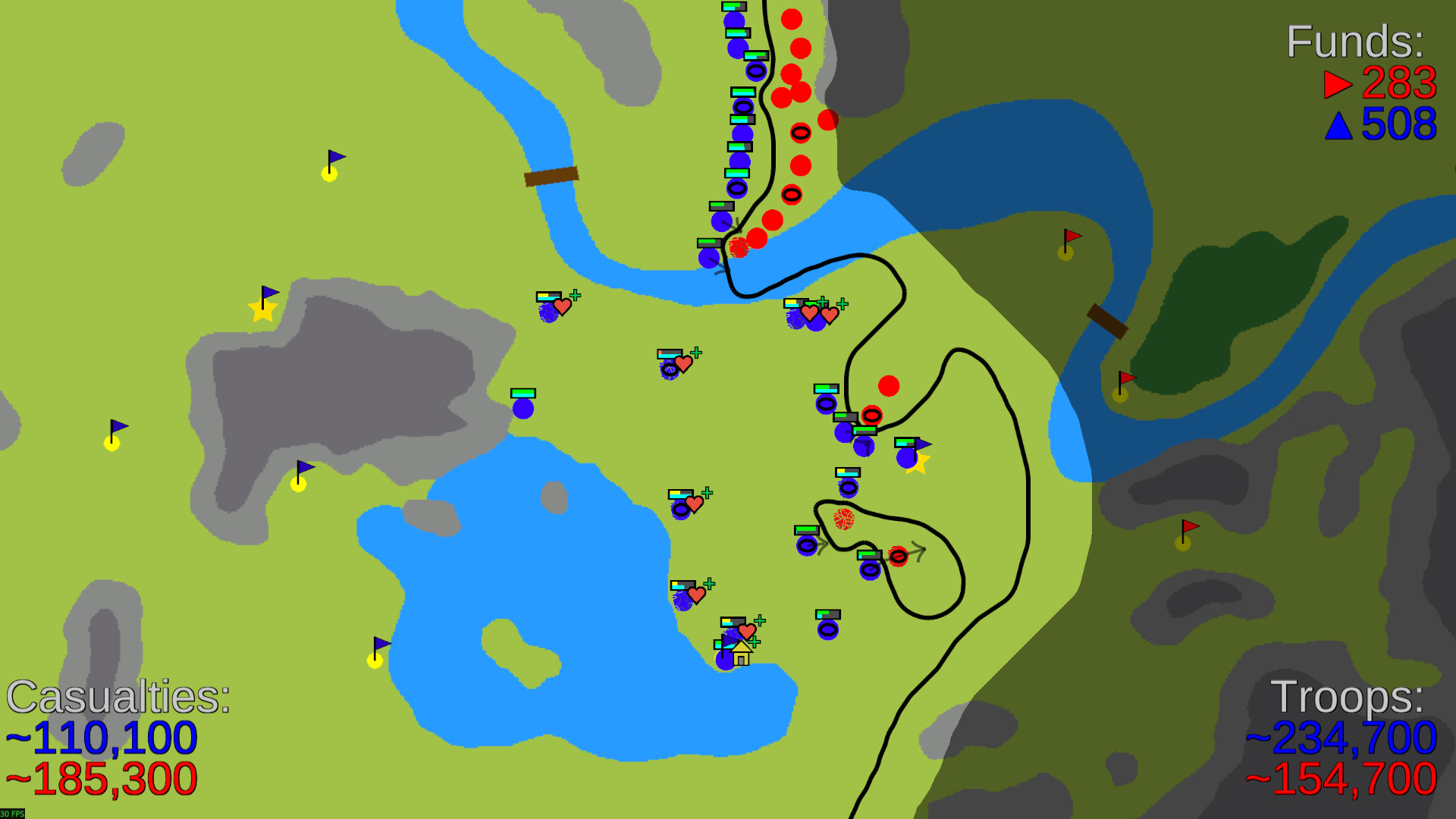
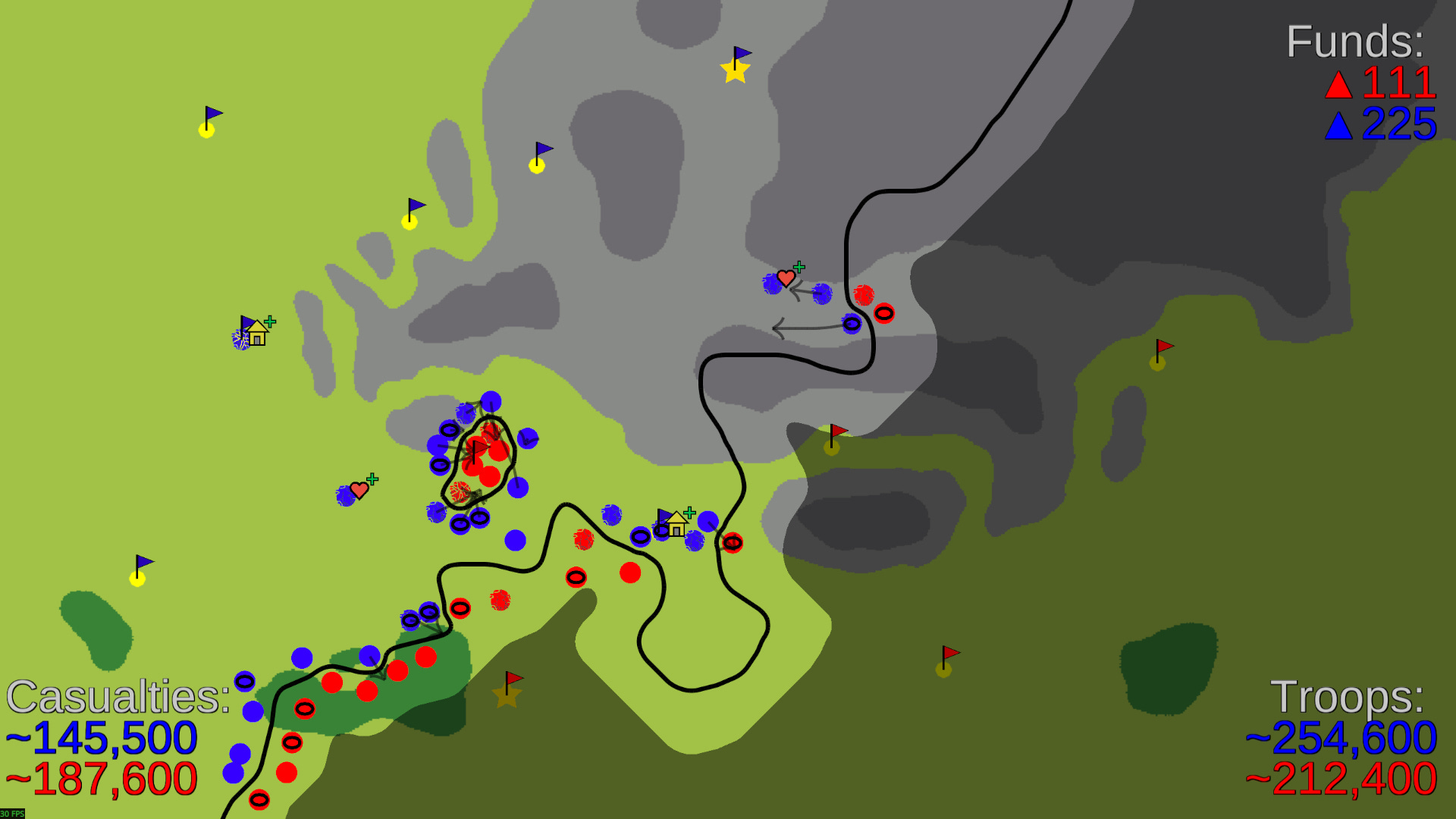
What you see in War of Dots is precisely what you get. In essence, the game revolves around managing a frontline by strategically pinning, encircling, and overwhelming enemy armies with your own. In service of this are exactly two unit types: infantry (a dot) and armor (a dot with a circle in the middle). The enemy — either other human players or a fairly capable computer opponent — will take advantage of any undefended pathway to your cities, so you’re to block their means of ingress with the bodies of your men. Attacking into a defended position is a losing proposition unless you have some kind of tactical ace up your sleeve, which causes the natural emergence of a frontline that dynamically updates as units make progress or are forced to fall back. Well-placed armor divisions can punch through infantry, which creates opportunities for encirclements that grant local superiority to the clever tactician. Any experienced player of Hearts of Iron will be familiar with the core mechanism here, and with the rush one gets from pulling it off.
What may surprise said HoI player, though, is the extent to which tactical positioning of units is foregrounded at the expense of practically every other system. Creating new units, for example, is almost entirely out of the player’s hands: you generate funds every second based on a simple formula, and new units are automatically fielded when you reach a certain threshold. Common wargaming systems such as air support, resource management, and technological progression are entirely absent. There are naval mechanics, sort of — any unit can simply move into water, and will then transform into a boat after a few seconds of uninterrupted preparation. It can then turn back into its corresponding land unit after a three-second disembarkment, opening up naval invasion as a tactical option in your arsenal without the added complexity of shipbuilding or sea-zone control.
And, I must say, the effect it achieves through this aggressive distillation of established wargaming mechanics is incredibly stimulating. Free from all ancillary considerations of economy, politics, and indeed most warmaking strategy, War of Dots brings you straight to the most dopaminergic part of an operational tactics game and lets that alone carry the entire experience. I wouldn’t have thought such a thing would work if you pitched it to me in a vacuum, but I can’t deny that it does. Startlingly, the feeling of perverse glee I feel after completing a nutty encirclement doesn’t seem appreciably dampened by the lack of broader strategic context around it. This realization forced me to reconsider what exactly draws me to wargames in the first place, and that’s what I’d like to think over for the rest of this installment.
THE LIZARD-BRAIN APPEAL OF WARGAMING
Wargames certainly support a power fantasy of sorts, but they’re distinct from the workaday power fantasies to which popular media has acclimated us. It’s not like Gears of War or Doom or Warhammer 40,000: Space Marine, in which you enjoy the fantasy of embodying a single warrior who can individually slaughter hundreds of foes. Instead, one enjoys the fantasy of sending very ordinary people to die in their thousands in service of one’s whims, however arbitrary those may or may not be.
No, these games are power fantasies in the Machiavellian sense of “power.” They might be more accurately termed something like “control fantasies” in which you’re given a fanciful degree of influence over the wills of your subjects and can shape whole societies in accordance with your desires. Some games of this ilk, perhaps most notably Hearts of Iron IV, are all but constructed around that fanciful influence — you can decide, essentially by fiat, to install a fascist regime in Canada or a democratic republic in Nazi Germany, and the game will not only accommodate you but give you tools to directly facilitate it. It might even offer to sell you a DLC flavor-pack to lend the fantasy a veneer of groundedness. Of course, these mechanics are ultimately secondary to the large-scale combat simulations that give the wargaming genre its name and its core identity, and the real control fantasy is in commanding men and resources in the theater of battle.
After all, what greater power fantasy could there be than that of commanding hundreds of thousands of men to march into the line of enemy fire and have them obey without hesitation? The Doomslayer might kill a few thousand demons of hell throughout the campaign of a given Doom sequel, but that pales in comparison to the blood spilt at the command of an empowered military strategist. It’s the manipulation of wills not in service of constructive, political ends, but toward the deconstruction of an order that would impede those ends. It operates on a cathartic principle of dominance and is enhanced by the satisfaction inherent to overcoming an intellectual challenge. It just so happens that the intellectual challenge in question is that of maximally efficient slaughter.
Of course, there’s a balance to be struck. To inure oneself to killing is bad for the soul, and, in my opinion, the best wargames don’t allow the player to lose sight of the human cost of their actions. Shadow Empire is my favorite in the genre precisely because every casualty is reflected not just in his unit’s reduced combat readiness stats, but also in the attitudes of your non-combatant citizens back home. Even War of Dots, for all its presentational streamlining, will still play the sound of a man screaming in agony from time to time as the battle rages. A minor flourish, to be sure, but it’s enough to keep one’s experience from degenerating into a thoughtless exercise of limitless power. The most empowering wargaming fantasy of all is also the most empowering fantasy in real-life warmaking, i.e., to realize peace while spilling as little blood as possible.
Thanks so much for reading to the end. If you’re a fan of strategy games where operational tactics are paramount, then the two games we discussed this week are easy recommendations. Both are free. Lines of Battle is playable in-browser with a Steam version forthcoming, and War of Dots is a free download on Steam. If you’ve only got time for one, make it War of Dots — I think it exhibits the better ratio of complexity to enjoyability. Let me know in the comments if you give or have given either of these a try.
Before we close out, a quick update on the publication. First, the good news: at over 200 Subscribers, The Spieler continues its trend of steady growth, and my confidence in our shared project — that of enhancing the dignity of game design as a modern artform — remains high. Now, the other news: between looking for work in a dreadfully shitty job market and scraping together a few dozen billable hours in contract work here and there, I’ve got less time than ever to invest back into the publication and growth has palpably slowed relative to past trends.
This is obviously a consequence of how little time I’ve spent on self-promotion and engagement with the broader games-writing ecosystem, and getting a handle on that is a near-term priority of mine. I considered dropping back to a bi-weekly publishing cadence, but I’ve really come to value the structure I get from putting these newsletters out each week. On the other hand, I think the average quality of my work over the past several weeks has suffered somewhat from my petty insistence on dropping a 2,500-word essay each week even while my time for doing so is limited. A compromise, then: going forward, I’m going to publish longer-form work every other week and shorter-form musings on individual games in between. It’ll be a great excuse to finally begin working through my veritable CVS receipt of games I’ve been meaning to write about.
Looking forward to the next chapter! Thanks again for reading, and I’ll see ya next week.
if you’re interested in rts game design (especially weird innovative minimalist stuff) i definitely recommend checking out “Echoes of the Architects”. its lacking some depth, but its a very fascinating concept for a game