

Humanity is the Best Horror Game Monster
Iron Lung (2022) and how great horror reflects contemporary neuroses

CALL ME FISHMEAL
It’s hard to write effective horror these days for the same reason it’s hard to write effective satire. Just as The Onion struggles lately to invent headlines more asinine or ribald than the world it satirizes, it takes real skill to invent a horror scenario that breaks through the nightmarish discontent to which we’ve all been forcibly inured. I suppose that goes some way toward explaining the state of horror cinema, and why horror films that aren’t legacy IP reboots or gimmicky trash produced for D-tier streaming services are pretty thin on the ground.
Video games, meanwhile, have exhibited the opposite problem for years now. Since anybody with a hundred bucks and a tax ID can list a game on Steam, and because horror games require little in the way of mechanical sophistication relative to most other genres, the market is absolutely sodden with low-effort dreck that takes “horror” to mean “waving a spindly 3D model in your face while saturating your eardrums with shrieking noises.” I guess this was the natural destination for the genre after Five Nights at Freddy’s transitioned from plucky experiment to billion-dollar multimedia franchise, thereby spawning an entire generation of slop-raking Unity neophytes who considered their shameless rip-offs worthy of comparable adulation.
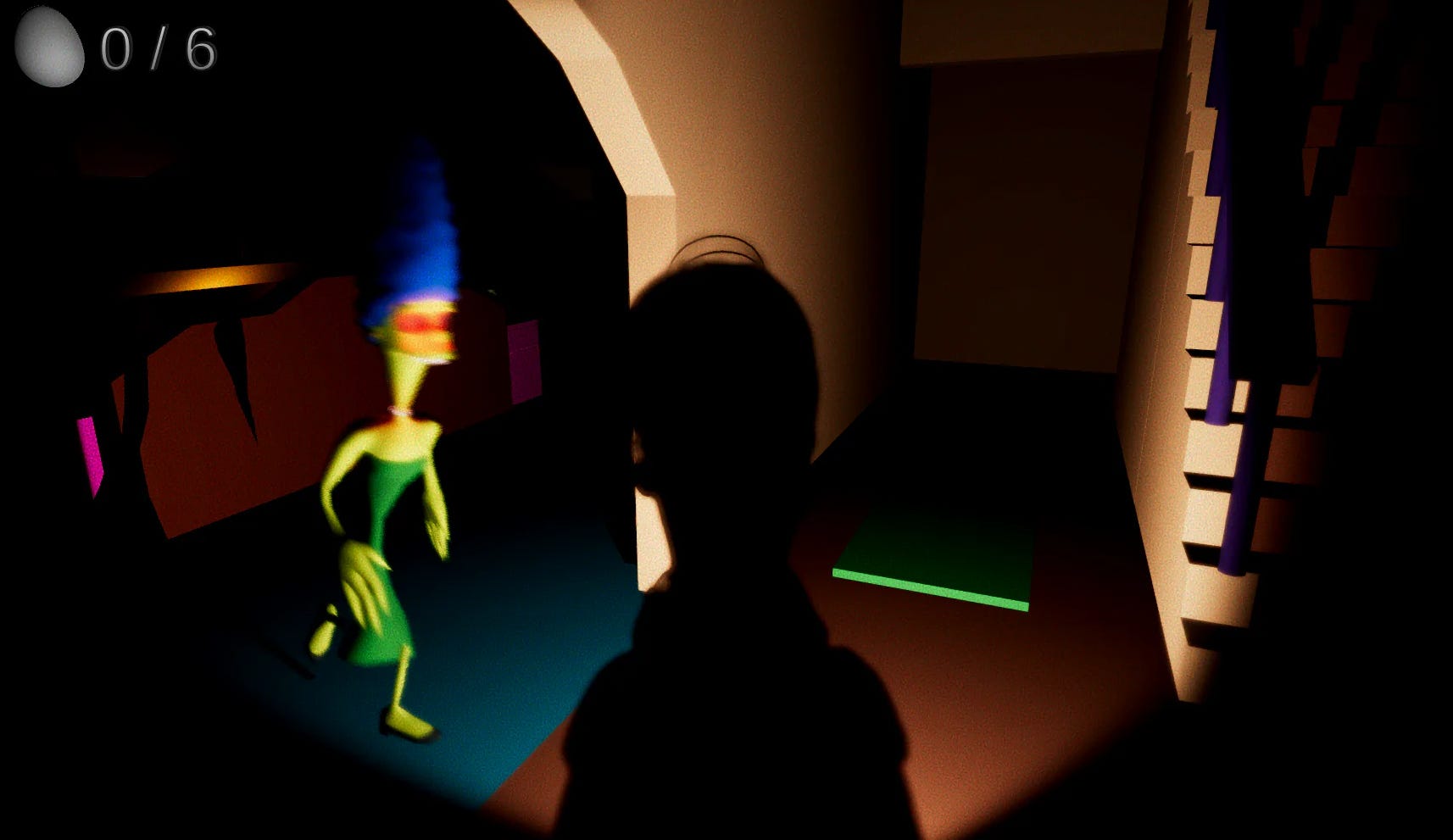
Actually, let me dwell on FNAF for a moment. If you ask me, the scariest part of the original game from 2014 (the only one I’ve played) is neither the ShowBiz Pizza Place mascots nor the gritty hovel through which they roam. Instead, I’m most frightened by the implications of the employment on which the game is premised. As a quick refresher:
It’s 1993, and you take a job as a night guard at a family pizza restaurant
You have to ration power in order to keep your safety equipment operational
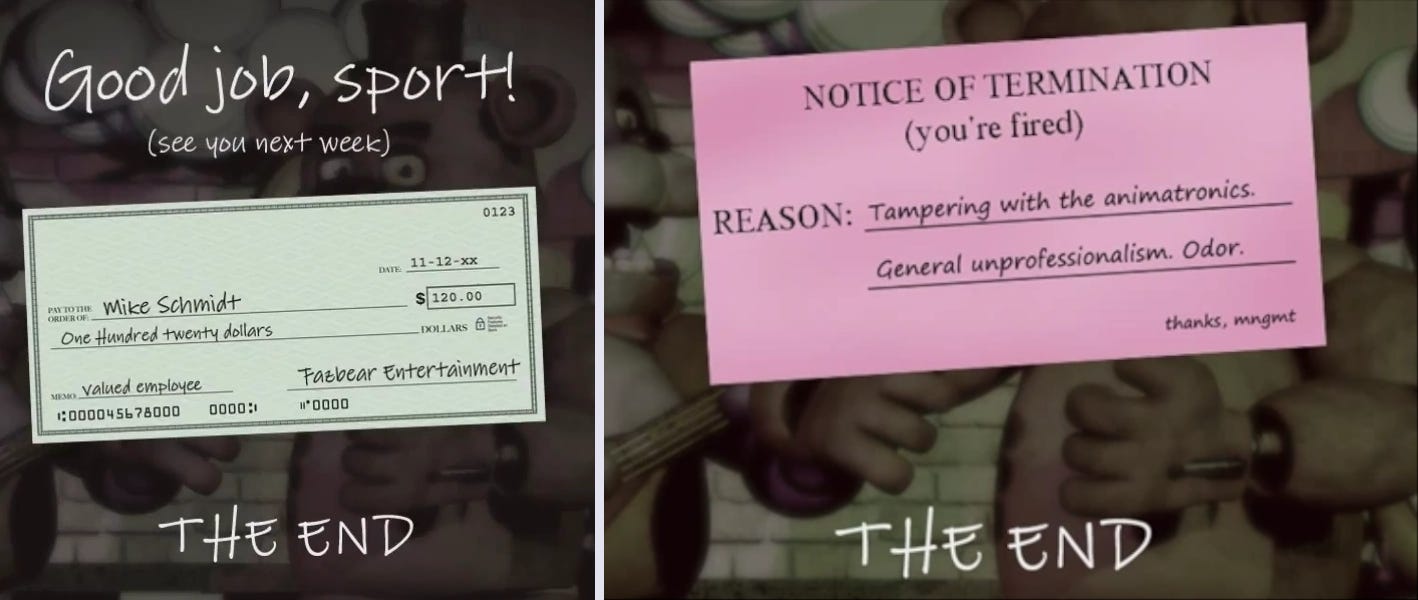
In exchange for five shifts of six hours each, you’re paid $120, or about $4/hour, or about $0.25/hour less than the federal minimum wage in 1993
If you complete the optional sixth night, you’re paid $0.50 in overtime
It makes the pay schedule at the Amazon warehouse look like utopian socialism. And yet, I almost never hear people talking about the elements of social horror that undergird FNAF and its setting. Exactly what kind of notional dystopia produced the material conditions necessary for this kind of pizza-centric exploitation of labor? Or, is the implication supposed to be that rapacious family entertainment kingpins pillage vulnerable young men under the very noses of polite society, and are continuing to do so even as we speak?
Perhaps FNAF was simply ahead of its time. It wasn’t until two-and-a-half years after its release that Jordan Peele’s Get Out and the driving hype around it brought “social thriller” back into the media lexicon. Horror like this, grounded in the cruel excesses of society and/or man’s inhumanity to man, has remained a persistent fascination of the popular culture since then. And rightfully so, I reckon. When recalling the period through which we’re now living, future generations will speak of a grand and all-encompassing conflict between the fearsome apparatus of technofeudal repression and us, its malcontented subjects. Assuming we’re not all vaporized in nuclear fire or nerve-stapled by malevolent language models before producing those future generations, anyway.
In my opinion, the most effective horror is that which holds a dim and flickering light up to our subconscious insecurities. Those can be primal and visceral in nature (e.g., getting chased around a claustrophobic space station by a xenomorph), or socially conditioned by the exigencies of a given era (e.g., getting your body stolen by a family of white suburbanites). Of course, there’s nothing stopping one from doing both.
And what better medium to capture the essence of subconscious insecurity or to interrogate our response to it than game design? To give an audience control over a protagonist in a horror game is, in effect, the assignation of the human player’s agency onto the circumstances of the game’s events. It provides a degree of tangible ownership over the emotional response to those events, and it’s a straightforward means of encouraging a player to project their own sensibilities onto the experience. Besides, the relative ease of creating and distributing video games these days gives the auteur designer a pathway to an audience that doesn’t run through the very hypercorporate machinery they so often seek to analyze or critique. So, I can hardly stay mad at the Steam Direct shit-mongers — at least trudging through that swampy mire can be counted on to bring the good stuff into sharper relief.
And speaking of swimming through effluent, this week’s subject is the 2022 horror game in which you must navigate a submersible through an ocean of human blood. It’s a game about isolation, hope in the face of despair, and claustrophobia of the highest degree. Above all, I’m not sure I can name a horror game from recent memory that gets this much mileage out of so small a budget. Let me tell you more.
IRON LUNG (2022)
In case you haven’t been keeping up with the meager handful of solo-developed horror games that’re actually worth talking about, allow me to quickly explain the premise of the cheap-ass Unity project that spawned a rabid following and several “scariest game of all time” plaudits, not to mention a 2026 film adaptation that grossed over fifty million dollars at the box office.
It’s sometime in the distant future, and a spacefaring humanity has charted the observable universe. Awhile back, every star and habitable planet known to man suddenly vanished without a trace. So too did all of humanity, save what few individuals were aboard space stations or spaceworthy vessels at the time of the so-called “Quiet Rapture.” You are one of them, a member of a militant faction of humanity’s remnants now captured and held by some other militant faction thereof. Your captors offer you your freedom in exchange for your help with a scientific endeavor: they have discovered an isolated moon, its surface entirely covered by an ocean of human blood, and they believe it may hide resources or secrets that could lead to humanity’s restoration. You’re to be sent to the bottom in a rickety submersible and there perform reconnaissance. Cross-reference an orbital scan of the ocean floor’s trench network against your instruments to navigate, and photograph each point of interest. If you capture an image of them all, you’ll earn your freedom. Supposedly.
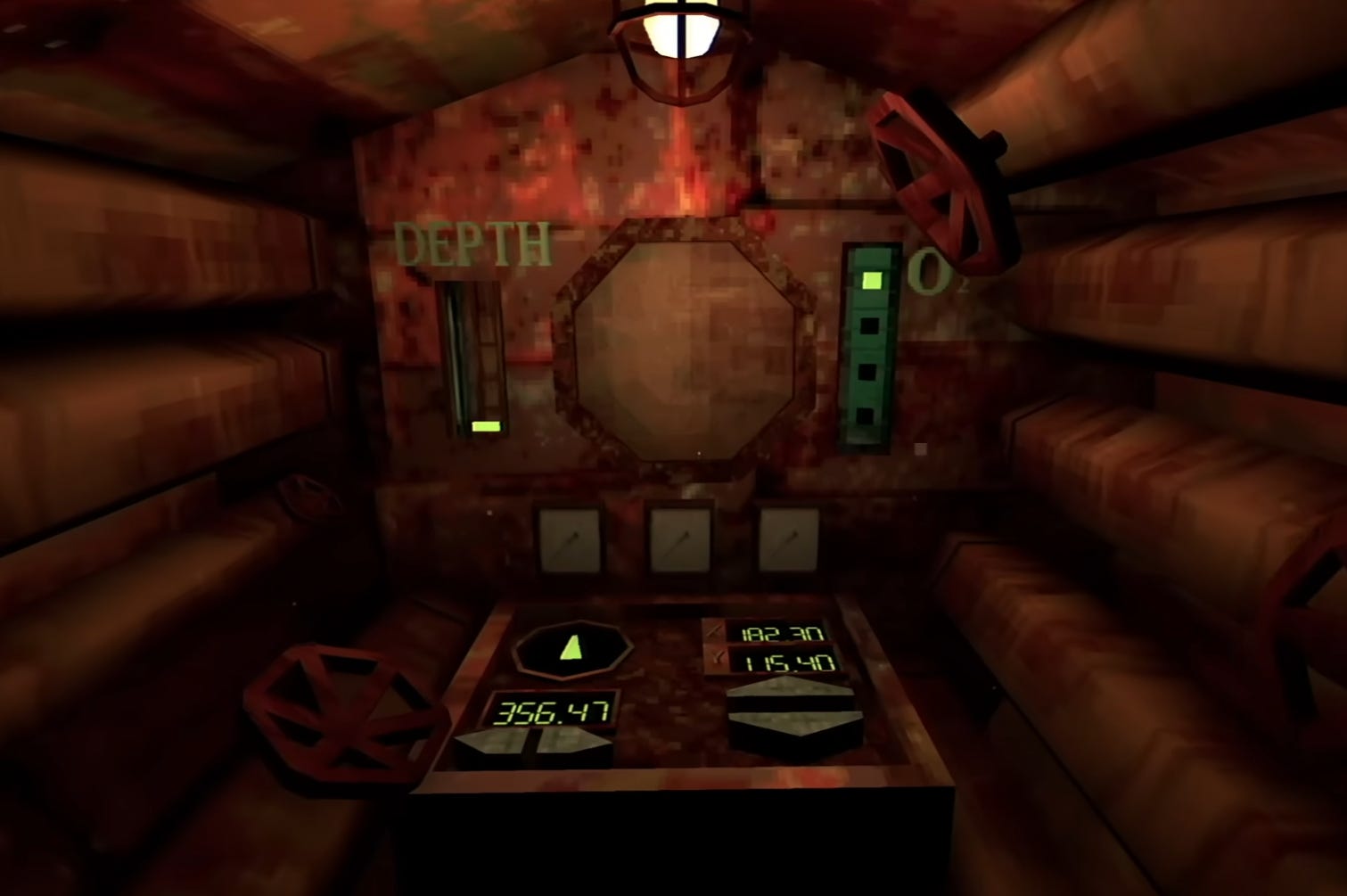
David Szymanski’s 2022 opus is by no means the most elaborate horror game ever made, but it might very well be the most efficient. That is, the effect that Iron Lung achieves on the newly exposed player is a sum dramatically greater than its parts. It’s an extremely low-tech game for 2022: aside from its scant handful of scuffed, low-fidelity assets, there’s very little going on from a standpoint of primary gameplay. Your vessel is equipped with directional controls, a simple radar system to track walls and points of interest, and a low-resolution camera that can capture monochrome images of whatever the ship is pointed at. That last bit is the lynchpin of Iron Lung’s moment-to-moment tension — your porthole is welded shut in order to better resist the high pressure, so it’s your only means of seeing outside the submersible. You press a button to take a photograph, then have to sit there for a few seconds as it renders onto a display in front of you. No spoilers just yet, but what you see in these photographs can be quite startling indeed.
But what truly separates Iron Lung from the titanic library of one-off horror games is the atmosphere around its primary gameplay, which permeates your vessel as surely as the human blood that leaks in through its quaking hull. Most notable from a presentational standpoint is the excellent and economical use of sound. As the game begins, for example, you’re given updates on your descent by a friendly voice on the radio, which fades into static as you reach cruising depth, and you’re thereafter left alone with your thoughts. The lack of music during gameplay produces an eerie, oppressive silence that hangs over the entire runtime, except during the moments when it’s punctuated by groaning steel or sparking electronics. And, shit — did something just knock against the hull from outside?
The most interesting things about the game are, I think, the story it tells to justify its premise and the parallels we can draw with our own experiences as non-space-faring folk who haven’t (yet) been raptured into the vengeful aether. Moderate spoilers ahead — if you’re into horror games but haven’t tried Iron Lung yet, go pick it up on Steam. It costs a few dollars and you can finish it in less than an hour.
For the rest of you, let’s break down the game’s true monster. My sources are the events that the game directly portrays, and the information terminal that Szymanski patched into the game to cater to sickos like me after the game exploded in popularity.
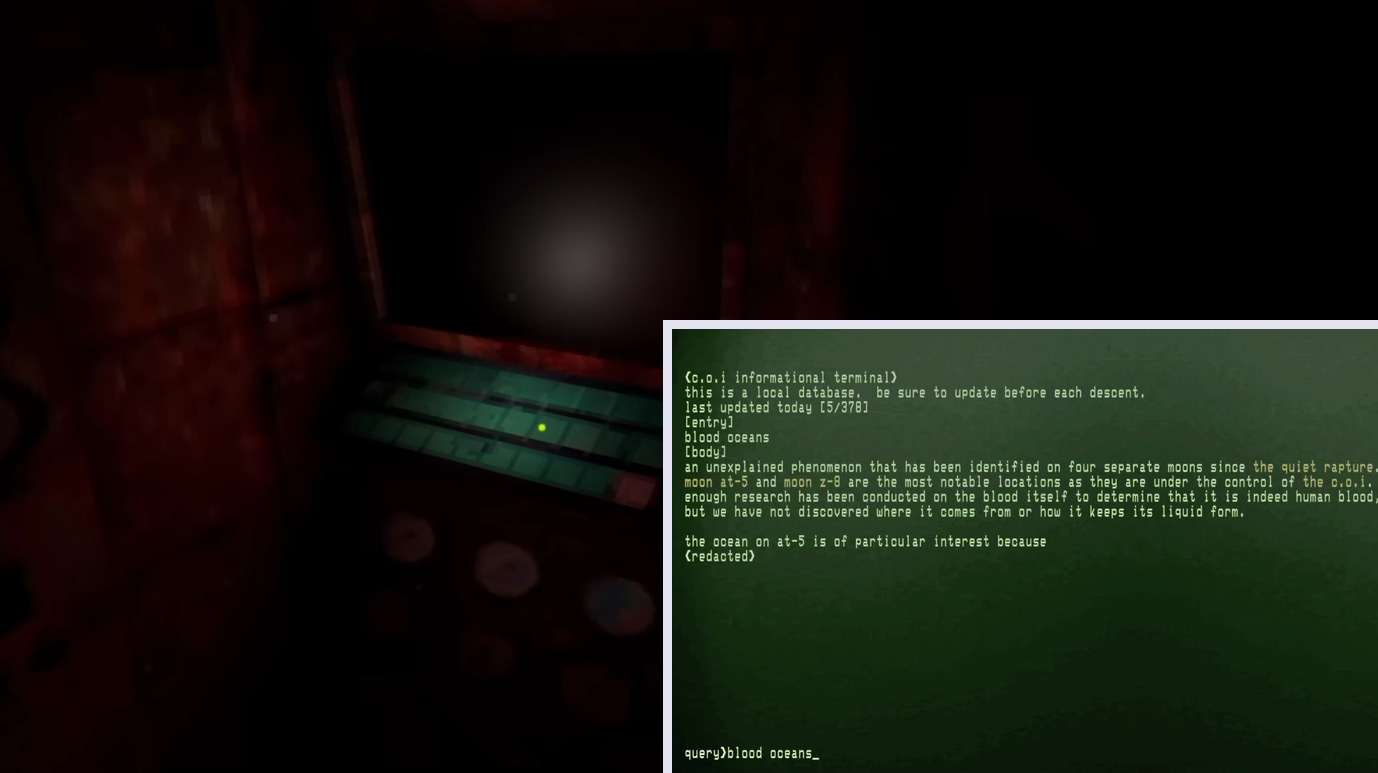
Let’s begin with the premise as it’s established when the game begins. All the universe’s stars and planets have been AWOL for decades. In the absence of planetside support, supplies are hopelessly limited and critical infrastructure is unrepairable. Even the light is running out, with only the photons still in transit from the extinguished stars left to illuminate space. All that remains of humankind are two major factions, each formed from among unraptured spaceships and a pair of stations. It does rather beg the question of why the fractional remnants of humanity should split into factions rather than unite when circumstances became so desperate, but I suspect we all know the answer already. More on that shortly.
Second, we have the narrative as it emerges in gameplay. Nearly every player will chance upon a hastily scrawled note stuffed into a corner as they wander the tiny walkable area of the submersible. Let me reproduce its most substantive portion for you:
“When they put you in here, they don’t want you to return. And even if you do, and even if they keep their promises... what freedom waits for you? A few dying ships in a sea of dead stars?
If there is still hope, it lies beyond the veil. Hope in this void is as illusionary as the starlight. I will choose to breathe my last here at the bottom of an ocean, unseen, unheard, and uncontrolled.”
Right, well, I guess it would’ve been naïve to assume generosity or magnanimity of an organization that welded us into a hunk of scrap metal and then sent us to the bottom of a blood ocean. But the most interesting part is the very end, when the note’s anonymous author makes the fateful decision to express what little agency they have left by dying of their own volition.
Hope — or lack thereof — is heavily centralized as a theme. The note above, written from the perspective of a convict who may or may not have participated in a violent attack on the expedition’s organizers, expounds the author’s absence of hope from their prison at the bottom of the sanguinary depths. What seems to push them over the edge is the realization that, even if they’re successful and subsequently freed, only misery and hardship await. It’s a coldly logical way of looking at the situation — what would lead a reasonable person to believe that any future was possible on this side of eternity?
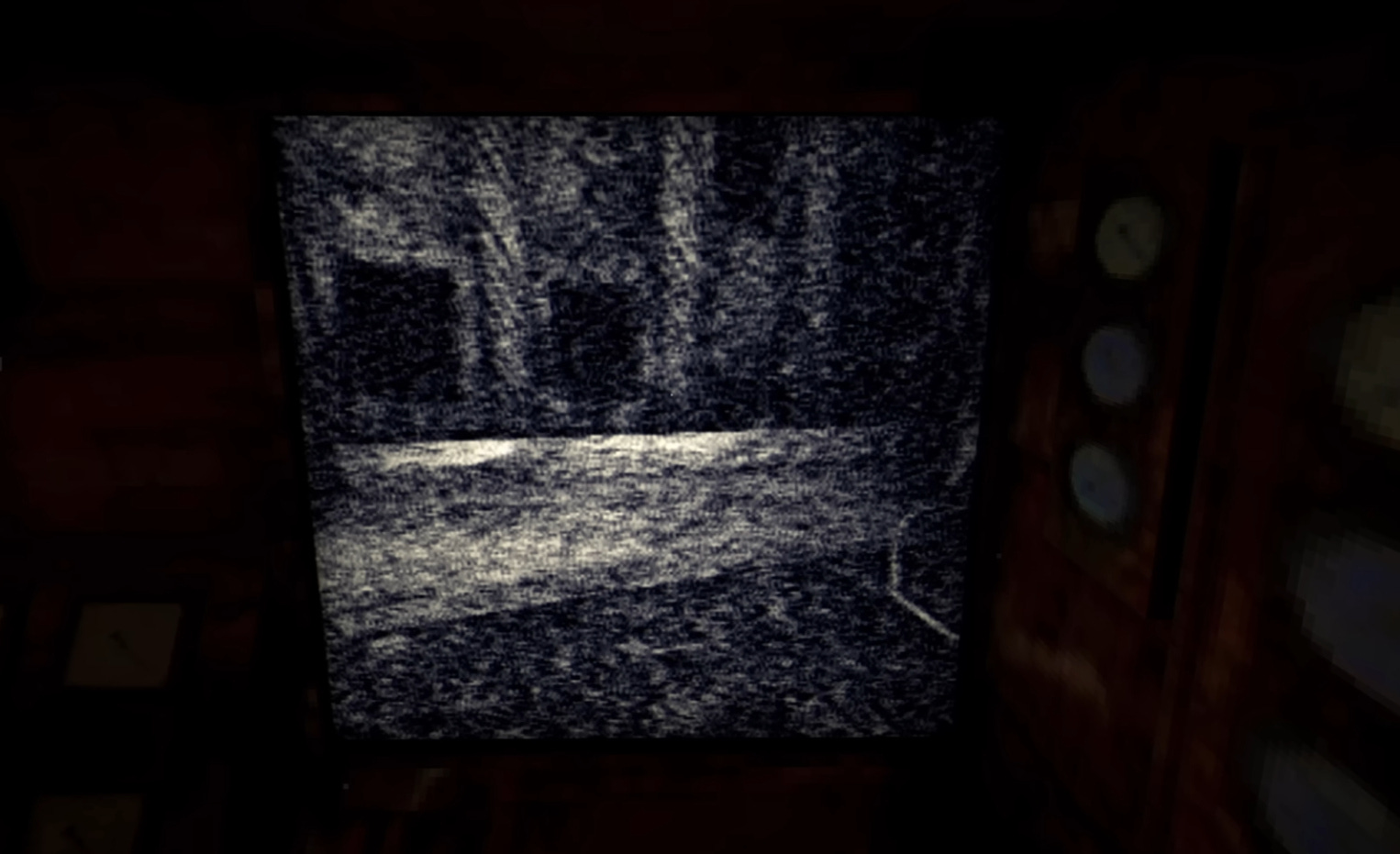
Well, strictly speaking, nothing at all. Another major theme is isolation, and the sense of hopeless fatalism that often accompanies it. Iron Lung feels very much like a game of the pandemic era, and I don’t think it’s much of a stretch to read its fiction as a metaphor for the deleterious effects that isolation had on us as individuals and our broader communities and societies, many left unprocessed and unresolved to this day.
Overcoming the despair of isolation at its darkest depths calls for radical volition and resolve, and we get a last-ditch manifestation of that from the expedition’s organizers themselves, in whose voice the text crawl at the end is written. Again, I’ll reproduce the important part without spoiling the whole-ass ending:
“The stars shine pale as bones. The moon is a lifeless corpse, its ocean a gaping wound. The universe… what’s left of it… is dying.
But somewhere in the void, there must be hope…”
Note well the verbiage in that final line. There must be hope, but it’s not to be obtained from any of the usual sources. In desperate situations, human beings have traditionally turned to faith in one another as the principal driver of precious hope: solidarity from mutual struggles; communitarianism; shared belief in better circumstances; and so on. In Iron Lung, however, any possibility of such anthropogenic optimism is entirely discounted. Where must there be hope? Somewhere in the void. “Void,” of course, implies a total lack of any material thing, so this obstinate declaration doesn’t exactly hold water as a logical argument for hope. Maybe that angry prisoner was onto something.
And this is where I’ll once again turn to the deep-lore terminal that Szymanski saw fit to add to the game. As mentioned above, the remaining extent of humanity is ostensibly restricted to two factions. The one from which the player character is heavily implied to originate has an extant population of at most 468, and the one now detaining the player has at most 257. That’s a total of 725 humans still known to be capable of direct contact. According to the most optimistic estimates of conservational biology, there must exist a minimum of 500 “effective” (i.e., fertile, fecund, and available) individuals in a population to prevent gradual extinction caused by birth-rate depressions associated with inbreeding.
Now, I hesitate to identify subtle brilliance on the part of David Szymanski’s storycraft where none may exist. This is, after all, the man whose next high-profile project was Squirrel Stapler, a game about stapling squirrels to a human cadaver in anticipation of physically encountering God.1 But if I were to stretch my analysis just a little, I’d suggest that the two factions’ populations — each individually less than 500, but greater in sum — was a deliberate choice. It implies that, insofar as hope for humanity’s continued existence does still exist, it exists strictly in the possibility of unification and cooperation, i.e., in a rejection of isolation. So, it’s a bearish sign indeed that our knowledge of the two factions’ relationship is characterized by mortal enmity. “[We] consider [them] a threat to all collective well-being after their attack on [our] station,” reads a foreboding entry on the lore terminal. Well, shit.
As regular readers are well aware, I’m a major proponent of the artistic potential of game design and want nothing more than for video games to be understood as art objects on the level of other popular media. Accordingly, I’ve been wanting to write about Iron Lung ever since that Markiplier flick suddenly brought in a whole new audience that was happy to shell out for it. David Szymanski’s is a worthy success story — the medium grows stronger by the efforts of hardworking creatives whose work resonates with our lived experience, and Iron Lung is like a template for how to adapt horror to the insecurities of an age.2
Now, before we close out, a quick word on the film adaptation. I haven’t seen the movie yet and I’m not in any tremendous hurry to do so, but I do think it’s worth taking a look at how it was received. Like many films adapted from niche artifacts of non-cinematic media, it was a big hit with its core audience while sharply polarizing critics. Tellingly, reviews to the effect of “it’s slow-paced and more atmospheric than thrilling” recur over and over again as both praise and criticism. It’s a sign of a production that sought fidelity to the aura of its source material over wider accessibility, and that’s worth celebrating in contrast to the throwaway cash-grabs that have so often characterized video game movie adaptations.3 Compare, if you like, Five Nights at Freddy’s (film) and Five Nights at Freddy’s 2 (film), which made practically no effort to translate the ethos of the games onto the screen even as they made shitloads of money at the box office. Pushing digestible trash into theaters isn’t a viable path for improving the esteem of game design beyond the existing audience of regular gamers — that demands artistic integrity, so big shout-out to Szymanski and Markiplier for making an earnest go of it.
Alright, that’ll be it for this week. Have you played Iron Lung or any games like it that scratch a similar itch? Let me know downstairs, and I’ll see ya next week.
I’m less inclined to recommend Squirrel Stapler as a commercial product, but I’d at least suggest watching a YouTube video about it.
Incidentally, Szymanski also made DUSK, which is one of the finest boomer-shooter revivals of the past decade by my reckoning. I’m probably going to have to write about that one, too.
Fingers crossed for Zach Cregger’s forthcoming Resident Evil movie. If in fact it’s possible to make a good RE film, I reckon he’s one of the few who could credibly pull it off.
I really hate 'horror' games, and most 'horror' movies for that matter, so I haven't played too many to recommend, but I have played a very similar game, which is only maybe debatably horror, from 2018 called Scavenger SV-4 that you might enjoy. The premise is that your character is from one of a few backgrounds, with some desperate situation or personal drive that has brought them to an unsurveyed planet to retrieve artifacts from the ruins of an alien civilization to sell on the black market. You are, as you might expect, alone on a ship, in sole command of its consoles and controls, and completely isolated from any hint of human intelligence for the duration.
But there's a further hitch - the planet is so thoroughly irradiated that not only do you have to explore the surface solely with a remote-controlled rover you drop down and yank back up, the radiation prevents your control signals and camera feed from working unless you are in low enough orbit to also mildly irradiate your ship, and your self. So that explains why you have to peer at the world and its ruins through a grainy, glitchy monitor, and forces you to take frequent breaks to climb into your med-bed unit and try to purge as much of the radiation damage as you can from your body so you don't start permanently destroying your organs while looting. And the treatment becomes less efficient each time. And the ruins aren't totally quiet.
The game is tough to recommend generally because it's quite short, kind of half-baked, and leaves you wanting more that's never going to come [I think the dev has moved on from game dev entirely] but I would recommend it to you because it's very much of this vein but a lot more. I really like that you can adjust your rover's loadout on the ship to save more power for systems you actually need, and not waste time and space sending down a microphone [all you'll hear is static and wind anyway, right? ...usually] or whatever, and some of the alien artifacts can be scanned and then modified to be used as modules on the rover itself, say, to scan for more signatures of that tech on the planet. There's stuff I won't spoil [like, say, when something gets inside your rover's cargo bay of its own accord] because it's worth experiencing for yourself.