

Curb-Stomping the Bratva as a Cold Remedy
REVIEW: Mother Russia Bleeds (2016) by Le Cartel Studio

IN SOVIET RUSSIA, CRACK SMOKES YOU
Our subject for this week is somewhat more depraved than usual, so let me ease you into it with a benign anecdote. See, a few weekends ago, my wife and I took a train up to Philadelphia to celebrate our wedding anniversary. I’d never been, and my impression was largely positive: the place has developed a whole bunch of quality attractions over 350-some-odd years. What’s more, the food is terrific in both senses of the word, i.e., “extremely good” and “causing terror.” I thought I knew what to expect from cheesesteak, but I seriously underestimated the endocrine brutality of which shaved ribeye and processed cheese were capable. Maybe the sandwich weakened my immune system, or maybe Philadelphia incubates some exotic rhinoviruses to which I was previously naïve. In either case, I returned home with an absolute monster of a cold.
At times like those, when my sinuses are packed and over-the-counter cold remedies impair my consciousness, I prefer to lie in bed and while away my convalescence with a video game that requires as little higher logic as possible. That’s what led me, scrolling idly through my expansive Steam library, to install a 2016 beat-’em-up called Mother Russia Bleeds. It’s one of those games that seems to spontaneously appear in the collection of one who’s been playing PC games for the better part of three decades. I certainly don’t remember buying it. Whether it was a gift, a part of some ancient bundle, or a divinely manifested artifact that appeared before me when I most needed an idle distraction, there it sat in a list of long-neglected games.
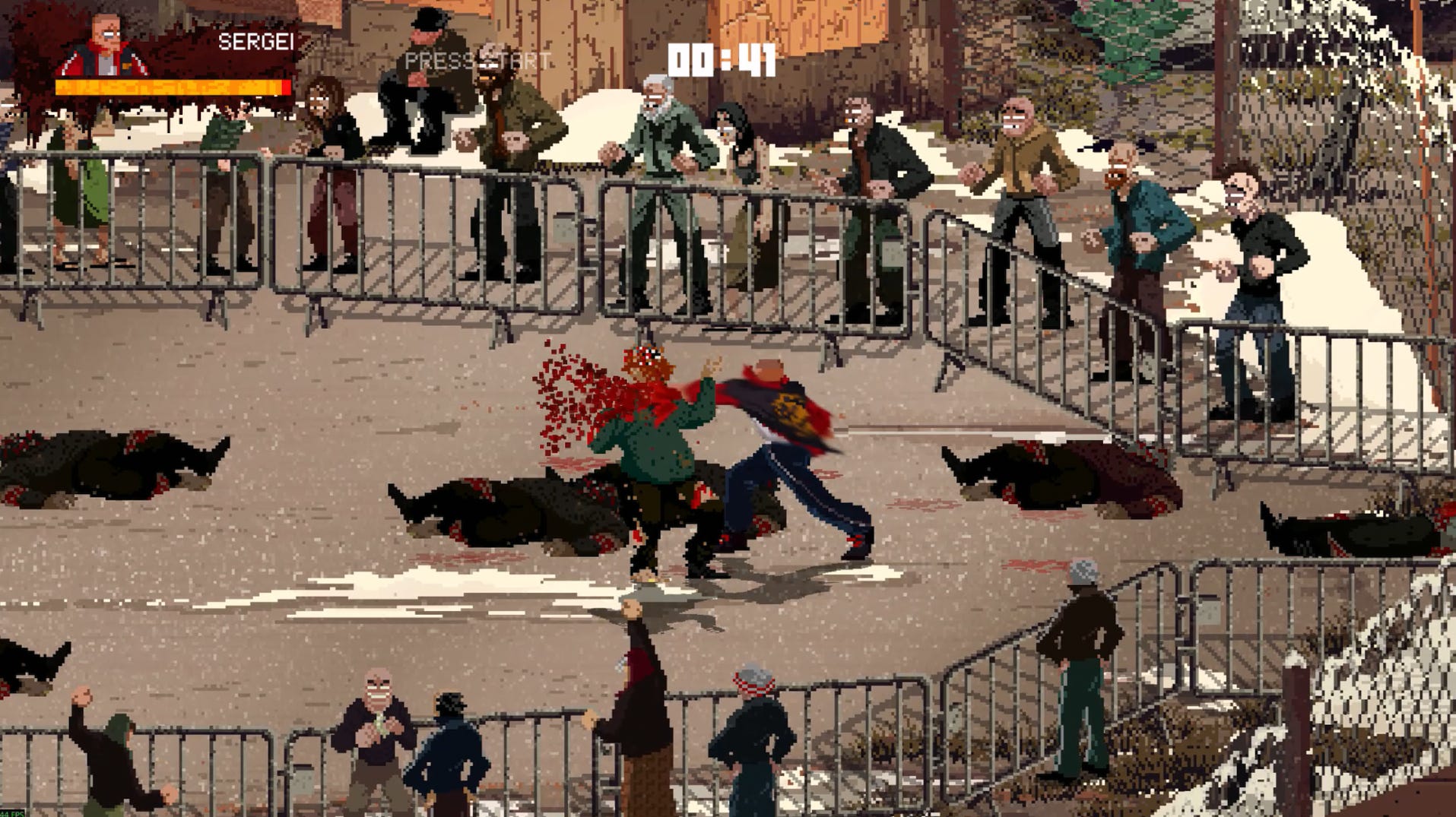
I whipped through the whole thing in a single sitting — or, more accurately, a single splaying — and was pleasantly surprised by what I found. You see, with the prominent exception of the legendary Simpsons arcade cabinet from the early nineties, I’ve never really been drawn to the sidescrolling beat-’em-up genre. I find that almost every one of them I’ve played suffers from the same aggravations that artificially limit my ability to get into the flow-state upon which their gameplay loops essentially rely, and so I’ve seldom invested much time into them. Call it a skill issue if you must, but I can’t stand how often these games go from high-octane action to plodding slog whenever you’re waiting for a knocked-down enemy to wander back into your reach from off-screen, or when you get booted into a group of toughs and beaten to death without any recourse.
Now, Mother Russia Bleeds suffers from every single one of those aggravations, which we’ll talk about later. Crucially, though, it set itself apart from genre peers by virtue of a unique permutation of the beat-’em-up formula — that of augmenting your combat abilities through narcotic abuse — and the exceptional presentation that supports it. These kept me interested enough to keep playing even as the unremarkable story and the regularly frustrating gameplay kept gnawing at my patience. I think we can learn from the design choices that kept me playing Mother Russia Bleeds all the way through credits, so that’ll be our subject for this week. I’ll start with the game’s premise, then we’ll talk gameplay and presentation, and I’ll close out with some criticisms and pertinent reflections. The story isn’t really the core of the experience, but I’ll refrain from spoiling any major plot details.
Before we get stuck in, a polite notice: the thematic core of this game is chemical addiction, and its portrayals thereof are strikingly grounded. I’ll do my best to be tactful in discussing it, but there’ll be no hard feelings if you prefer to give this subject a miss. Now, then:
THE PREMISE
The year is nineteen-eighty-something. Somewhere in a visually recognizable but temporally distinct vision of the USSR, a camp of North Russian Romani earn a hardscrabble living through violent, no-holds-barred street fighting. Their ranks populate the list of four playable characters from whom you select as the game begins — I select the impulsive and moderately built Sergei, whose jack-of-all-trades combat stats radiate first-playthrough energy. The game tutorializes its genre-standard combat mechanics by having you savagely beat a couple dozen disheveled tramps, which is postured as some kind of high-stakes prize fight.
But the day’s wholesome event calendar is suddenly interrupted when a platoon of heavily armed soldiers raid the camp, incapacitating and kidnapping the player characters.1 You come to in a dank, filthy cell, and swiftly learn that you’ve been chemically enslaved by a mysterious faction of maniacs clad in hazmat suits. The reasons behind your kidnapping are never explicitly spelled out, so I gather that this setup is largely intended to cultivate a suitably hateable antagonist. It’s pretty effective in that regard, and I had an accordingly cathartic go of slaughtering my way out of the prison-lab complex as I discovered the nature and limits of this new chemical dependency.
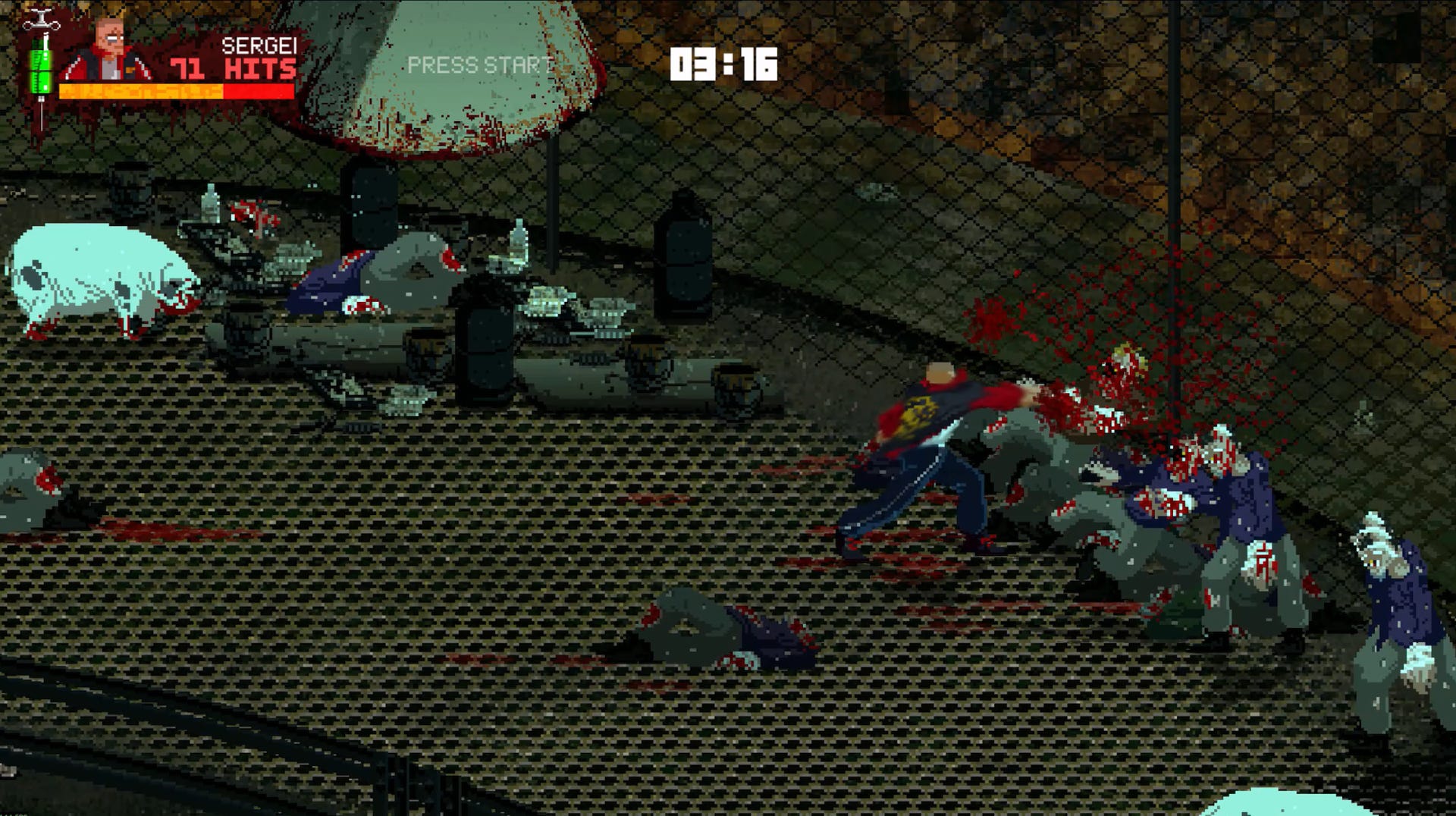
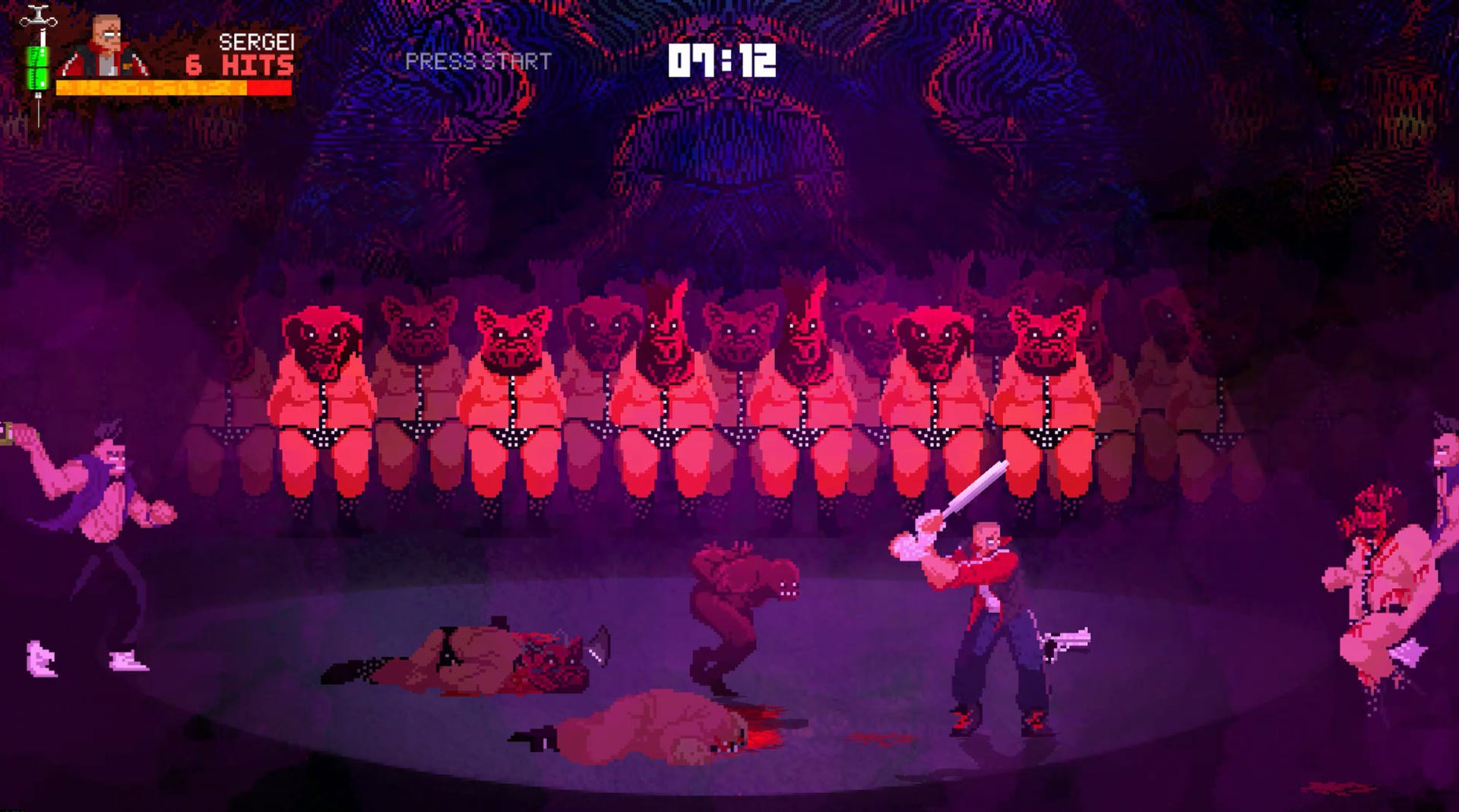
The substance in question is an enigmatic drug called “Nekro,” postured in gameplay as some kind of profoundly addictive stimulant-analgesic whose effects are indispensable in combat. Indeed, a significant proportion of your foes bear the outwardly visible signs of prolonged abuse, which is gameplay-relevant for reasons we’ll discuss shortly. The impetus for the sudden outbreak is a mysterious conspiracy between the government and the Bratva, and your character resolves to take the fight directly to those at the top, consequences be damned. Meanwhile, a faction of revolutionary Bolsheviks seeks its own revenge against the decadent state that enabled such oppression, and your extraordinary capacity for deadly violence proves crucial to their designs. What follows is a few hours of brutal revenge, appalling squalor, and a trip to a Bratva fetish club where you’re aided by a friendly gimp.
But, as with most sidescrolling brawlers, the story is not the main attraction in Mother Russia Bleeds. Its basic narrative architecture is a fairly insipid and predictable revenge thriller, but there are a couple of relatively effective plot developments that turn the proverbial screw and keep it just interesting enough that I’d say it’s worth experiencing. Keep in mind that, insofar as I recommend this game, I do so almost strictly for its cathartic primary gameplay and for the overall theming as it exists independent of the story. With that in mind, let me tell you about the experience of actually playing this game.
GAMEPLAY AND PRESENTATION
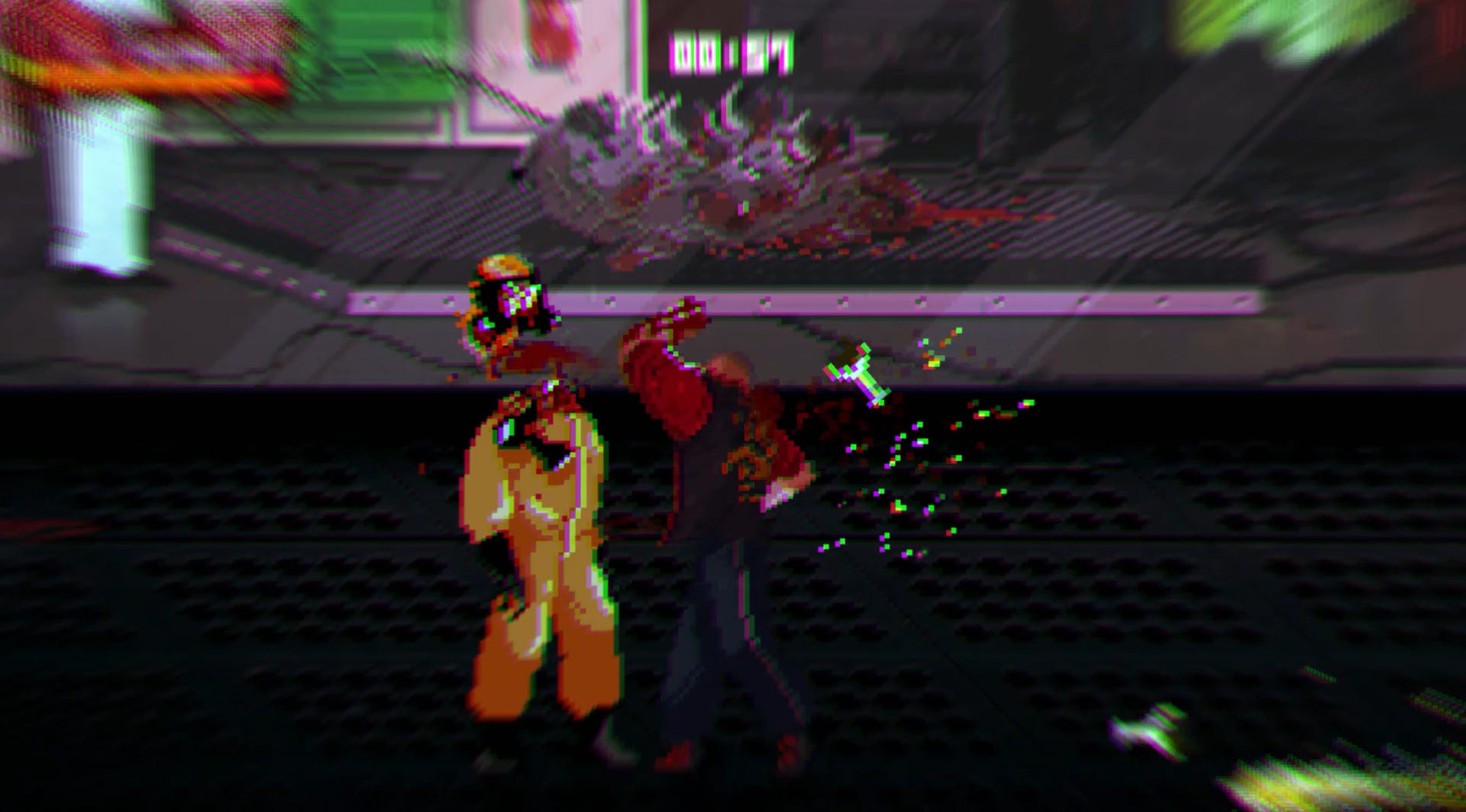
Let’s get the obvious out of the way first: if you’ve ever played a sidescrolling beat-’em-up before, then Mother Russia Bleeds will feel very familiar in most respects. You have a variety of attacks, movement abilities, and combos at your disposal for beating up the aforesaid ‘em, and can take up various environmental objects or dropped weapons to give yourself a temporary advantage over the legions of addled fiends. The moment-to-moment combat is unremarkable in game-mechanical terms, but the way it’s presented is one of MRB’s major highlights. Each hit lands with a satisfying, punchy sound effect and a gout of pixelated blood, and just about every enemy type has several variants of its sprite that reflect increasingly gruesome injury. Even better are the charged strikes, which require good positioning and timing to pull off. If you manage it, you’re rewarded with the percussive, eardrum-saturating sound of bones crunching under the force of your blow, and the hapless enemy is sent flying across the screen along with a liter or two of their spilled blood.
Relatedly, I think it’s probably accurate to call this one of the more violent games I’ve ever completed. You might think that low-res pixel art would set a fairly low ceiling for what magnitude of carnage could reasonably be represented, but I found that not to be the case. The action is vicious and occasionally downright harrowing, and the balance it strikes is one of the game’s more interesting aspects. Where a game like Hotline Miami — another pixel-art-based title about slaughtering Soviet gangsters — often trends closer to a sophomoric, Adult Swim-esque goofiness in its depictions of violence before reverting to a dissociated haze in the cold aftermath of each massacre, Mother Russia Bleeds has practically no interest in levity of any sort.
As it happens, MRB actively invites the comparison to Hotline Miami in its Steam store page description, but rather specifically to HLM’s bleakest aspects: “...somewhere between the classic style of Streets of Rage and the ultra-violence of Hotline Miami… Mother Russia Bleeds aims to conjure up anxiety, unease, and drug-addled frenzy.” Notably absent in that curated list are marketer-friendly terms like “catharsis,” “empowerment,” or indeed “fun.” This is, first and foremost, a game about the institutionally abetted suffering of a socially marginalized people and their grim descent into psychological desolation and disorderly bloodshed. Of course, none of this necessarily precludes a fun and cathartic power fantasy, and Mother Russia Bleeds is all of those things, too — the catch is that one-hundred percent of the enjoyment one gets out of this game is filtered through a dysphoric and oppressive narrative context.2 The result, when it works, is exceptionally effective.
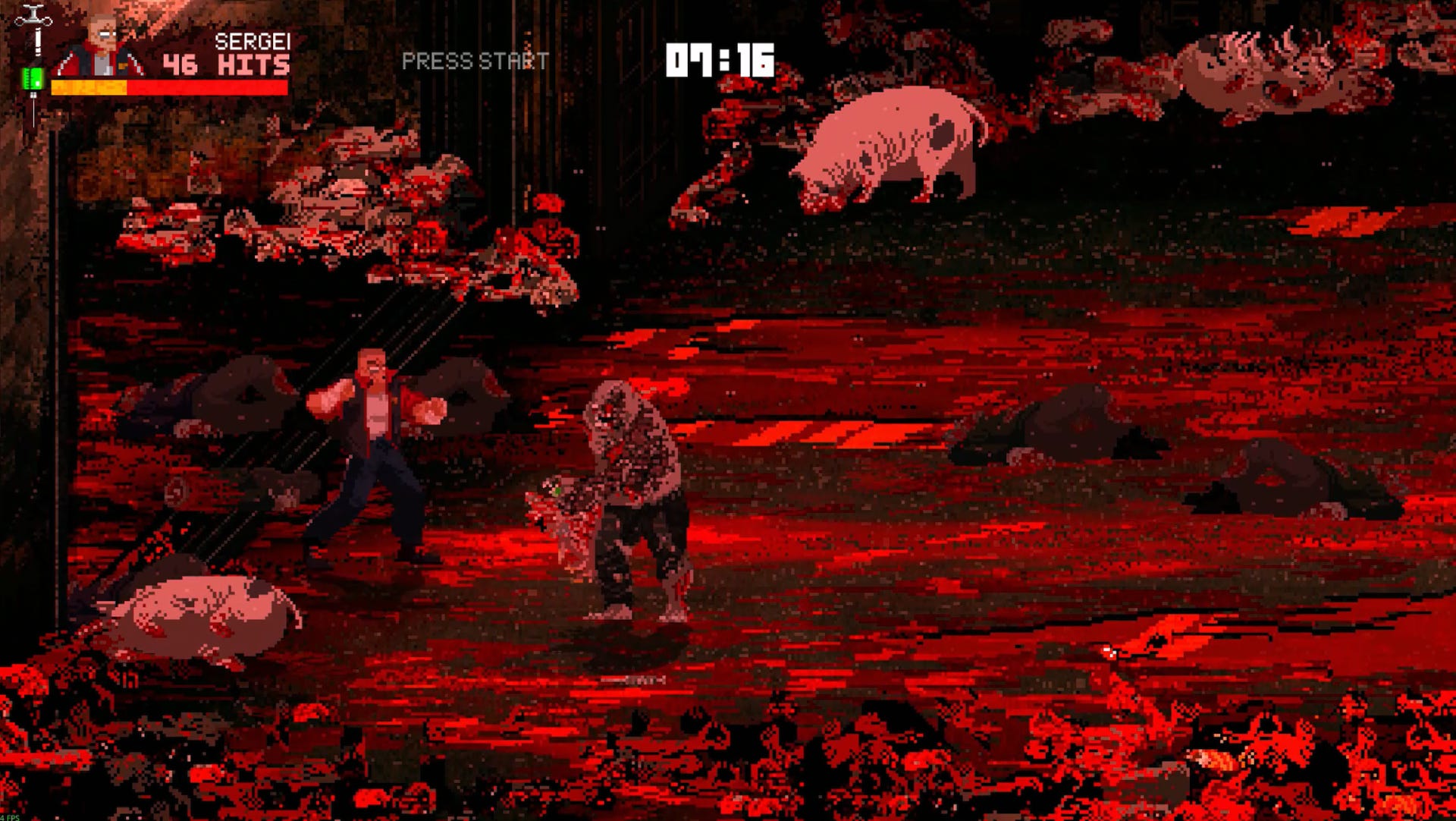
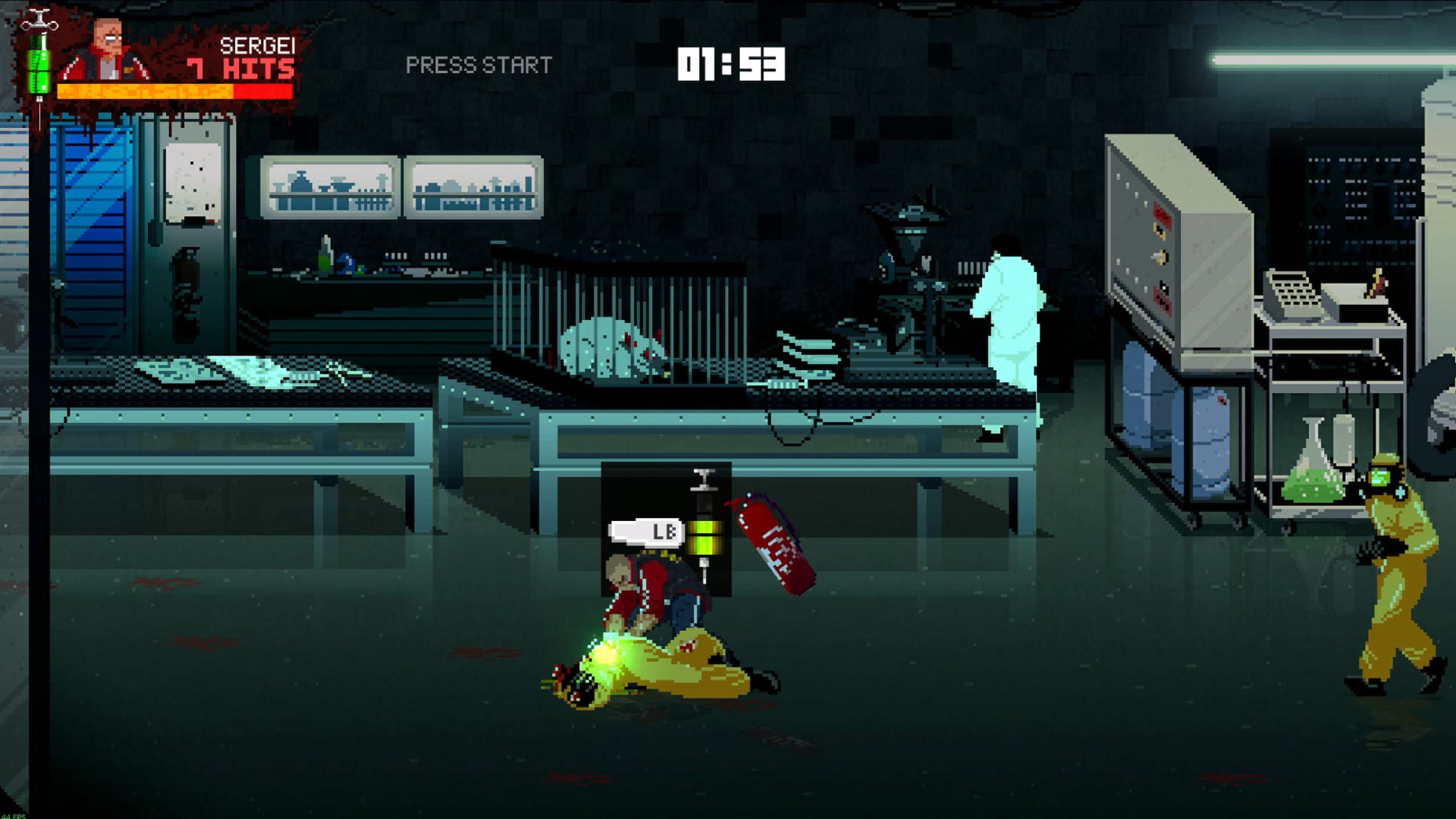
And on that note, let me tell you about the game’s most interesting contribution to the beat-’em-up formula, to wit, helpless drug addiction. Nekro is a soupy, phosphorescent-green chemical administered by jugular injection. Your chosen character takes up a syringe of the stuff as the first chapter begins and is never without it thereafter, despite the obviously destructive effect it has on the mind and the body. In gameplay terms, its effects are twofold: pressing the left trigger rapidly heals a portion of your hitpoints, and the right trigger sends your character into a berserk rage during which attacks are dramatically more powerful. Sometimes, your enemies’ heads just explode.
Both effects are supremely useful throughout most of the game, and your usage is constrained only by the amount of the drug you can keep in your syringe. It stores up to three doses at a time, and your means for replenishing doses is nothing short of gut-wrenching. Sometimes, a defeated enemy will hit the floor and, instead of dying outright, begin uncontrollably convulsing in place for several seconds before expiring. This indicates that the enemy in question was hopped up on Nekro, and that it still courses through their collapsing veins. During that period, you can jam your needle into their flesh and draw their blood to refill your syringe. The macabre implication is that you play through the game regularly injecting yourself with the filthy blood of desperate addicts. The story doesn’t really fixate on this implication, but it nevertheless stands out as one of the single darkest narrative devices I can recall from a video game.
What is fixated upon is your character’s stressful relationship with Nekro. It’s made explicitly apparent right from the beginning of Chapter One that you’re physiologically dependent on it, and that you suffer from withdrawals without it. And, several times throughout the story, the action is interrupted while your character experiences a terrifying, hallucinatory meltdown during which the drug is physically embodied as a skull-faced villain who sits upon a throne of heaving cardiac tissue. Hardly a subtle metaphor for the antagonistic malice of addiction, I’ll grant you. But it’s done effectively, and reads as if written by someone who personally experienced the lowliest agonies of addiction. In particular, there’s a heart-rending reflection on how chemical dependency curtails the ability of its sufferers to express willful agency, which culminates in one of the more symbolically elaborate final boss fights I’ve seen.
So, my overall impression of Mother Russia Bleeds was broadly positive, and it stands out in its field for how effectively it balances fun and engaging gameplay against a brutal and chilling narrative. I do have some criticisms, though.
First, all of the problems inherent to the sidescrolling beat-’em-up genre are present and accounted for in MRB: scoring a hit requires you to line up with an enemy along two axes of movement, which is particularly aggravating in high-pressure scenarios or when using a ranged attack; you’ll repeatedly knock enemies off screen and end up twiddling your thumbs while they stand up and limp back into the playspace3; and you’ll sometimes get into unlucky situations where an enemy knocks you back into a group of his fellows, who proceed to stun-lock you and empty a full healthbar in a couple of seconds. These are issues common to every game of this kind I’ve played, and I don’t know if there’s yet been any that ameliorate all of these pain-points — please do tell me in the comments if you know of any, though. Perhaps I just need to get good at sidescrolling brawlers.
Second, there are some issues more particular to MRB. Enemies with aerial attacks are some of the most annoying I’ve ever experienced in any video game, period. Guns are dramatically more effective than punching people, have no readily apparent trade-offs, and are bizarrely common in certain levels. The story is thematically strong but isn’t exceptionally well structured and never gets around to thoroughly developing any of its characters, so the closures of their arcs are largely unsatisfying. Finally, there are two possible endings — one happy, one sad — and the trigger that determines which you get is very awkwardly integrated into the game’s final moments. Without spoilers: the bad ending makes you wonder why it took so long for the bad events to transpire, and the good ending is strangely at odds with the themes the game introduces up to that point.
FINAL WORD
Mother Russia Bleeds was tremendously divisive at the time of its release in 2016. Some critical outlets (e.g., Destructoid) praised it as an excellent and cathartic brawler supported by a unique and compelling narrative premise, while others (e.g., PC Gamer) ruthlessly panned it as a derivative and boring also-ran weighed down by an underrealized attempt at a story.
I find myself somewhere in the middle. The premise and the story, while indeed disjointed, underwritten, and short of reaching their full potentials, were compelling enough to keep me interested in the narrative’s developments. And, mercifully, the story seldom gets in the way of the action for longer than it absolutely needs, and it never breaks the flow of gameplay. Said gameplay is plagued with predictable issues and often veers into frustrating territory, but the general tenor of the experience is satisfying and cathartic. The game’s lowest moments are aggravating slogs that are likely to disappoint genre veterans, and I bet it could’ve done with another month or three of polish. But when everything comes together — when story and gameplay work in harmony with one another — the effect is close to sublime.
MRB has a lot going for it in spite of its many problems. I’d only call it a must-play for completionists of the beat-’em-up genre, but I’d recommend it to just about anybody whose stomach isn’t too sensitive. And, if ever you’re laid out in bed with nose stuffed and sinuses pounding, I can tell you from experience that you could do a lot worse to pass the time.
Thanks for reading to the end! Playing Mother Russia Bleeds got me interested in exploring its genre in greater depth, so I welcome any recommendations for relatively accessible beat-’em-ups (beat-’ems-up?) if you have any — let me know in the comments. I’d also love to hear about your own experiences with this game, whether you loved it, hated it, or merely tolerated it throughout its three-hour runtime.
Up to four players can simultaneously play through the campaign in co-op mode. I played the whole thing solo, though.
For more on the subject, check out my 2025 article on the role of dysphoria in game design.
There does exist a combo attack meant to quickly force off-screen enemies back in-bounds, but I found it unreliable — the biggest issue is that it’s hard to line up an attack with an off-screen enemy, and it’s exceptionally frustrating to miss such an attack and then take a hit, which happened to me a lot.
While I don't have any good recommendations for other beat'em'ups in the same vein [heh] I can, and will, insist that you play The Slater, a first person Hitman knockoff that really stretches what you can shed from a formula with a low enough budget. If not for the plot revolving around a designer drug that can only be manufactured with one particular, uh, typewriter thing if I recall correctly, or for the insanely wooden voice acting and NPCs that can turn their heads all the way around like an owl to watch you as they walk away, then you'll at least appreciate the level that includes an extended delve into a fetish bar complete with masked men walking around with their robes fully open. If you don't believe me, check out the first trailer in the store page and tell me you haven't already wishlisted or purchased it before hearing 'you are a seriously fucking crazy motherfucker!'
https://store.steampowered.com/app/881690/The_Slater/
Amazing soundtrack by Fixions as well.